

Ship the interface your protocol deserves.
Plenty of web3 teams have deep protocol talent and nobody who owns the front end. We build the app layer: wallet connection, on-chain data display, token-gated access, dashboards, docs, and a marketing site that reads like a real product. We do not write your Solidity or audit your contracts. We build everything wrapped around them, with the auth, payments, performance, and security discipline behind 300+ websites shipped since 2019.
300+ websites shipped, clients in 4 countries
What we deliver
The shape of a Web3 & Blockchain engagement.
Specific deliverables, not generic promises. Here's what ships when you work with us.
Wallet connection that works across MetaMask, WalletConnect, Coinbase Wallet, and embedded wallets, with signed-message sessions wired into real server-side auth.
On-chain data surfaced in a readable UI, with an indexer or subgraph feeding balances, positions, transactions, and prices instead of hammering an RPC endpoint on every render.
Token gating that verifies holdings or NFT ownership on the server, so gated dashboards, downloads, and content cannot be unlocked from the browser console.
Transaction flows a non-technical user can finish, with clear gas and slippage states, pending and confirmed states, failure handling, and a receipt they can point at when they contact support.
A marketing site and docs stack that loads fast, indexes cleanly, and answers the questions investors, exchanges, and integration partners ask before they commit.
A pre-launch security pass on the app layer covering RPC key exposure, signature handling, API authorization, and dependency risk, delivered as a prioritized fix list.
Services we use
The practices we pull from on every build.
Most engagements span more than one of these. Here's the lineup.
Custom Web Applications
Built to solve what off-the-shelf cannot.
Learn more
SaaS Development
Ship features, not excuses.
Learn more
API & Backend Development
Plumbing your frontend and customers can rely on.
Learn more
Custom Website Development
Fully custom sites for businesses that have hit the template ceiling.
Learn more
Security Audits
Find vulnerabilities before attackers do. Real testing, not a checklist.
Learn more
Performance Optimization
Core Web Vitals, page speed, and the numbers Google and your visitors care about.
Learn more
Case study spotlight
Proof, not portfolio fluff.
E-commerce
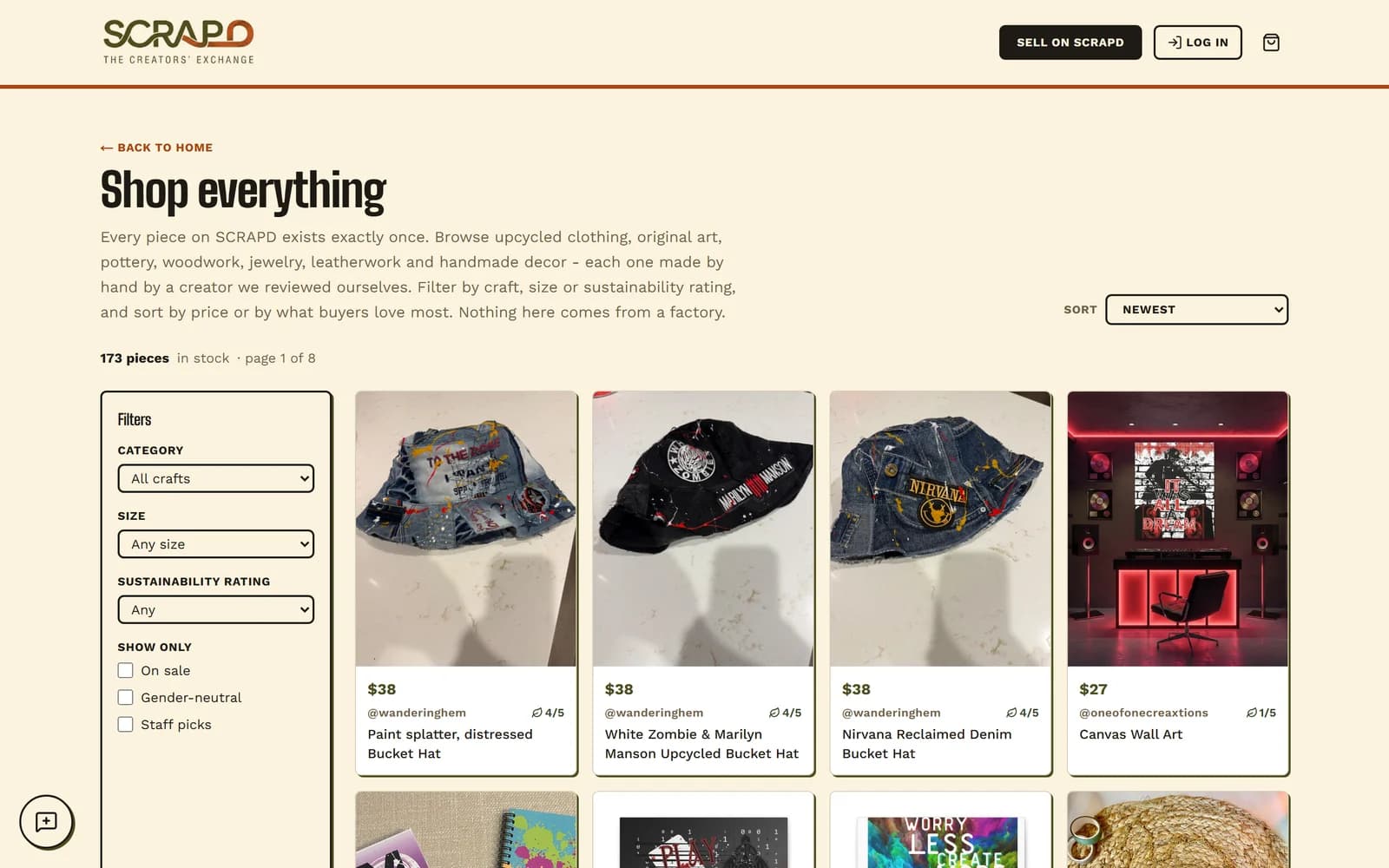
SCRAPD, a curated marketplace for handmade and upcycled goods
Buyers can browse one-of-one handmade and upcycled goods across more than twenty craft categories
SCRAPD set out to be a deliberate alternative to mass-market e-commerce, a place for upcycled, handmade, and reworked goods where authenticity is the whole point. That meant the platform could not behave like a generic storefront builder. It needed a two-sided marketplace that protects buyers from fast fashion, dropshipping, and factory resale, while giving independent makers a clean path to open a shop, list one-of-one pieces, and get paid directly. The brand also wanted human curation baked into the model, with every storefront reviewed by a real person in Nashville rather than approved by an algorithm, plus a transparent sustainability signal buyers could trust. The build had to carry that ethos through every screen, from category browsing to checkout to creator payouts.
WitsCode built SCRAPD as a server-rendered web marketplace on Next.js, with Supabase handling data and image storage and Stripe powering secure checkout. The buyer side is organized around browsing by craft, with more than twenty categories spanning upcycled clothing, jewelry, pottery, woodwork, crochet, denim, original art, and more, alongside editorial surfaces like a "Creator of the week" spotlight and a "Just dropped" feed of newest inventory. Each item carries a sustainability rating scored across four verified criteria (materials, waste, packaging, and durability), giving shoppers a consistent way to read the impact behind a piece.
The seller side gives independent makers a clean path to open a storefront and list pieces without listing fees or subscriptions. Storefronts pass through a human review step before going live, and creators receive direct payouts through Stripe Connect once their shop is approved. A Giving Back page surfaces causes and lets visitors support them directly, keeping the platform's ethos visible all the way to the footer.
Frequently asked
Questions before you reach out.
No, we build the application layer around your contracts, which means the interfaces, dashboards, wallet connection, on-chain data display, token gating, docs, and marketing site, while your protocol engineers or a specialist audit firm own the Solidity and the on-chain security review. We do run security audits as a service on the app layer, covering key handling, API authorization, signature flows, and dependency risk. That is the part most teams leave uncovered once the contract audit clears.
We work against any EVM chain through standard tooling such as viem, wagmi, ethers, and RainbowKit or ConnectKit for wallet connection, and we integrate Solana wallet adapters when your product lives there, so the chain becomes a configuration decision rather than a rebuild. For multi-chain products we keep one network and wallet abstraction, so adding a chain later touches config instead of every screen.
Our shipped work sits in marketplaces, payment flows, and SaaS products rather than crypto brands, so we sell this as capability instead of a client list, and the parts that transfer are the hard parts: real auth, money movement, payout and escrow logic, live data in a dashboard, and performance under load. SCRAPD is the closest reference, a Next.js and Supabase marketplace with Stripe Connect payouts, delivery-based escrow holds, and an audit-logged operator console. Swap the settlement rail and the product problems are the same.
We put an indexing layer between the chain and the browser, using a subgraph, a hosted indexer, or a service that writes normalized events into Postgres, then serve the UI from that with cached reads and websocket updates so pages render immediately instead of waiting on sequential RPC calls. Reads come from the index, writes go to the chain. That split is what keeps Core Web Vitals healthy on a data-heavy dashboard.
Yes, we verify holdings or NFT ownership on the server after a signed wallet message, issue a session, and gate routes, dashboards, downloads, and content behind that check, then connect the same identity to Discord roles, allowlists, or an email list so access stays consistent across every surface. Client-side gating is theater. If the check does not happen on the server, the content is public.
We start with a scoped discovery week that produces a fixed spec and a fixed proposal, then build in weekly sprints against a private staging URL, so you see a clickable product every week and the launch date is set by the scope you signed rather than by an open-ended hourly arrangement. Most protocol teams start with the marketing and docs site, then bring us back for the app once the mainnet or token date is locked.
Ready to start? Let's talk.
Tell us where you are and what you're trying to build. We'll scope it and share a fixed proposal within 48 hours.