

Custom Ecommerce Web Development Company
Bespoke storefronts, marketplaces, and checkout flows built from scratch when platforms stop fitting your model.



Who this is for
If any of this sounds like you, we should talk.
Your business model does not fit a standard storefront
Gated trade pricing, curated inventory, unusual checkout flows, commerce buried inside a bigger product. When the model is the differentiator, the platform has to bend to it, not the reverse.
You are building a two-sided marketplace
Vendors, listings, moderation, split payments, payouts. Marketplace mechanics are exactly where storefront platforms give up and custom engineering starts.
You hit the ceiling of your current platform
A dozen apps approximating what you actually need, checkout logic you cannot touch, monthly costs climbing with every workaround. A purpose-built stack removes the ceiling.
You need commerce inside a larger product
A SaaS with usage billing, a booking product with payments, a members platform with a store. We build commerce as a feature of your product, not a bolted-on shop.
What changes for you
Outcomes you can point to, not features you can ignore.
- A storefront engineered around your business model instead of a theme you fight.
- Checkout, payments, and payouts built to your exact flow with Stripe, including Connect for marketplaces.
- An admin your team actually uses: inventory, orders, moderation, whatever the model demands.
- Code you own outright, with no platform rent and no app-stack lock-in.
- The speed and SEO control of a purpose-built Next.js stack.
What is included
Scope, organized by phase.
Product discovery (Phase 1 of 3)
Phase 1
Product discovery
What we lock down in this phase before moving on.
- Business model and user flow mapping, both sides if it is a marketplace
- Data model and catalog architecture
- Payment and payout architecture (Stripe, Stripe Connect, or your processor)
- Honest build-vs-platform call: if Shopify fits, we say so here
How an engagement works
From hello to handoff, step by step.
Map the model
We work through your business model, user flows, and money movement. If an off-the-shelf platform can honestly do the job, we tell you now and save you the build.
Get a scoped proposal
Within 48 hours, you receive a written scope, architecture outline, milestone plan, and fixed deliverables.
Architect the foundation
Data model, payment flows, and integration contracts get designed and reviewed before feature code, because these are the decisions that are expensive to reverse.
Build in shippable slices
The platform comes together in working increments on a staging environment. You test real flows early, catalog, checkout, payouts, and steer while steering is cheap.
Harden the money paths
Payments, refunds, payouts, and edge cases get tested end to end. Nothing that touches money launches on hope.
Launch and iterate
Production launch with monitoring and analytics live from day one, then an iteration roadmap based on what real users do.
Case study
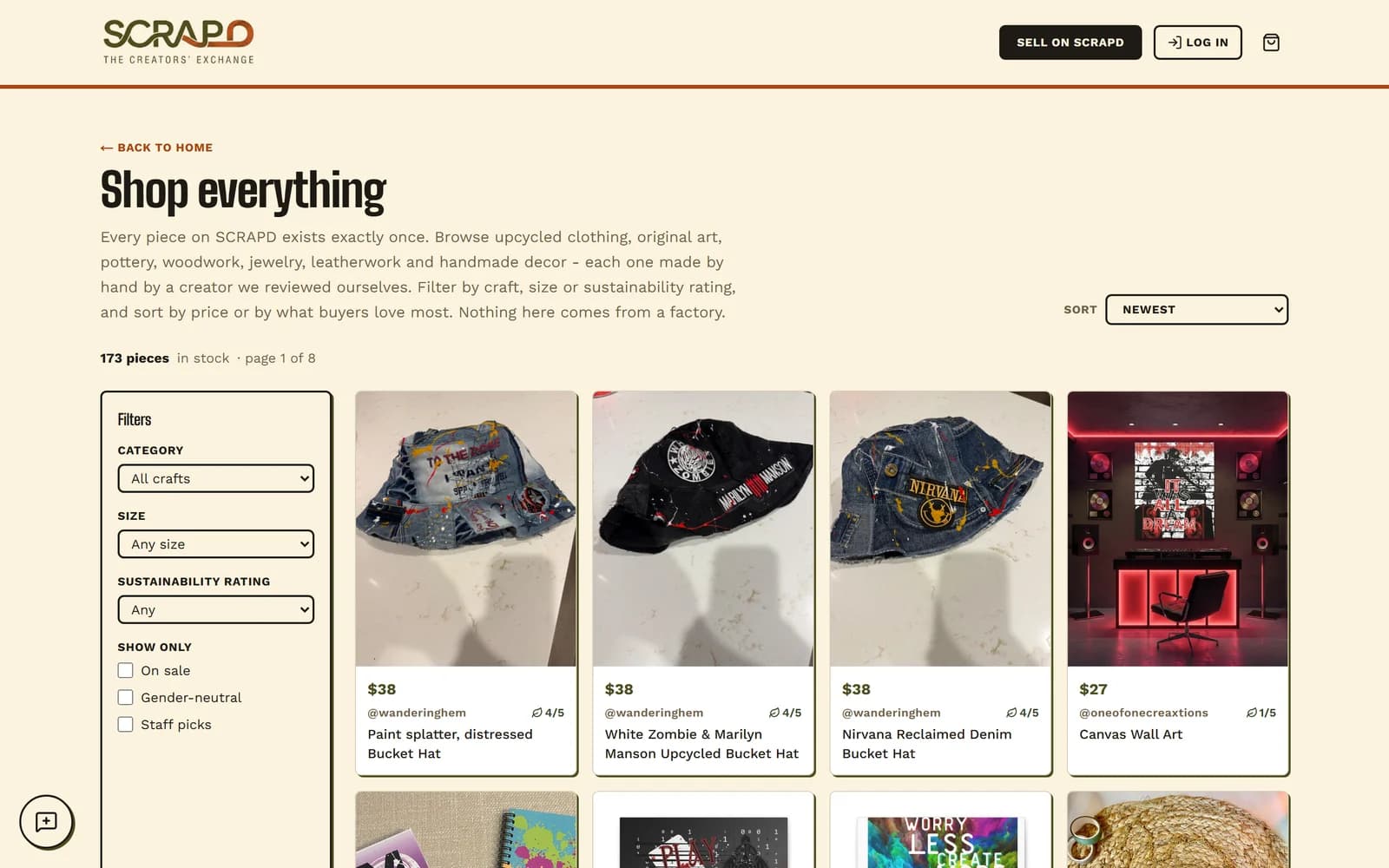
SCRAPD
Independent makers open storefronts and list one-of-one pieces with no listing fees or subscriptions, buyers get a consistent sustainability signal on every piece, and creators are paid directly through Stripe Connect once approved. The platform's ethos survives all the way to checkout.
SCRAPD set out to be a deliberate alternative to mass-market ecommerce: a curated marketplace for upcycled, handmade, and reworked goods. A generic storefront builder could not carry the model. It needed two-sided marketplace mechanics that keep out dropshipping and factory resale, human curation of every storefront, a trustworthy sustainability signal, and direct payouts to independent makers.
We built SCRAPD as a server-rendered marketplace on Next.js, with Supabase handling data and image storage and Stripe powering checkout. Buyers browse more than twenty craft categories with editorial surfaces like a creator spotlight and a newest-inventory feed. Every item carries a four-point sustainability rating, every storefront passes human review before going live, and creators receive direct payouts through Stripe Connect.
Why us
What you get with WitsCode that you don't get elsewhere.
We tell you when you do not need custom
Custom ecommerce is the most powerful option and the most expensive to get wrong. If Shopify or WooCommerce honestly fits your model, we say so in discovery and scope that instead.
Full-stack commerce engineering
Storefront, backend, checkout, webhooks, payouts, admin tooling. One team ships the whole system, so nothing falls between a frontend vendor and a backend vendor.
300+ websites shipped
Since 2019 we have shipped marketplaces, gated B2B stores, and social commerce platforms alongside conventional sites. Your build inherits patterns proven on real products, not first drafts.
WitsCode rebuilt our Shopify store so it finally converts the traffic we were already getting. They understand speed and storytelling in equal measure, and the store has been a real growth lever since launch.
Frequently asked
Questions before you reach out.
Custom ecommerce development means engineering your store from the ground up, storefront, backend, checkout, and admin, instead of configuring a platform like Shopify. You define the data model, the buying flow, and the operations tooling, so the software matches your business model exactly rather than approximating it through themes and apps.
Choose custom when your model breaks platform assumptions: multi-vendor marketplaces, split payments and payouts, curated or gated inventory, commerce embedded in a larger product, or checkout logic platforms will not allow. If you sell a conventional catalog to consumers, a platform is usually the right call, and we will tell you so before you spend on a build.
Our default stack is Next.js and React for the storefront, Supabase or Postgres for data, auth, and storage, and Stripe for payments, with Stripe Connect when marketplaces need split payouts. It is server-rendered for speed and SEO, and we adapt the stack when your product or team has different requirements.
A focused custom storefront typically ships in 6 to 12 weeks. Two-sided marketplaces with vendor onboarding, moderation, and payouts run longer because the money paths need engineering and testing on both sides. You get a firm milestone plan in the proposal, and we ship in working increments so you see progress weekly rather than waiting for a reveal.
Yes, marketplaces are a core specialty. We build vendor onboarding, listing management, storefront review workflows, buyer-side browsing and search, and split payments with direct payouts through Stripe Connect. SCRAPD, our curated marketplace for handmade and upcycled goods, runs exactly this architecture in production.
You do, entirely. The repository, the infrastructure accounts, and every integration are yours from day one, and we document the system so any competent team can maintain it. There is no platform rent, no proprietary lock-in, and no dependency on us, though ongoing development and care are available if you want them.
Have a store no platform can build?
Book a free architecture call. You get an honest build-vs-platform read and a scoped proposal within 48 hours.