

React Native Mobile App Development
One React codebase, two app stores, and native performance for founders who ship fast.



Who this is for
If any of this sounds like you, we should talk.
You want one app for iOS and Android, not two builds
Two native codebases means two teams, two release cycles, and double the bugs. React Native ships both platforms from one codebase without turning your app into a web view.
You have a React web product and need it on phones
Your web app already works. React Native reuses your business logic, your API layer, and your component thinking instead of starting the product over from zero.
You need to launch fast without a rewrite later
Expo and React Native are production infrastructure, not a prototype shortcut. Some of the biggest consumer apps run on this stack. What we ship is what you scale.
You have a validated idea and a deadline
Customers are waiting, or investors are. You need working software in both app stores, not a long native engagement that burns your runway before version one exists.
What changes for you
Outcomes you can point to, not features you can ignore.
- One React Native codebase that ships to both the App Store and Google Play.
- Native feel on both platforms: gestures, navigation, and offline behavior that never read as a wrapped website.
- Expo powered delivery with over the air updates, so fixes reach users without waiting on store review.
- A complete product, not a shell: auth, push notifications, payments, and analytics wired in from day one.
- Typed, documented code your next developer can pick up without an archaeology project.
What is included
Scope, organized by phase.
Discovery (Phase 1 of 4)
Phase 1
Discovery
What we lock down in this phase before moving on.
- Product and user flow mapping
- Platform review (iPhone, Android, tablet)
- Backend and API audit, or a plan to build one
- App store accounts and compliance checklist
How an engagement works
From hello to handoff, step by step.
Book a scoping call
We review your product idea, designs, and backend. You get an honest read on what a version one should include and what can wait.
Get a scoped proposal
Within 48 hours you receive a written scope, milestone plan, and fixed deliverables. No vague hourly traps.
Build in weekly increments
You get TestFlight and Android test builds as features land. You use the real app on your own phone throughout the build, not at the end of it.
Harden and polish
Performance passes on real devices, offline states, error handling, and store review guidelines checked before we submit anything.
Submit and launch
We handle App Store and Play Store submission, listings, and the review back and forth until both apps are live.
Iterate after launch
Over the air updates for fast fixes, store releases for bigger features, and an optional care plan for ongoing work. Your call.
Case study
Spottle
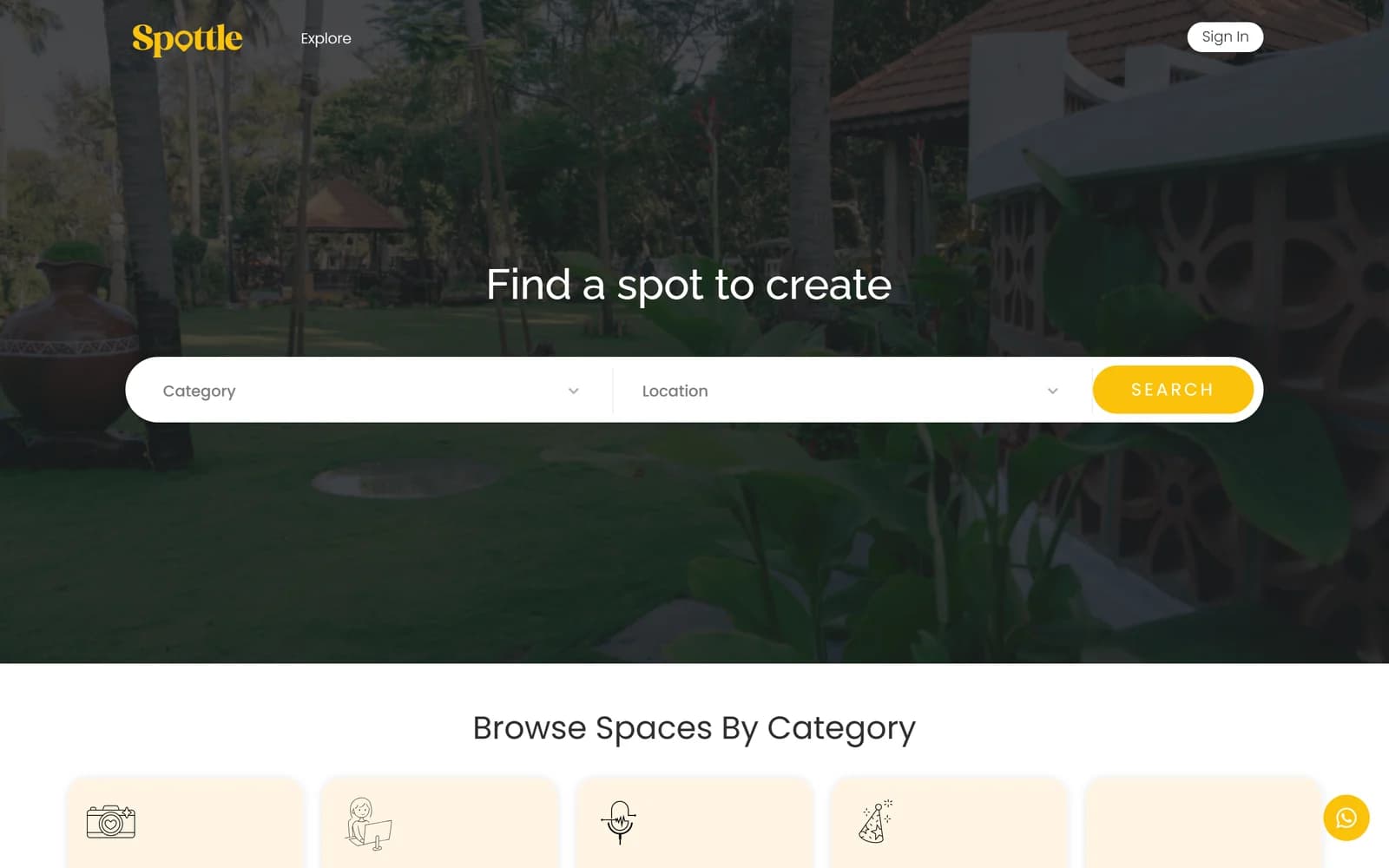
Spottle is live across Chennai and Bengaluru. Guests book photo studios, podcast rooms, and event venues in a few taps, and hosts list and manage their own spaces without touching us.
Creators and teams in Chennai and Bangalore had no clean way to find and book creative spaces by the hour, and space owners had no simple way to list studios, set rates, and manage availability without endless back and forth inquiries.
We built Spottle as a two-sided booking marketplace in React: city and category browsing, transparent hourly pricing, host onboarding, and instant booking flows. It runs on the same React component architecture our React Native builds extend to the app stores.
Why us
What you get with WitsCode that you don't get elsewhere.
Product engineers, not an app factory
We have shipped 300+ websites and products since 2019. Your app gets that pattern recognition: typed code, real QA, and an architecture that survives version two.
Expo used properly, native when it matters
We use Expo for build tooling, over the air updates, and store submission, and drop to native modules when the platform demands it. No fighting the framework, no web view shortcuts.
We ship the whole product
Backend, auth, push, payments, analytics, and both store listings. You get a launched app in users' hands, not a repository and a goodbye.
WitsCode rebuilt our Shopify store so it finally converts the traffic we were already getting. They understand speed and storytelling in equal measure, and the store has been a real growth lever since launch.
Frequently asked
Questions before you reach out.
React Native is a framework from Meta that builds real native apps for iOS and Android from one JavaScript and React codebase. You use it because one team ships both platforms at once, your web and mobile code share logic, and apps like Instagram, Shopify, and Discord prove it holds up at serious scale.
Yes. React Native renders real native components, not a web page in a wrapper, and it powers flagship apps at some of the largest consumer companies in the world. For most products the user cannot tell the difference, and the cases where true native wins (heavy 3D, custom hardware) are rare and identifiable up front. We tell you if yours is one.
Both are strong cross-platform frameworks and we build with both. React Native fits teams that already have React web code, React developers, or an API-driven product, because everything transfers. Flutter fits design-heavy apps where you want full control of every pixel. On a scoping call we recommend one based on your product and your team, not our preference.
Yes, on almost every build. Expo is the production toolchain for React Native: managed builds, store submission, and over the air updates that push fixes without waiting on Apple or Google review. When a feature needs code Expo does not cover, we add native modules through the Expo development build workflow instead of ejecting into chaos.
A focused version one typically ships in weeks, not months, because one codebase covers both platforms and Expo removes most of the release friction. The real driver is scope: number of screens, backend complexity, and native integrations. You get a firm timeline in your scoped proposal before anything starts.
Yes. React Native talks to any API: REST, GraphQL, Supabase, Firebase, or a custom backend your team already runs. We audit what exists during discovery, wire the app to it, and only propose backend changes when something genuinely blocks the mobile experience.
You choose. Over the air updates let us push fixes and small improvements immediately, store releases carry bigger features, and an optional care plan covers monitoring, OS version updates, and ongoing work. Or take the keys and run it with your own team. The code is documented for exactly that.
Ready to ship your app to both stores?
Book a free strategy call. You get a scoped proposal within 48 hours, no pressure, no pricing games.