

Business Process Automation Services
We map your back office, automate the repetitive work, and hand you the documentation.



Who this is for
If any of this sounds like you, we should talk.
Your operations run on copy-paste
Orders, invoices, onboarding, reporting. The same data gets retyped between systems every day, and every retype is a chance for an error that costs real money.
Growth is adding admin work faster than revenue
Every new customer means more manual steps. You want the volume without the operational drag, which means the process has to run itself.
Your back office lives in spreadsheets
Approvals tracked in one sheet, payouts in another, status in someone's head. It worked at the start. Now things slip through and nobody can see where.
Handoffs between tools keep breaking
The CRM does not talk to the invoicing tool, which does not talk to the fulfillment system. Humans are the glue, and the glue is tired.
What changes for you
Outcomes you can point to, not features you can ignore.
- Repetitive back office work runs itself, on schedule, without a person pushing it.
- Data flows between your systems automatically, so retyping errors stop at the source.
- Every automated process is logged, so you can see what ran, when, and what it did.
- Exceptions route to a human with context, instead of failing silently.
- Documented workflows your team can read, audit, and extend after handoff.
What is included
Scope, organized by phase.
Process mapping (Phase 1 of 3)
Phase 1
Process mapping
What we lock down in this phase before moving on.
- Workflow inventory across teams and tools
- Time, volume, and error cost per process
- Automation candidates ranked by payoff
- System and API access audit
How an engagement works
From hello to handoff, step by step.
Map the real process
We sit with the people doing the work and document how it actually runs, including the exceptions nobody wrote down.
Rank by payoff
Not everything deserves automation. We rank processes by hours consumed, error cost, and build effort, and you approve the shortlist.
Scoped proposal in 48 hours
A written scope per workflow: trigger, steps, integrations, exception handling, and delivery milestones.
Build and parallel run
The automation runs alongside the manual process until the outputs match. Nothing gets cut over on faith.
Cut over with runbooks
Your team gets documentation, monitoring, and alerts. The process runs itself; humans handle the exceptions it routes to them.
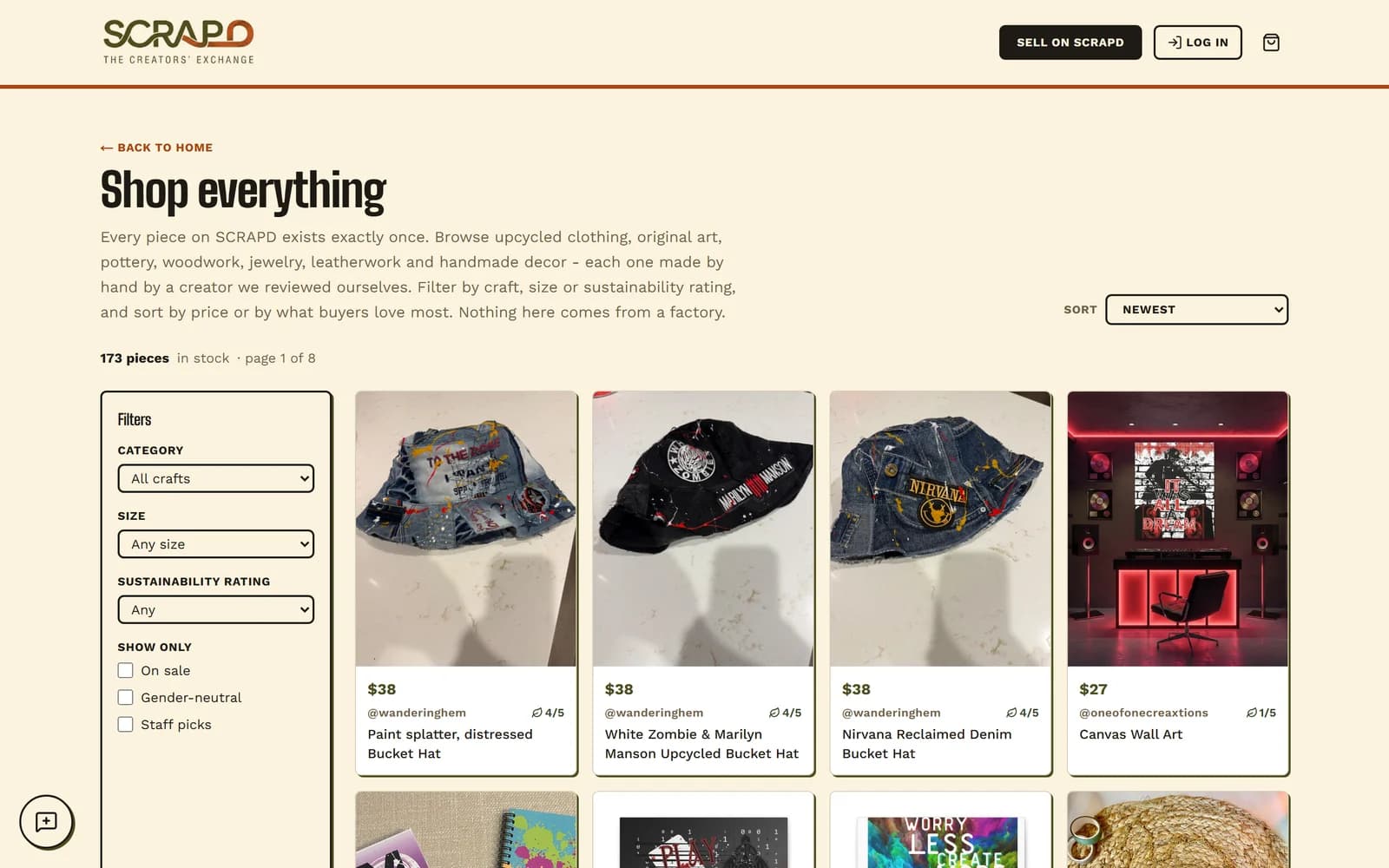
Case study
SCRAPD
Marketplace operations run from one console. Payouts release themselves when delivery conditions are met, review and moderation queues route work to a human only where judgment is needed, and the audit log means every automated action is traceable.
SCRAPD, a curated US marketplace for handmade and upcycled goods, could not run its back office by hand. Seller reviews, payout timing, moderation, and marketplace health all needed to happen reliably as the platform grew, without an operations person chasing every step in spreadsheets.
As part of the platform build, we automated the operational core: seller onboarding with a human review gate, Stripe Connect payout scheduling with delivery-based holds and escrow states that release automatically, a moderation queue, and an operator console showing live marketplace health, with every action audit-logged.
Why us
What you get with WitsCode that you don't get elsewhere.
We automate our own operations
Our lead pipeline, CRM routing, and notifications run on the same n8n stack we deploy for clients. We live with our own automation choices daily.
Engineers behind the workflows
When a no-code tool hits its limit, we write code. Since 2019 we have shipped 300+ builds, so your automation is not capped by what a template supports.
Documentation is the deliverable
Every workflow ships with runbooks, logs, and exception paths in writing. Your automation never depends on the memory of whoever built it.
WitsCode rebuilt our Shopify store so it finally converts the traffic we were already getting. They understand speed and storytelling in equal measure, and the store has been a real growth lever since launch.
Frequently asked
Questions before you reach out.
Business process automation services replace manual, repetitive back office work with software workflows: moving data between systems, generating documents, routing approvals, sending notifications, and updating records automatically. A provider maps your processes, builds the automations, connects your existing tools, and documents everything, so the work runs on triggers and schedules instead of on someone remembering.
Start with processes that are high volume, rule-based, and painful when done wrong: invoicing, data entry between systems, onboarding steps, report generation, and status notifications. The best first candidates have clear rules and a measurable time cost. Processes needing human judgment stay human; automation should route those cases to a person with full context.
RPA (robotic process automation) mimics human clicks on top of software interfaces, which is brittle and breaks when screens change. BPA works underneath, connecting systems through APIs and webhooks so data moves reliably. We build API-first automation, and treat screen-level bots as a last resort for legacy systems with no other access.
Almost never. Automation works best when it connects the tools your team already knows: your CRM, accounting software, email, e-commerce platform, and databases. We integrate through their APIs. If a tool genuinely blocks automation because it has no API and no export path, we tell you and propose the smallest possible swap.
It fails loudly, by design. Every workflow we ship logs each run, retries transient errors, and routes genuine failures to a human with the full context attached. Silent failure is the real risk in automation, so alerting and exception queues are standard scope, not an add-on.
A single well-defined workflow typically ships within 1 to 3 weeks including the parallel run. A broader back office program rolls out in phases over a few months, highest-payoff processes first, so you see returns from the first cutover instead of waiting for a big-bang launch.
Ready to take the busywork off your team?
Book a call. We will map your highest-payoff processes and scope the automation within 48 hours.