

Build financial products people trust with their money.
In fintech, trust is the product. The build has to carry payment integrations that reconcile, role-based access that holds under scrutiny, and an audit trail you can hand to a reviewer without apology. We bring Stripe and payment platform integration work, multi-tenant architecture, and security audits as a standing service. We build to support your compliance requirements and work alongside the advisors who own them.
300+ websites shipped, clients in 4 countries
What we deliver
The shape of a Fintech engagement.
Specific deliverables, not generic promises. Here's what ships when you work with us.
Payment integration on Stripe, Stripe Connect, or the acquirer you already use, with webhook handling, idempotency keys, and reconciliation that survives a failed request.
Multi-tenant Postgres with row-level security and tenant isolation, so an operator, an analyst, and an admin each see exactly what their role permits and nothing else.
Append-only audit trails on every sensitive action, so account changes, payouts, refunds, and admin overrides trace back to a specific user and timestamp.
An internal operator console covering queues, approvals, holds, and manual review, so your operations work does not run out of a database client.
A security audit before launch and on a standing cadence after it, covering authentication flows, access control, dependency risk, and data handling.
Architecture documentation your compliance and legal advisors can read, mapping data flows, retention, and third-party processors so their review starts from facts.
Services we use
The practices we pull from on every build.
Most engagements span more than one of these. Here's the lineup.
MVP Development
Turn your prototype into a product people pay for.
Learn more
SaaS Development
Ship features, not excuses.
Learn more
Custom Web Applications
Built to solve what off-the-shelf cannot.
Learn more
API & Backend Development
Plumbing your frontend and customers can rely on.
Learn more
Security Audits
Find vulnerabilities before attackers do. Real testing, not a checklist.
Learn more
Care Plans
Updates, backups, security, monitoring, and small content changes so your site does not rot.
Learn more
Case study spotlight
Proof, not portfolio fluff.
E-commerce
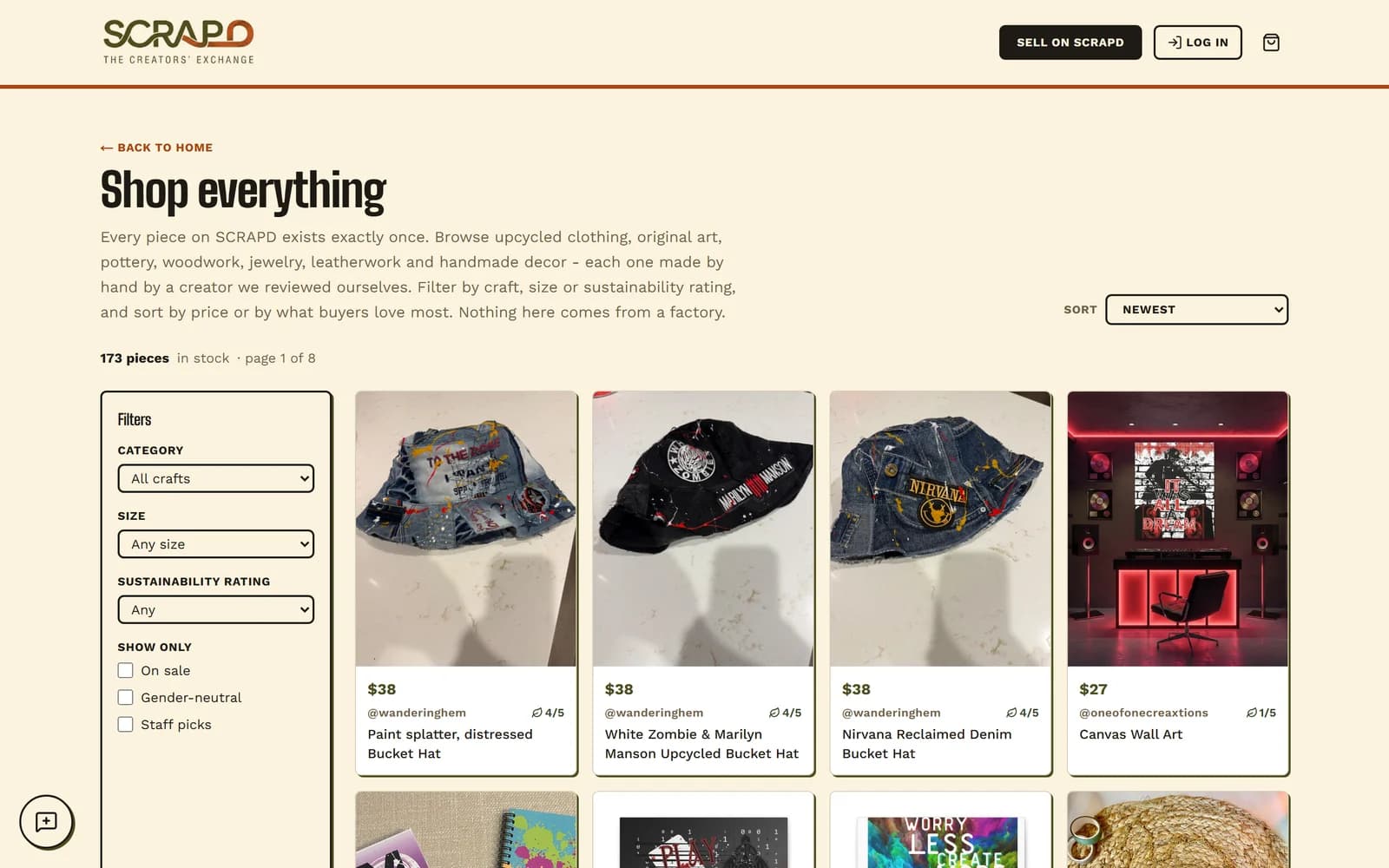
SCRAPD, a curated marketplace for handmade and upcycled goods
Buyers can browse one-of-one handmade and upcycled goods across more than twenty craft categories
SCRAPD set out to be a deliberate alternative to mass-market e-commerce, a place for upcycled, handmade, and reworked goods where authenticity is the whole point. That meant the platform could not behave like a generic storefront builder. It needed a two-sided marketplace that protects buyers from fast fashion, dropshipping, and factory resale, while giving independent makers a clean path to open a shop, list one-of-one pieces, and get paid directly. The brand also wanted human curation baked into the model, with every storefront reviewed by a real person in Nashville rather than approved by an algorithm, plus a transparent sustainability signal buyers could trust. The build had to carry that ethos through every screen, from category browsing to checkout to creator payouts.
WitsCode built SCRAPD as a server-rendered web marketplace on Next.js, with Supabase handling data and image storage and Stripe powering secure checkout. The buyer side is organized around browsing by craft, with more than twenty categories spanning upcycled clothing, jewelry, pottery, woodwork, crochet, denim, original art, and more, alongside editorial surfaces like a "Creator of the week" spotlight and a "Just dropped" feed of newest inventory. Each item carries a sustainability rating scored across four verified criteria (materials, waste, packaging, and durability), giving shoppers a consistent way to read the impact behind a piece.
The seller side gives independent makers a clean path to open a storefront and list pieces without listing fees or subscriptions. Storefronts pass through a human review step before going live, and creators receive direct payouts through Stripe Connect once their shop is approved. A Giving Back page surfaces causes and lets visitors support them directly, keeping the platform's ethos visible all the way to the footer.
Frequently asked
Questions before you reach out.
Yes. We build the web and product layer for financial products and work alongside the compliance and legal advisors who own your regulatory position. We do not certify compliance, issue attestations, or act as your advisor. We take the requirements they define and build the software controls that support them. Bring us in early and your advisors review a build that already logs, restricts, and documents itself.
Yes. Payment work is core for us: card checkout, Stripe Connect payouts, split payments, escrow-style holds, refunds, and reconciliation. We built SCRAPD, a US marketplace where creators are paid directly through Stripe Connect, with delivery-based holds and released, upcoming, and in-escrow balances surfaced in the dashboard. The same patterns carry over when money moves between more than two parties.
Every sensitive action writes an append-only record with the actor, the timestamp, and the state before and after. Access is role-based and enforced in the database with Postgres row-level security, not hidden in the interface. Operators, analysts, and admins get separate permission sets. That combination is the first thing a reviewer asks for, and it is far cheaper to build in than to retrofit.
No. We are a build partner, not an auditor or a certification body, so we never claim certification on your behalf. We build to support the controls your auditor will test: card data stays with your payment service provider, secrets are managed properly, access is logged, and the architecture is documented. Your compliance advisor and auditor stay in charge of the certification itself.
We build the product surface. That means onboarding and KYC flows wired to your identity provider, account dashboards, order and transaction history, balance and wallet views, internal operations tooling, and the marketing site that has to convert before any of it matters. We integrate the custody, market data, and identity vendors you have selected rather than rebuilding those primitives, and we say so early when a specialist vendor is the right call.
Scope drives the timeline. We lock a fixed scope in week one, then build in the order that removes risk fastest: authentication, permissions, and money movement first, reporting and polish after. Regulated products add review cycles with your advisors, so we plan around those rather than discovering them late. You get a fixed price and a schedule before we write code.
Ready to start? Let's talk.
Tell us where you are and what you're trying to build. We'll scope it and share a fixed proposal within 48 hours.