


How to Build an Automated Lead Scoring Model Without Buying a Platform
The full pipeline for scoring an inbound lead at form submit: spam gate, enrichment, a set of narrow typed questions instead of one score out of 100, a threshold set from your own closed-won data,...
You can build automated lead scoring from parts you already own: your form handler, a spam gate, the data already inside the submission, a small set of typed questions answered by a model, a threshold you set from your own closed-won records, and a write to your CRM. No scoring platform, no new seat, no migration. The pipeline below is seven steps and runs inside the form request.
The short version
- Score at form submit, inside the request, not in a nightly batch. The evidence on response speed is old, large and consistent, and it all points the same way.12
- Do not ask for one score out of 100. Ask five or six narrow questions that each return a probability, then weight them yourself.
- Keep the weighting in your own code. You can change it on a Tuesday afternoon without retraining anything, and you can explain any rejection to the person who asks.
- Set the threshold from a labeled set built out of your own closed-won and closed-lost records. Not from a benchmark. The published benchmarks for this funnel stage disagree by roughly three times.67
- The marginal cost of scoring a lead is now small enough that the arithmetic fits in a paragraph. It is published further down, from list prices, with the tokens shown.
- Eleven of the twelve pages currently ranking for this term are published by companies that sell lead scoring software. Every one of them ends at a buying decision. None publishes a cost per scored lead.
- Never auto-bin a lead on a model call alone. Keep a human on anything that looks large.
Why every guide to lead scoring ends at a checkout page
We read the full first page of results for this term before writing anything. Eleven of twelve are vendor properties: CRM, enrichment, routing, ABM. The twelfth is Wikipedia.
They are not bad articles. HubSpot's is the canonical explainer on fit versus interest. The pattern is what matters. Every article titled "how to build a lead scoring model" reaches a step called build, and that step says choose the right platform. Not one of the twelve publishes a cost per scored lead. Not one publishes a latency figure for scoring at form submit. The number that decides build versus buy is missing from the entire first page, which is what you would expect when the people writing it sell the buy.
This post ends with a build instead. If you want the model design work first, what to score, how fit composes with intent, where negative scoring earns its place, that is a separate piece: the lead scoring model guide that ends with a build. If you want the latency question specifically, the sub-second path from submit to a sales notification is covered in lead routing at form submit. This one is the implementation.
The economics changed because of a class of small decision model that returns a typed answer with a calibrated probability instead of a paragraph. We wrote the plain-English explainer for that: what a System One model actually is, including which of its published numbers survive a check. You do not need it to build the pipeline. You do need it before you quote any vendor speed claim to your team.
The pipeline, in order
Seven steps. Everything happens inside the POST request your form already sends.
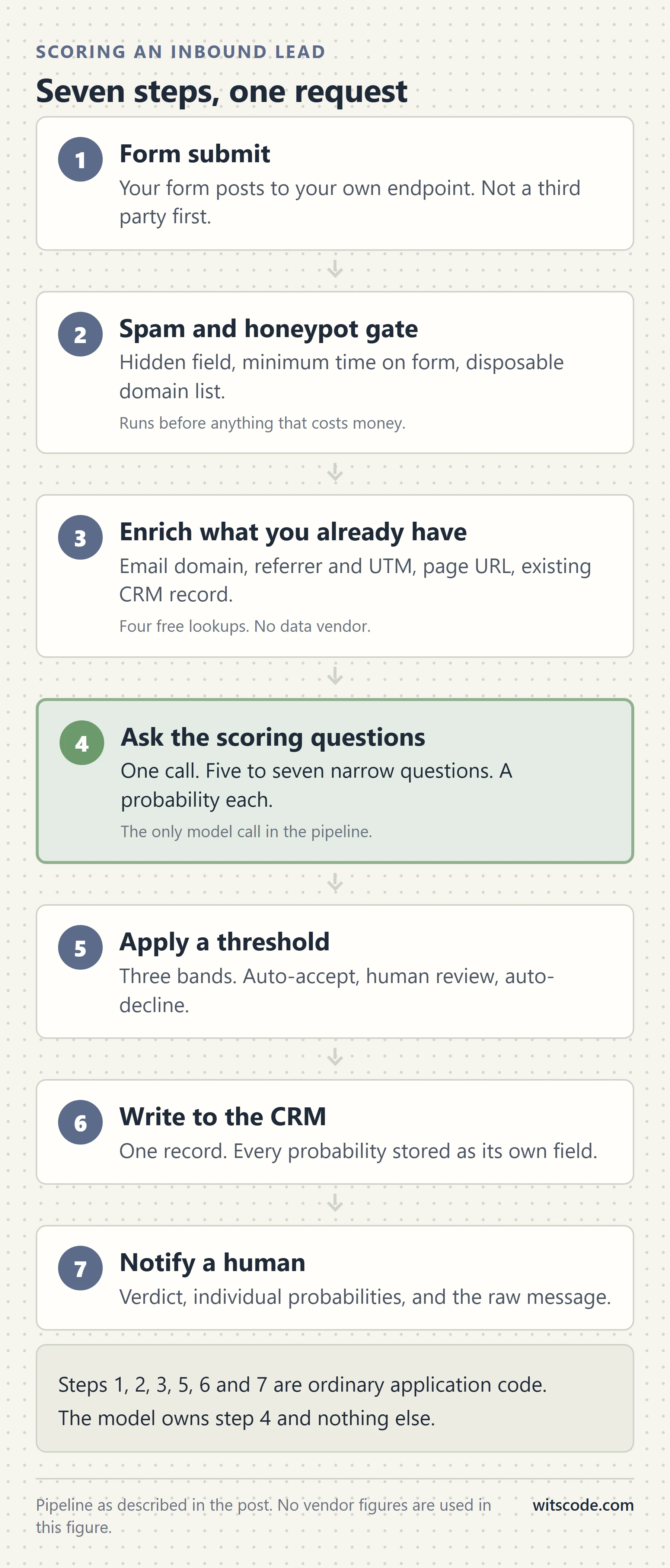
1. Form submit. Your form posts to your own endpoint, not to a third party first. You need the raw payload before anything else touches it.
2. Spam and honeypot gate. This runs before anything that costs money. A hidden field humans never fill and bots usually do. A minimum time-on-form check, because a submit two hundred milliseconds after page load is not a person. A disposable-domain list. Reject silently and return the same success response everyone else gets. Every submission you kill here is one you never pay to score.
3. Enrich what you already have. Not a paid data vendor. The email domain tells you whether this is a company address or a free inbox, and what the company website is. The referrer and UTM parameters tell you which channel produced it. The page URL tells you what they were reading when they decided to contact you. Your own CRM tells you whether this domain has been here before. Four free lookups, and all four change the answer.
4. Ask the scoring questions. The only step that calls a model. It takes the free-text field plus the enriched context and returns answers to a fixed set of narrow questions. Details in the next two sections.
5. Apply a threshold. Not one cutoff. Three bands: auto-accept, human review, auto-decline. The middle band is the one every vendor article skips and the one that decides whether this works.
6. Write to the CRM. One record, with every probability stored as its own field, not just the final verdict. When you later want to know why the model liked a lead in March, the answer has to be in the record.
7. Notify a human. The notification carries the verdict, the individual probabilities, and the raw message. A salesperson reading it should be able to disagree with the model in five seconds.
Steps 1, 2, 3, 5, 6 and 7 are ordinary application code. Your own workflow layer owns the loops, the retries, the permissions and the side effects. The model owns step 4 and nothing else. That separation is the whole design.
Why one score out of 100 is the wrong output
Ask a model for a lead score between 0 and 100 and you get a number that is confident, unexplainable and impossible to tune.
You cannot tell whether 68 means "strong fit, no budget signal" or "weak fit, urgent and funded." Those are opposite leads. They route to different people. A single score erases the difference. And if you decide next quarter that budget signal should count twice as much as urgency, a single score gives you nothing to turn.
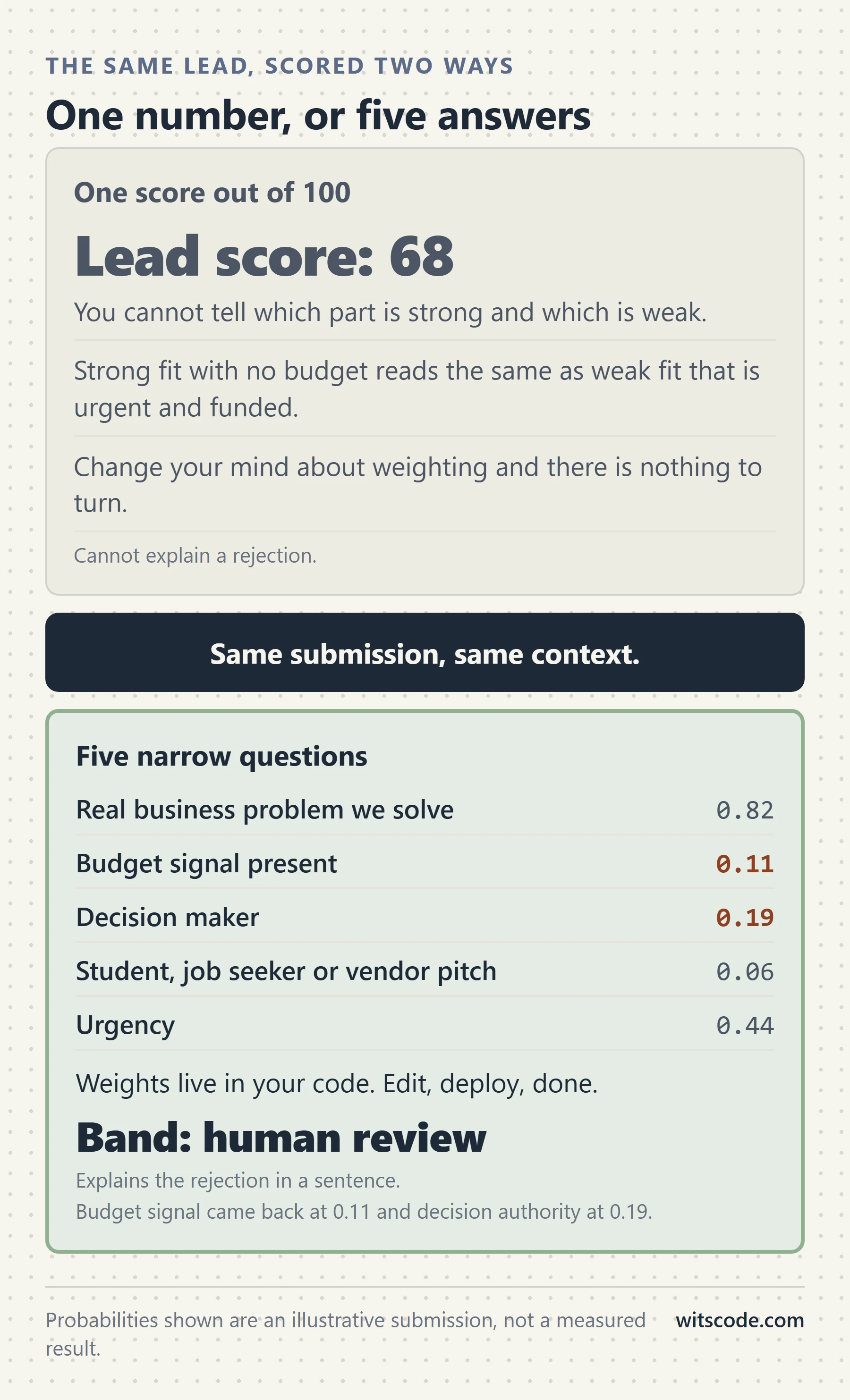
Ask several narrow questions instead. Each returns a probability. You compose them in your own code.
Three things follow immediately.
You can change the weights without retraining anything. The weighting is a few lines in your handler. Edit, deploy, done. Nothing is fine-tuned and nothing needs a data science ticket.
You can explain a rejection. When someone asks why a lead went to the low band, the answer is a sentence: budget signal came back at 0.11 and decision authority at 0.19. That is auditable. A score of 34 is not.
You can measure each question separately. If your fit question is excellent and your urgency question is noise, the per-question calibration shows it and you drop the bad one. With a composite score you would never know which part was wrong.
The question shapes
Five to seven questions is the working range. Each one narrow enough that a person could answer it from the submission alone.
Does this describe a real business problem we solve? The most load-bearing question of the set. It reads the free-text field against what you actually do. It is what separates a genuine inquiry from a vague one, and it is the exact thing keyword rules cannot do.
Is there a budget signal? Not "what is their budget." A probability that the message carries funded intent: a timeline, an existing spend, a named incumbent to replace, a procurement reference.
Is this a decision maker? Reads title, email format, phrasing and how the request is framed. Somebody writing "we need to" is different from somebody writing "my manager asked me to look into."
Is this a student, a job seeker, or a vendor pitch? Three separate questions, or one choice question returning a distribution across four options including "none of these." This is your negative scoring, and on a public site it is a real share of raw volume. The model design post covers where negative scoring earns its keep and where it backfires.
How urgent does this read? A position on a scale you define, with probabilities across the positions. Urgency moves a lead across a band on its own more often than anything else, so keep it separate from fit.
Every answer is a probability, not a label. A label throws away the distance between 0.51 and 0.94, and that distance is where your threshold lives.
How to calibrate the threshold from your own data
Do not set the cutoff by intuition and do not import it from a benchmark. Build a labeled set.
Pull your last 200 to 500 closed leads. Both outcomes, plus the ones nobody replied to because they were obviously not real. You need the losses more than the wins.
Reconstruct the original submission for each. Whatever the form captured at the time. If you never stored the free-text field, start storing it today and come back in a quarter. This is the most common blocker and it is entirely self-inflicted.
Run the questions over that set. Same questions, same code path, no human in the loop. You now have every probability against a known outcome.
Plot the outcomes against the composite. You want two numbers: the level above which almost everything closed, and the level below which almost nothing did. Those are your band edges. The gap between them is your human review band, and it should be wide enough to make you slightly uncomfortable.
Try it
Where would you draw the line?
4,000 judgments, each returned with a confidence. Move the two lines and watch how much work gets done without you, and what it costs you in wrong calls.
2,679
acted on automatically
67 percent of the run, with about 160 expected to be wrong.
1,104
queued for a human
28 percent of the run. This is the pile that decides whether the whole thing saves you time.
222
left alone
Too uncertain to be worth anyone's attention this round.
The lesson is in the second box. Push the accept line high enough to make the error count comfortable and the review queue grows until a person is doing the job again. The threshold is a business decision about how much a wrong call costs you, and it belongs in your code, not in the model.
Check calibration, not just accuracy. Take every lead the model scored around 0.7 on fit. Roughly seven in ten of them should have been real. If nine in ten were, the model is underconfident and your threshold is costing you leads. If four in ten were, it is overconfident and you are auto-accepting rubbish. This check takes an hour and almost nobody runs it.
Recheck quarterly. Your ICP moves, your traffic mix moves, your ad targeting moves. The weights live in your code precisely so this stays cheap.
One warning. If you go looking for a published MQL to SQL conversion rate to anchor against, you will find averages of 13 percent, 15 to 21 percent, and 26 to 51 percent, all presented as the benchmark for the same nominal metric.678 They disagree by roughly three times. That disagreement is the argument for measuring your own funnel, not for picking the friendliest number.
What it costs to score a lead
Here is the arithmetic the entire first page of Google omits. List prices only, at the time of writing, with the tokens shown.
A scored lead needs the form fields, the enriched context and the free-text message in the prompt. On real inbound that runs around 500 to 700 tokens. Call it 600, batched into a single call, because a typed decision model answers several questions from one context.
Typed decision model. Published input price is $0.042 per million tokens, with output free.9 That is 600 tokens at $0.042 per million, or $0.0000252 per lead. One thousand leads a month costs about 2.5 cents. Ten thousand costs about 25 cents.
A frontier chat model doing the same job. Published list prices across the frontier range run roughly $0.20 to $10 per million input tokens, with output typically around five times input.10 Take a mid-range model at $1.25 input and $10 output. The same 600 input tokens plus roughly 150 tokens of structured output gives $0.00075 plus $0.0015, or $0.00225 per lead. One thousand leads costs $2.25. Ten thousand costs $22.50.
Static rules. Free, and they cannot read the free-text field, which is where the intent lives.
So the model call sits somewhere between free and a couple of dollars a month at the volumes most inbound funnels actually run. The rest of the pipeline is your existing form handler, your existing workflow layer and the CRM you already pay for. There is no new seat in that list.
Do the arithmetic
What does this job cost, three ways?
List prices only, as published in September 2026. No benchmark claims, no projected savings. Change the job and watch which engine the arithmetic favors.
- Typed decision model$0.1680
Jev list price. Returns a value and a probability, no text.
- Small frontier model$1.44
gpt-5-nano list price. The honest comparison, and it is close on input.
- Frontier model$84.00
A mid-tier frontier model at $3 in and $15 out, the usual default.
Two things usually surprise people. Against a small model the input price is close, so the gap comes from free output and from answering several questions in one pass. Against a frontier model the gap is large enough that it changes what you are willing to run across a whole site rather than a sample.
Two honest caveats. The $0.042 figure is a vendor list price published at launch, checkable on the provider's console, not an independently audited number. And cost per call is not cost of ownership: you still spend engineering time building the pipeline and an hour a quarter recalibrating it. The point is not that scoring is free. The point is that marginal cost stopped being the reason to buy a platform, and every page ranking for this term is silent about it.
The speed evidence, and the two statistics you should stop repeating
Response speed is the most robustly evidenced finding in inbound sales. It is also the topic most polluted by invented numbers. What holds up:
Dr James Oldroyd's Lead Response Management work, run at MIT Sloan with InsideSales in 2007 across three years of data, six companies, more than 15,000 leads and over 100,000 call attempts, found that contacting a web lead within five minutes rather than thirty raised the odds of making contact by 100 times and the odds of qualifying it by 21 times.1 Read that carefully. Those are contact odds, not revenue.
The 2011 Harvard Business Review study by Oldroyd, McElheran and Elkington audited 2,241 US companies with test web leads. Average first response was 42 hours. Twenty-three percent never responded at all. Responding within an hour made a firm about seven times more likely to qualify the lead.2 Old data, still the strongest single citation in the category.
Drift's 2017 lead response report submitted real forms to 433 B2B SaaS companies. Seven percent responded within five minutes.3
XANT's 2021 audit, the largest recent sample at 5.7 million leads, found conversion roughly eight times higher inside five minutes than after six, and 77 percent of leads receiving no response at all.4
Velocify's 2013 study of around 3.5 million leads across more than 400 companies found that 50 percent of leads never get a second call.5
Now the two you should drop.
"78 percent of buyers purchase from the first responder." Attributed everywhere to a Lead Connect survey. We went looking for the primary and found no published report: no methodology, no sample, no date, no document. It is the most repeated statistic in this category and we could not locate the study behind it.
"48 percent of salespeople never make a single follow-up attempt." Attributed to the National Sales Executive Association. We could not establish that the organization exists. Use Velocify's finding instead: 50 percent of leads never get a second call, from a stated sample with a stated method.5
We made the same point about nine load-bearing lead generation statistics in the 2026 lead stack post. It is not a gotcha. If you put an unsourced number in a board deck and somebody checks it, the credibility you lose is not the number's.
What not to automate
Never auto-bin a lead on a model call alone. Auto-decline should archive with a flag, not delete, and somebody should read the declined queue weekly for the first two months. One badly shaped question can quietly bury your best channel.
Keep a human on anything that looks large. Put an explicit override ahead of the threshold: known domain, enterprise signal, existing customer, partner referral. Those route to a person regardless of what the model said. A false negative on a large opportunity does not cost the same as a false positive on a small one, so your policy should not be symmetric either.
Do not auto-send anything that commits you. Scoring decides routing and priority. It does not decide price, scope or availability.
Do not let the uncertain band collapse. The temptation is to narrow it until almost everything auto-routes. Resist it. The middle band is where the model is honestly unsure, and a human reading twenty of those a month is cheap insurance.
If you want this built into an existing site and CRM rather than described, that is our lead generation and marketing automation work. The pipeline above is the one we run on our own forms.
Frequently asked questions
What is lead scoring?
Lead scoring assigns a value to an inbound lead so you can decide how fast to respond and who handles it. Traditionally it was a points total built from firmographic fit and behavioral signals. The more useful modern form is a set of separate probabilities that you weight yourself.
Can you do automated lead scoring without a platform?
Yes. The required parts are a form endpoint you control, a spam gate, free enrichment from data already in the submission, a model call returning typed answers, a threshold in your own code, and a write to whatever CRM you already use. No scoring product is required at any step.
How many points should each lead scoring criterion be worth?
This is the wrong shape of question, which is why vendor guides answer it with placeholder numbers like "award 20 points." Ask narrow questions that return probabilities instead, then set the weights from your own closed-won data and change them whenever the data says to.
What score should make a lead an MQL?
Whatever level your own closed-won records support, which you find by running your questions over 200 to 500 historical leads with known outcomes and looking for the level above which almost everything closed. Published benchmarks for this stage range from 13 percent to 40 percent for the same nominal metric, so anchoring on one of them is guesswork with a citation attached.
How much data do you need to calibrate a lead scoring model?
Two hundred labeled leads is enough to set usable band edges. Five hundred is comfortable. You are not training a model, you are choosing two thresholds, which needs far less data than people assume. The harder requirement is having stored the original free-text submission.
What is negative lead scoring?
Explicitly scoring down the patterns you do not want: students, job seekers, vendor pitches, competitor research. On a public site these are a real share of raw volume. Treat them as their own question rather than as penalty points inside a composite score.
How do you handle leads the model is unsure about?
Send them to a person, with the individual probabilities attached so that person can see where the uncertainty sits. This band should be deliberately wide. Every guide that assumes a clean cutoff is skipping the place where routing actually goes wrong in production.
How fast should you respond to an inbound lead?
Inside five minutes if you can. That figure comes from Oldroyd's 2007 study, where five minutes against thirty raised the odds of contact by 100 times and the odds of qualifying by 21 times, and it is supported by XANT's 2021 audit of 5.7 million leads showing conversion roughly eight times higher inside five minutes. Scoring inside the form request is what makes that achievable without a person on standby.
Is it safe to let a model decline a lead automatically?
Only with a flag, an archive rather than a delete, a human reading the declined queue for the first two months, and an explicit override that routes large or known-account leads to a person regardless of score. A model call is judgment, not authority.
- Dr James Oldroyd, Lead Response Management Study, MIT Sloan with InsideSales.com, 2007. leadresponsemanagement.org
- James B. Oldroyd, Kristina McElheran and David Elkington, "The Short Life of Online Sales Leads," Harvard Business Review 89, no. 3, March 2011. hbr.org
- Drift, "Lead Response Report," 2017. drift.com
- XANT (formerly InsideSales.com), "Lead Response Management 2021," three years of data across 400 plus companies and 5.7 million marketing leads. insidesales.com
- Velocify, "The Ultimate Contact Strategy," approximately 3.5 million leads across 400 plus companies, 2013. Study PDF hosted on Salesforce AppExchange. appexchange.salesforce.com
- First Page Sage, "MQL to SQL Conversion Rate by Industry," aggregated client data 2019 to 2025. firstpagesage.com
- First Page Sage, "B2B SaaS Funnel Conversion Benchmarks," MQL to SQL by acquisition channel, updated June 2025. firstpagesage.com
- The Digital Bloom, B2B SaaS funnel conversion benchmarks, 2025. thedigitalbloom.com
- TypeSafe AI, Jev model pricing, published 15 September 2026. Vendor list price, checkable on the provider console. typesafe.ai
- TrueFoundry, comparative analysis of Jev against frontier model list pricing, September 2026. truefoundry.com
Sources checked on 23 September 2026. The token prices in the cost section are list prices at that date. Re-check them against the provider's own pricing page before you quote them.
Leads sitting in an inbox?
Tell us how enquiries reach you today. We wire scoring and routing into the form itself, so the good ones reach a human while the visitor is still on the page.
- Scoring and routing at form submit, not overnight
- Confidence thresholds so nothing is auto-binned silently
- Scoped estimate within 48 hours
Want to discuss non-tech founders for your business?
Start a project and we'll talk through where you are, what's working, and the highest-leverage moves for the next 90 days.
Keep reading
More from the Non-Tech Founders archive.
- Non-Tech Founders

September 24, 2026
Lead Routing at Form Submit: Scoring and Assigning an Inbound Lead in Under a Second
Every page ranking for lead routing runs scoring asynchronously, and none of them publishes a latency figure. Here is the millisecond budget for a form handler, what async routing costs you, which...
- Non-Tech Founders

September 24, 2026
The Lead Scoring Guide That Ends With a Build, Not a Buying Decision
Why the 0 to 100 point model is the wrong shape, how to keep fit and intent apart, what belongs in negative scoring, where deterministic rules still beat a model, and how to define an MQL you can...
- Non-Tech Founders

September 21, 2026
Jev Model Explained in Plain English, Including the Numbers That Do Not Add Up
Jev is a model that makes decisions instead of writing sentences. What a System One model is, the five contradictory speed multiples in circulation and which survive a check, the only two solid...