


Jev Model Explained in Plain English, Including the Numbers That Do Not Add Up
Jev is a model that makes decisions instead of writing sentences. What a System One model is, the five contradictory speed multiples in circulation and which survive a check, the only two solid...
Jev is a model that makes decisions instead of writing sentences. You hand it some text and a question with a fixed set of answers, and it picks one and tells you how confident it is. It cannot write you a paragraph. It costs $0.042 per million input tokens with free output, and it answers in 70 to 500 milliseconds.1 That is the whole product.
TypeSafe AI launched it on 15 September 2026 with a $40M seed round.2 Fourteen pages now explain how to call it. Every one of them is written for someone who will type code. None of them tells you whether it changes your bill, and the performance numbers in circulation contradict each other badly enough that five different speed multiples are being quoted as fact.
This post does three things nobody has done yet. It explains the model in business language. It puts the contradictory numbers in one table and says which ones survive a check. And it separates "cannot produce a type error" from "cannot be wrong," which is the single most misreported thing about this model.
The short version
- A System One model answers typed questions with typed answers. Three shapes only: yes or no, one option from your list, or a position on your scale. Every answer carries a confidence number.1
- It cannot write a sentence. Not a subject line, not a product description, not an explanation of its own decision.1
- Two numbers are solid: $0.042 per million input tokens with free output, and 70 to 500ms end to end. Both are published list figures, repeated consistently everywhere.13
- Everything else is contested. Five different speed multiples are in circulation, from 20x to a flat 200x, published by five different outlets. The only independent measurement found is about 6x against Gemini 2.5 Flash-Lite.4
- It loses an independent accuracy test. Jevals, an independent benchmark covering 31,500 scored decisions across seven models, put Jev at a Decision Score of 67.8 on pick-one questions against Gemini 3.8 Flash at 74.1. Jev ran at about a twenty-eighth of the price.5
- "Zero hallucinations" means the output shape is guaranteed, not the answer. It cannot return a value outside your list. It can absolutely pick the wrong value from inside it.6
- It gives you no reason, only a probability. That rules it out for anything with an appeals process.
- Adoption is real: Vercel said Jev became the fastest-adopted model in AI Gateway history, used by nearly 13% of paid teams within 24 hours.7
What is a System One model?
The name comes from Kahneman's System 1 thinking: the fast, automatic judgment you make before you have finished reading the sentence. The contrast is System 2, the slow deliberate reasoning that a chat model does when it writes you five paragraphs of analysis.1
A chat model generates text one token at a time and can say anything. A System One model does the opposite. You define the possible answers up front, and the model picks one. There is no generation step.
There are exactly three shapes of question you can ask.
Noul. A yes or no answer with a probability. "Is this support ticket about billing?" comes back as yes at 0.94.
Choice. One option from a list you defined, with probabilities spread across all the options. "Which of these 24 categories does this document belong to?" You can define up to 255 options.1
Score. A position on a scale you defined, also with probabilities. "How urgent is this, on a scale of 1 to 5?" Scales run from 2 to 10 levels.3
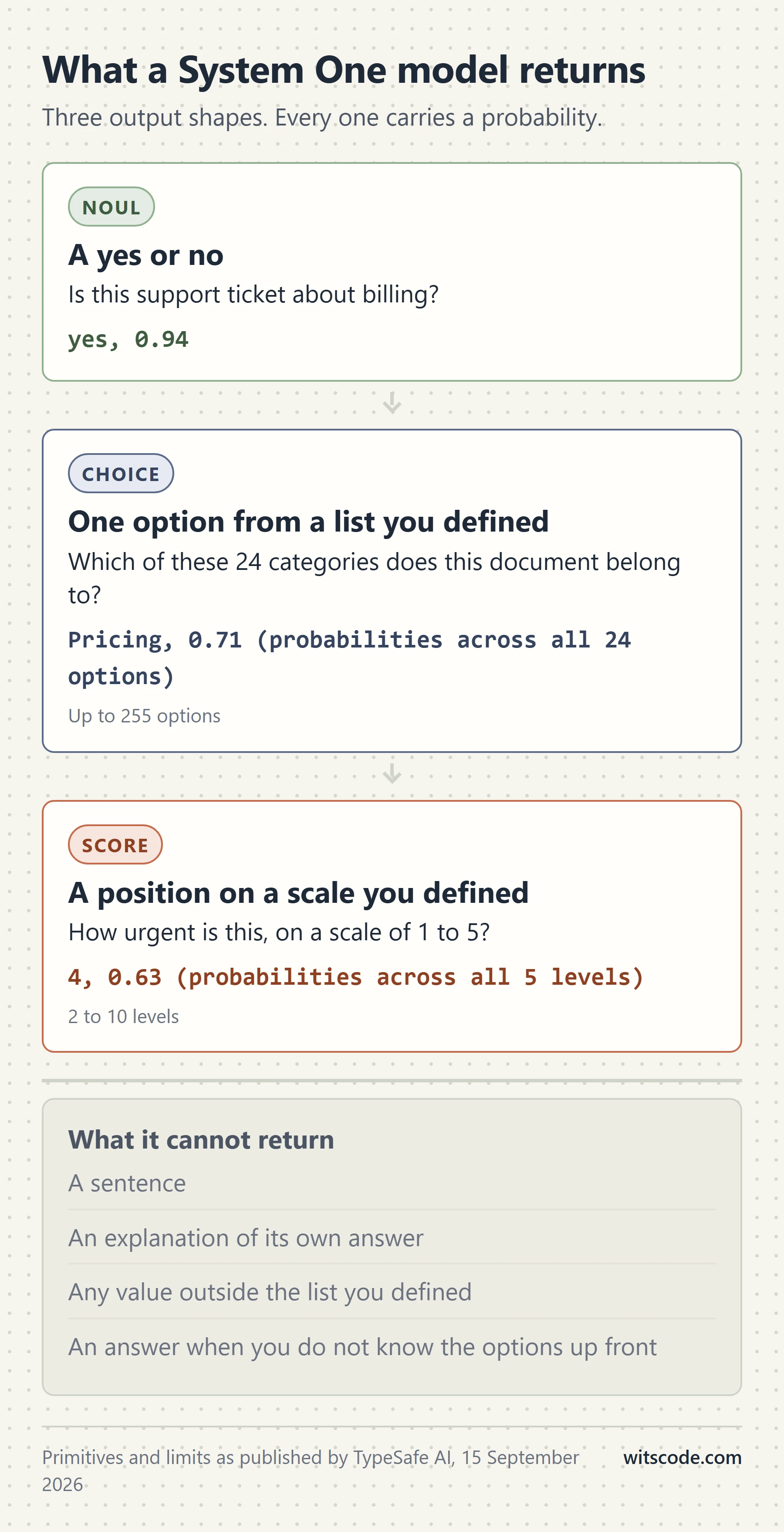
The confidence number is the part that makes it useful in a business process. Your own code decides what to do with it. Auto-approve above 0.9, send to a person between 0.6 and 0.9, reject below that. The model supplies the judgment. Your application still owns the thresholds, the retries, the permissions and every side effect.1
The training method is called RLCD, Reinforcement Learning for Calibrated Decisions. It optimizes for honest probabilities rather than for answers a human rater would like. There is no paper, no released weights, and no outside party has tested the calibration.18
How fast is Jev, and why does every source say something different?
This is where the coverage falls apart. Here are the five multiples in circulation and who published each.
| Claim | Published by | Verdict |
|---|---|---|
| 40x to 200x faster | TypeSafe AI, launch post1 | The vendor's own range. Use this one, always attributed. |
| 20x to 200x faster | Langfuse9 | Contradicts the primary source's own lower bound. Do not use. |
| More than 100x faster | Latent Space10 | Newsletter paraphrase. Origin of much of the secondary coverage. |
| 200x faster, 400x cheaper | LangChain11 | Quotes only the top of both ranges as if it were typical. Misleading. |
| Up to 100x faster and 100x cheaper | The funding press release2 | Press-release rounding. Understates the vendor's own technical range. |
| 193.6x faster, 444.6x cheaper | TypeSafe homepage1 | A ceiling. TypeSafe itself says these sit at the high end. |
| About 6x faster than Gemini 2.5 Flash-Lite | Cody AI, independent test4 | The only independent speed measurement found anywhere. |
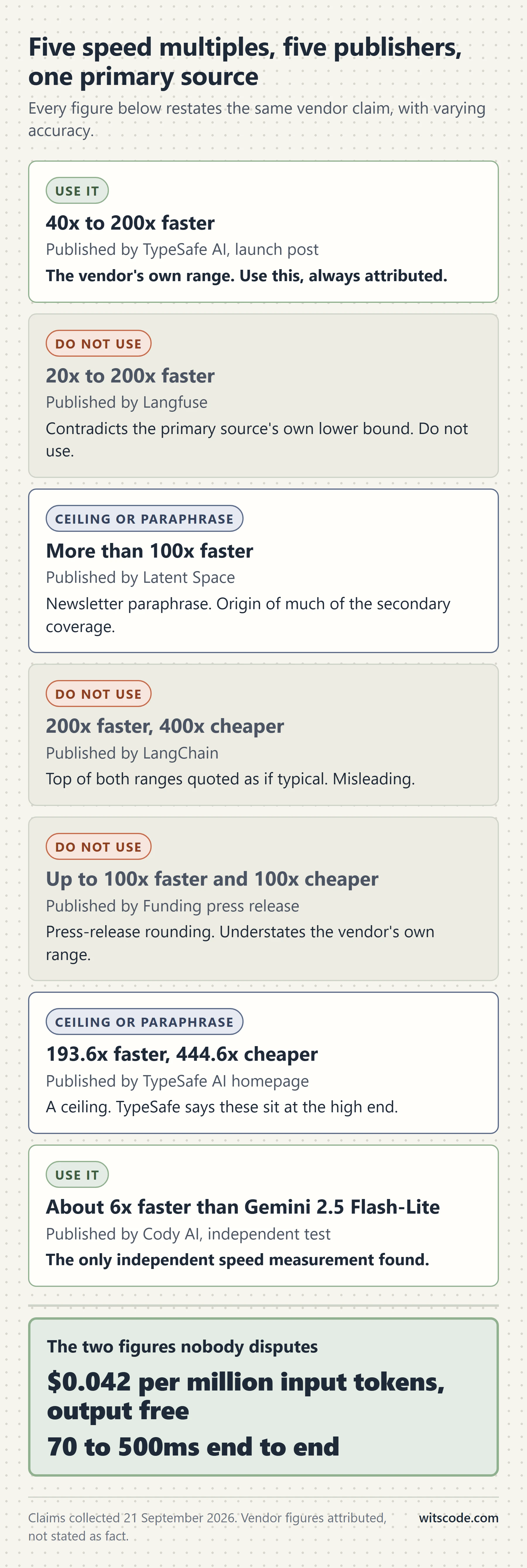
Read the table honestly and the position is this. The vendor says 40x to 200x. Every larger or rounder figure you see is somebody restating the vendor with less care. The single measurement not run by TypeSafe came in at about 6x, against an already-cheap, already-fast small model rather than a frontier one.
One more data point. Vercel's Guillermo Rauch said the safety reviewer in fx runs on GPT Luna today and Jev is "up to 18x faster (p95) and more accurate."21 Vercel sells access to the model, so take that as a customer testimonial, not a benchmark.
The two figures nobody disputes are the latency band and the list price. Those are the ones to build on.
What does Jev actually cost?
$0.042 per million input tokens. Output tokens are free, because there are no output tokens: the answer is a selection, not text.1
That is a published list price you can check on the console, which makes it the most defensible number in this cluster. It is also the only one you need, because you can do the arithmetic yourself instead of trusting a multiplier.
A 300-token support ticket costs about $0.0000126 to classify. One hundred thousand tickets cost about $1.26.12 One developer sorted 1,018 academic papers into 24 categories for $0.08, at a median of 256ms per decision.13
Do the arithmetic
What does this job cost, three ways?
List prices only, as published in September 2026. No benchmark claims, no projected savings. Change the job and watch which engine the arithmetic favors.
- Typed decision model$0.1680
Jev list price. Returns a value and a probability, no text.
- Small frontier model$1.44
gpt-5-nano list price. The honest comparison, and it is close on input.
- Frontier model$84.00
A mid-tier frontier model at $3 in and $15 out, the usual default.
Two things usually surprise people. Against a small model the input price is close, so the gap comes from free output and from answering several questions in one pass. Against a frontier model the gap is large enough that it changes what you are willing to run across a whole site rather than a sample.
The strongest cost evidence that did not come from TypeSafe is Langfuse's. Working with Good Start Labs, they ran 6,003 rubric checks through five models to grade AI outputs. Jev came out at $160 per million graded answers. Fable 5.1 came out at $33,000 per million for the same work.9 That is a third party, measuring a real workload, publishing the numbers. It is the best independent cost comparison that exists.
Two caveats before you plan around any of this.
First, TypeSafe has not said whether the pricing is subsidized.6 A venture-funded company six days into early access can charge what it likes. Free output tokens are a pricing decision, not a law of physics.
Second, the savings only exist where you were already paying a frontier model to do work a decision model can do. If your AI bill is mostly writing, the number does not move at all.
Does "zero hallucinations" mean Jev cannot be wrong?
No. This is the most important paragraph in this post.
TypeSafe reports a 0% hallucination rate and a 0% type error rate.1 Both are true, and both mean something narrower than they sound.
What is guaranteed is schema conformance. If you define five categories, the answer will be one of those five. It cannot invent a sixth. It cannot return a number where you asked for a category, cannot return malformed output, and cannot break the code downstream that expects a specific shape. That guarantee is real and it is genuinely useful. Structured output from chat models fails at this constantly.
What is not guaranteed is correctness. If the right answer is not in your list of five, the probability mass lands on the least wrong option, with a confidence score that may not warn you.14 If your categories overlap, or your question is ambiguous, or the input is adversarial, you get a confidently wrong answer in a perfectly valid shape.
Here is the number that makes this concrete. Jevals is an independent benchmark, unaffiliated with TypeSafe, that asked seven models 300 questions per task, five times each, for 31,500 scored decisions in total. It reports a Decision Score where 100 is perfect and 0 is guessing the base rate. On pick-one questions Jev scored 67.8 against Gemini 3.8 Flash at 74.1. On yes-or-no questions Jev scored 69.0 against the same model at 73.0.5 Jev lost both, by five to six points, at about a twenty-eighth of the price.
It cost roughly a twenty-eighth as much.
We are publishing the loss because it is the number that tells you how to use this thing. Jev is not the most accurate option available. It is close enough to the accurate option to be worth running at a price that makes volume possible. That is a real and valuable trade, and it is a completely different claim from "it does not make mistakes."
Anyone selling you this model on the strength of "zero hallucinations" either has not read the documentation or is hoping you will not.
What happens when someone disputes the decision?
Jev returns a value and a probability. It does not return a reason.6
That is not a gap in the product, it is the design. There is no generation step, so there is nothing to explain with. You get "rejected, 0.87" and that is the complete output.
Think about what that means. A customer asks why their application was declined. A candidate asks why their resume was filtered. "Our model returned 0.87" is not an answer anyone will accept, and in several jurisdictions it is not an answer the law will accept either.
So the rule is simple. If a decision has an appeals process, a regulator, or a human who will ask why, do not let a System One model make it alone. Use it to sort the queue, flag the edge cases and route the work. Keep a reasoning model or a person on anything that has to be justified.
The same applies to anything a client will read. A score with no reason is not an insight, and you cannot put it in a report.
What can Jev do, and what can it not do?
It is good at high-volume judgment calls where you already know all the possible answers. Routing and classification: tickets, emails, documents, enquiries, intent. Scoring and prioritization: urgency, risk, relevance, quality, lead fit. Moderation gating, where several questions run in one call fast enough to sit in front of a publish button. Verification: does this evidence support this claim. Bulk labeling across datasets too large to read.115
It cannot do these things, and no amount of prompting changes that.
- It cannot write text. No titles, no descriptions, no replies, no summaries.
- It cannot explain itself. Probability only.
- It cannot answer when you do not know the options up front. Open questions are outside the format entirely.
- It cannot be trusted alone on money pages or hard-to-undo changes. Anything where a wrong call costs you revenue or requires a rollback needs a review step.
- It cannot replace strategy or diagnosis. Deciding what to do is still a frontier model or a human.
Ninety second check
Is your job decision shaped?
Five questions. One no is enough to make this the wrong tool, which is worth finding out before you wire anything up.
Can you write down every possible answer before you run it?
Is the output a decision rather than something a person will read?
Does it happen often enough that doing it by hand hurts?
If a call is wrong, can you undo it cheaply?
Can you live without a written reason for each call?
Answer the five above and you get a straight verdict here.
Is there anything underneath it, or is it a clever wrapper?
The criticism is worth reading, because it is specific.
Nathan Flurry's line, which travelled furthest, is that Jev is "a really smart switch statement." Alexis Gallagher's point is blunter: fast, cheap zero-shot classifiers have existed for years, and the encoder models that did calibrated classification did not need a launch event.16
Sean Goedecke wrote the most careful version. He tested prefilled constrained decoding on a small open model, got a 2x to 3x speedup over standard structured output, and concluded "I suspect Jev does not have a substantial technical moat." He is still positive on the category, which is the interesting part: he thinks the idea is right and the defensibility is thin.17
Then there is OpenJev, an MIT-licensed package that reproduced the interface over a weekend. It poses a multiple choice question to a small open model, skips generation entirely, and reads the next-token probabilities per option. It hit the Hacker News front page with over 600 points.18 LocalJev, from GitHub Next, is wire-compatible in a different way: it asks a model for a JSON probability rather than reading the logits.19
Here is the honest headline. The reproductions copy the interface. None of them reproduces RLCD, the training method that is supposed to make the probabilities trustworthy, and nobody outside TypeSafe has tested that calibration.188
So both things are true. The pattern is reproducible and already reproduced. Whether the calibration is reproducible is the open question, and it is the only one that matters.
Do you need to do anything this quarter?
Probably not directly, and anyone telling you otherwise is selling something.
Here is what is likely to happen. Your vendors adopt it before you do. The tools you already pay for route their classification and moderation work to a decision model, their inference costs fall, and either their margins improve or your bill quietly does. Vercel's numbers suggest that is already underway: nearly 13% of paid teams within 24 hours, the fastest adoption in AI Gateway history.7
Three things worth doing, none of which take long.
Ask your vendors. If a supplier charges you per classification, per enrichment or per moderated item, ask whether they have moved that work to a System One model and whether your pricing reflects it. The question alone tells you how closely they watch their own costs.
Find the volume work you are not doing. The interesting cases are not the ones where you swap out a model you already pay for. They are the ones you skipped because judging 50,000 items was never worth it. That arithmetic just changed.
Do not rebuild anything on it yet. It is six days old in public, behind a waitlist, from a company that has never run it under months of messy traffic and adversarial input. Early access is not production.
Where this actually pays
This post explains the model. The rest of the series shows the arithmetic on specific jobs, each with the volumes and the costs visible.
- Keyword cannibalization is a yes or no question
- An internal linking audit in 45 seconds
- Classifying search intent across 50,000 keywords
- A technical SEO audit past the crawl limit
- An automated lead scoring model without a platform
- The lead scoring guide that ends with a build
- Lead routing at form submit
Frequently asked questions
What is Jev?
Jev is a decision model from TypeSafe AI, launched on 15 September 2026. It reads unstructured text and answers a typed question with a typed answer: a yes or no, one option from a list you defined, or a position on a scale you defined. Every answer carries a confidence probability. It cannot generate text, so it cannot write, summarize or explain. It is priced at $0.042 per million input tokens with free output and responds in 70 to 500 milliseconds.
What is a System One model?
System One is the category name TypeSafe created for models that make fast typed decisions rather than generating language. The name comes from Kahneman's System 1 thinking, the fast automatic judgment, as opposed to System 2, the slow deliberate reasoning a chat model performs when it writes an analysis. A System One model has no generation step. You define the possible answers up front and it selects one with a calibrated probability.
Can Jev hallucinate?
Not in the sense of inventing an output that is not on your list, which is what TypeSafe's 0% hallucination figure refers to. Schema conformance is guaranteed by construction. It can still return the wrong answer from inside your list, and if the correct answer is not among your options it will pick the least wrong one with a confidence score that may not warn you. Guaranteed shape is not guaranteed correctness.
How much does Jev cost?
$0.042 per million input tokens, with output tokens free because there are no output tokens. That works out to roughly $0.0000126 to classify a 300-token support ticket, or about $1.26 per 100,000 tickets. TypeSafe has not disclosed whether the pricing is subsidized, which matters if you are planning a long-term build on it.
Is Jev faster than a normal LLM?
TypeSafe reports 40x to 200x faster than frontier models, and other outlets quote 20x to 200x, more than 100x, a flat 200x, and up to 100x. Those are all restatements of the vendor's figure with varying accuracy. The only independent speed measurement found put Jev at about 6x faster than Gemini 2.5 Flash-Lite, a model that was already small and fast. The undisputed number is the latency band of 70 to 500 milliseconds end to end.
Is Jev more accurate than other models?
No. Jevals, an independent benchmark of 31,500 scored decisions across seven models, put Jev at a Decision Score of 67.8 on pick-one questions against Gemini 3.8 Flash at 74.1, and at 69.0 against 73.0 on yes-or-no questions. Jev lost both at roughly a twenty-eighth of the cost. The case for Jev is price at volume, not accuracy. TypeSafe's own evals show parity with frontier models on its internally designed task set, which is a self-graded result on a format the vendor invented.
Can Jev explain its decisions?
No. It returns a value and a probability, and nothing else. There is no generation step, so there is no reasoning to output. That rules it out as the sole decision maker for anything with an appeals process, a regulator, or a customer who will ask why. Use it to sort, flag and route, and keep a reasoning model or a person on anything that has to be justified.
Is Jev open source, and can I run it locally?
No. The weights and the RLCD training method are unreleased, and access is through TypeSafe's API. Two open reproductions exist: OpenJev, which reads next-token probabilities from a small open model over a constrained option set, and LocalJev from GitHub Next, which is wire-compatible but asks a model for a self-reported probability instead. Both copy the interface. Neither reproduces the training method, which is the part supposed to make the probabilities trustworthy.
Should I replace my current AI tools with Jev?
Only the parts that make repeated decisions over a known set of answers. Classification, routing, scoring, moderation gating and bulk screening are the fit. Writing, summarizing and anything that needs a justification are not. For most business owners the practical move this quarter is to ask your vendors whether they have moved their classification work to a decision model, and whether your pricing reflects it.
- TypeSafe AI, "Introducing System One models and Jev," 15 September 2026. typesafe.ai
- FinSMEs, "TypeSafe AI Raises $40M in Seed Funding," September 2026. finsmes.com
- Vercel, "TypeSafe Jev and the AI SDK," knowledge base guide, September 2026. vercel.com
- Cody AI, "TypeSafe Jev AI: the System One model," September 2026. meetcody.ai
- Jevals, independent benchmark of Jev against six other models, 31,500 scored decisions, 300 questions per task asked five times each, 18 September 2026. jevals.com
- DataCamp, "System One models and Jev," September 2026. datacamp.com
- Vercel, "Jev is the fastest-adopted model in AI Gateway history," September 2026. vercel.com
- TrueFoundry, "TypeSafe AI Jev," September 2026. truefoundry.com
- Langfuse, "Using TypeSafe's Jev for evals," 18 September 2026, citing Good Start Labs data across 6,003 rubric checks. langfuse.com
- Latent Space, "Jev, a System One model," September 2026. latent.space
- LangChain, "Building a harness with Jev," September 2026. langchain.com
- Flavio Copes, "Jev," September 2026. flaviocopes.com
- daily.dev, "Jev by TypeSafe: a guide," September 2026. daily.dev
- Hacker News, Jev discussion thread, September 2026. news.ycombinator.com
- CloudRaft, "Top use cases of Jev, the TypeSafe AI model," September 2026. cloudraft.io
- OpenChamber, analysis of 12,759 Jev launch posts on X, September 2026. openchamber.dev
- Sean Goedecke, "Jev means structured output is interesting again," September 2026. seangoedecke.com
- OpenJev, MIT-licensed typed decision API over open models. github.com
- LocalJev, GitHub Next. github.com
- ts2.tech, "TypeSafe AI raises $40 million for Jev, but its 445x cost claim is still self-tested," September 2026. ts2.tech
- Guillermo Rauch, CEO of Vercel, on the fx safety reviewer and Jev latency, X post, September 2026. x.com
Facts checked on 21 September 2026. The model is six days into public early access and the numbers are moving. Where a figure here is a vendor claim, it says so, and we will correct this page rather than quietly leave it wrong.
Still running ops by hand?
Tell us which workflows eat your week. You get a map of what to automate first and what to leave alone.
- n8n, Make, and Zapier builds
- MCP and Claude wired into your stack
- Scoped estimate within 48 hours
Want to discuss non-tech founders for your business?
Start a project and we'll talk through where you are, what's working, and the highest-leverage moves for the next 90 days.
Keep reading
More from the Non-Tech Founders archive.
- Non-Tech Founders
June 3, 2026
The Operations Tech Stack We Deploy for Every New Small-Business Client
Our standard small-business ops stack. n8n, Claude, Notion, Google Workspace, Slack, Stripe, and Shopify or WooCommerce. Why these seven, how they compose into one system, and what we swap for...
- Non-Tech Founders
May 31, 2026
Weekly Reporting Automation: The Founder's Monday Morning Setup
Pull metrics from Stripe, Shopify, HubSpot, and GA4 every Sunday night. Generate a Monday-morning markdown summary with Claude. Email it to yourself. The exact setup we run for ourselves and most of...
- Non-Tech Founders
May 27, 2026
Sales CRM Automation With Claude and Apollo
An end-to-end inbound lead flow. Webhook to Apollo enrichment to Claude triage to CRM to Slack. Prompt templates, confidence thresholds, and guardrails that keep false positives out of your Tier 1...


