


Free vs Paid Shopify Apps: Where the Real Cost Actually Hides
Free Shopify apps charge you in ways that never appear on your Shopify bill: JavaScript weight, data monetization, support lag, and upsell traps. Here is what a veteran sees that the SERP misses.
Every Shopify merchant I have audited in the last three years believed the same thing about their app stack. They believed the apps marked free were free. They believed the paid apps were the ones costing money. After more than two hundred and fifty stores, the pattern is so consistent it is almost boring. The free apps are usually the expensive ones. The paid apps are usually the cheap ones. The merchants who figure this out first are the ones who stop losing conversion revenue to things they cannot see on any invoice.
This is not a moral argument about free software. Plenty of genuinely good free apps exist on the Shopify App Store, and plenty of paid apps are overpriced bloat. This is a post about understanding what you are actually trading when you click install on something labelled free, because the economics of the Shopify App Store make free a business model, not a price. Every free app has to pay for its engineering team, its server costs, its support staff, its marketing budget, and its investors. If you are not paying with money, the payment is coming out of somewhere else, and that somewhere else is almost always your storefront performance, your customer data, your founder time, or your legal exposure.
The Four Business Models Behind Every Free Shopify App
There are really only four ways a free Shopify app sustains itself, and recognizing which one you are dealing with tells you almost everything you need to know about what it is costing you.
The first model is the freemium upsell ladder. This is the most honest of the four. Judge.me, Klaviyo, Privy before Attentive bought it, Loox, and dozens of others use the free tier as a lead magnet. Core functionality is real and works, but the moment your store grows past a threshold, whether that threshold is contacts, orders, reviews, or emails sent, the paywall snaps shut. The hidden cost here is timing. The paywall lands at the worst possible moment, usually during a launch or the week before Black Friday, when switching costs are highest and negotiating leverage is lowest. Merchants often pay more on the eventual paid plan than they would have paid if they had just started on the paid plan of a competitor and grown into it.
The second model, the one almost nobody talks about openly, is data brokerage through embedded tracking SDKs. A surprising number of free apps in the popup, analytics, social proof, and abandoned cart categories make their money by shipping a third-party pixel inside their app script. That pixel fires your visitors' behavioral data into an audience-enrichment network, which then resells segments to ad-tech buyers. You are the merchant, the data is about your customers, and the monetization is happening without you signing the contract. I will walk through how to detect this in your own store in a later section, because it is the single most under-reported cost on the App Store.
The third model is ad-supported, which used to be everywhere and is now mostly confined to review widgets and loyalty popups. Your emails or widgets carry a powered-by badge that links to the vendor, and in some cases the vendor cross-promotes other merchants on your pages. You are leasing pixels on your own checkout intent moments to drive traffic to someone else's store. The cost is direct: a fraction of your close-the-loop conversions leaks to a competitor or to the vendor's affiliate funnel.
The fourth model is the one I call community-built-but-abandoned. A solo developer built the app three years ago, never charged for it, and stopped responding to support emails eighteen months ago. The app still appears in your admin because Shopify has not forcibly deprecated it, but the underlying code calls API versions that Shopify rotates quarterly. One day the app stops working, a customer complains, and you discover the bounce-back email from the developer's domain. Free became expensive the moment your store broke on a Saturday afternoon.
Why Kilobytes Are Actually Dollars
The cost model that engineers understand and merchants rarely do is that every hundred kilobytes of JavaScript you ship on your storefront has a measurable, predictable effect on revenue. This is not theory. Deloitte and Google published the Milliseconds Make Millions study which showed that a tenth of a second improvement in mobile site speed drove retail conversion up by 8.4 percent and order value up by 9.2 percent. Shopify's own 2023 internal data showed sites with Largest Contentful Paint at or under 2.5 seconds converting 1.9 times better than sites over 4 seconds. These are not marginal curves, they are the steepest revenue levers most merchants have access to.
Here is the arithmetic that changes how you think about free. On a mid-range Android device running on a reasonable mobile connection, each additional hundred kilobytes of third-party JavaScript adds somewhere between a hundred and twenty and a hundred and eighty milliseconds of Total Blocking Time, and between eighty and a hundred and fifty milliseconds to your Largest Contentful Paint depending on when the script parses. Four free apps, each shipping between eighty and two hundred and fifty kilobytes of async-but-still-parsed JavaScript, will routinely add six hundred to nine hundred kilobytes of weight to your storefront. That is enough to push a store with an otherwise healthy LCP of 2.3 seconds past the 3 second line where conversion begins to fall off a cliff.
Run the numbers for a store doing five hundred thousand dollars a year. A ten percent conversion drag attributable to LCP degradation is fifty thousand dollars of revenue that never appears in your reports, because there is no line item in Shopify for customers who bounced before your hero image rendered. A paid app that replaces four free apps and ships fifteen kilobytes of server-rendered HTML with a lazily initialised web component is not a cost, it is a rounding error against the revenue you are recovering. The free app was costing you thousands of dollars a month. You just never got an invoice.
How to Detect Data-Brokerage SDKs in Your Own Store
This section matters more than any other in the article because it is the one thing you can act on in the next fifteen minutes. Open your storefront in a Chrome incognito window with DevTools open. Go to the Network tab, check Disable cache, filter to JS, and reload the page. Sort the list by Transferred size. Any row above a hundred kilobytes gzipped belongs to an app that needs to justify its existence.
Now remove the JS filter, set it to All, and scroll through the request origins. Mentally subtract anything served from your own storefront domain, cdn.shopify.com, and the handful of CDNs you recognize like fonts.googleapis.com. Every remaining third-party origin is something an app installed on your store. If you see calls going to domains ending in track, pixel, collect, or beacon, especially calls with a payload that includes a user identifier, a page URL, and referrer information, you are almost certainly looking at a data-brokerage beacon.
Common tells include calls to segment dot io, rudderstack dot com, fullstory dot com, mouseflow dot com, hotjar dot com, and a long tail of smaller enrichment networks that use domain patterns like api dot something dash analytics dot net. None of these are inherently malicious, and some merchants have explicitly chosen to install them. The problem is when they arrive bundled inside a free popup or review app that never mentioned data brokerage in its listing. Under the California Privacy Rights Act, which took effect in July 2023, this kind of cross-context behavioral sharing is classified as a sale or a share of personal information, and it triggers an obligation for the merchant, not the app vendor, to provide a Do Not Sell or Share My Personal Information link. The penalties run up to seven thousand five hundred dollars per intentional violation. Your app installed a liability you never knew you signed up for.
Lighthouse will also give you a cleaner view of this. Run it against your storefront, open the Performance report, and expand the Reduce JavaScript Execution Time section. You will see a breakdown by origin of exactly how much main-thread time each vendor is consuming. The worst offenders on merchant stores I have audited are usually free tools, not paid ones, because paid vendors can afford to write efficient code and free vendors cannot.
The Support Lag Nobody Budgets For
A free app almost always comes with email-only support and a 48 to 72 hour service level agreement, or a community forum with no SLA at all. A paid app on a 29 dollars per month tier typically offers live chat with a 4 hour response target. That difference looks small until an app breaks at 6pm on a Friday on a store that does 2,000 dollars a day.
The delta between fixed Saturday morning and fixed Monday afternoon is an entire weekend of revenue. On a store doing 500 dollars an hour on a Saturday night, that is thousands of dollars in lost orders that simply do not recover when the app comes back online. The customers who bounced on Friday at 7pm are not going to reappear at 2pm on Monday because they saw your Meta retargeting ad. They bought from your competitor.
The second, quieter form of this cost is the founder DIY tax. Every free app I have audited eventually generates a problem that a merchant tries to solve themselves instead of waiting for support, because support never arrives. I have watched store owners spend ninety minutes on a Loom recording and poking through Liquid templates trying to diagnose why their free review widget stopped rendering, when a paid vendor would have answered a chat in six minutes. At a conservative opportunity cost of a hundred dollars an hour for a founder, two or three of these incidents per year fully absorb the annual cost of the paid alternative.
Where Free Is Actually Free and Where It Is Not
I want to be concrete about the categories where the math works and the categories where it does not. Genuinely low-cost free apps are mostly first-party Shopify tools: Shopify Forms, Shopify Email at low volume, Shopify Inbox, the native Search and Discovery app. These are subsidised by Shopify's core revenue model and do not need to monetize you sideways. They ship light code, integrate cleanly, and have predictable product roadmaps.
The categories where free is almost always a trap are reviews, popups, visitor counters and social proof, abandoned cart recovery, and any app with analytics in its name. Review apps tend to use the free tier as a forcing function: the free tier requires you to manually trigger every review request email, which is a two to four hour per week task that costs a hundred to two hundred dollars of owner time per week and absorbs any possible saving. Popup apps are the canonical case for data monetization, and the native Shopify Forms product has made most of them indefensible. Visitor counters and the twenty three people viewing this product widgets are almost universally trust theatre layered on top of a data-harvesting module. Abandoned cart apps add weight and duplicate Shopify's native abandoned checkout. Analytics add-ons mostly duplicate GA4 and Shopify's native reporting while introducing schema drift that will cost you an afternoon of reconciliation every month.
The Audit Framework That Actually Answers the Question
Once you internalise that a free app is a business model and not a price, the right question stops being which apps are free and starts being what is the total cost of ownership for each app on my store. That calculation has four inputs. The first is JavaScript weight in kilobytes, benchmarked against a ceiling that I think of as two hundred kilobytes per third-party origin before it becomes indefensible. The second is data posture, which means whether the app ships a third-party pixel you did not explicitly authorise and whether your Do Not Sell obligations are covered. The third is support responsiveness, measured as the realistic time-to-fix on a Friday night incident. The fourth is feature coverage compared to the paid alternative you would switch to.
Any app that fails two of those four should be replaced or removed. Any app that fails three has almost certainly been costing you more than a paid alternative for longer than you think. This is not a subjective exercise, it is arithmetic, and once the numbers are in front of you the decision usually makes itself.
The WitsCode True Cost of Ownership Audit
This is exactly the exercise we run for merchants. It is a sixty-minute teardown of your installed app stack where we inventory every app, measure the JavaScript and CSS weight per origin on a real mobile device profile, map every third-party beacon firing from your storefront, score each app against a paid alternative on feature coverage, and put a projected revenue impact against each proposed swap using the Deloitte speed-to-conversion multiplier calibrated to your store's current LCP and revenue run rate.
The output is a ranked swap list. For each app, you see what it is costing you in performance dollars, data liability, and support risk, and what the paid alternative would cost you in actual money. Most stores we audit discover that removing or replacing three to five free apps will pay for a year of the WitsCode monthly retainer inside the first ninety days, purely from recovered conversion on the speed improvement, before any other lever gets pulled. If your gut has been telling you that the app stack is slowing things down but you have not had time to prove it, that is the audit to book. Send an email to WitsCode with your storefront URL and we will come back with a preliminary weight-and-beacon breakdown before the first call, so you know exactly what you are paying to host before you decide whether to continue.
Free is not a price. Free is a business model. Now you know whose business it is actually running.
Building or fixing a Shopify store?
Tell us what you are working with. You get a scoped plan and a straight answer on whether you need a rebuild or just a fix.
- New builds, replatforms, and migrations
- Speed, checkout, and conversion fixes
- Scoped estimate within 48 hours
Want to discuss ecom for your business?
Start a project and we'll talk through where you are, what's working, and the highest-leverage moves for the next 90 days.
Keep reading
More from the Ecom archive.
- Ecom
July 27, 2026
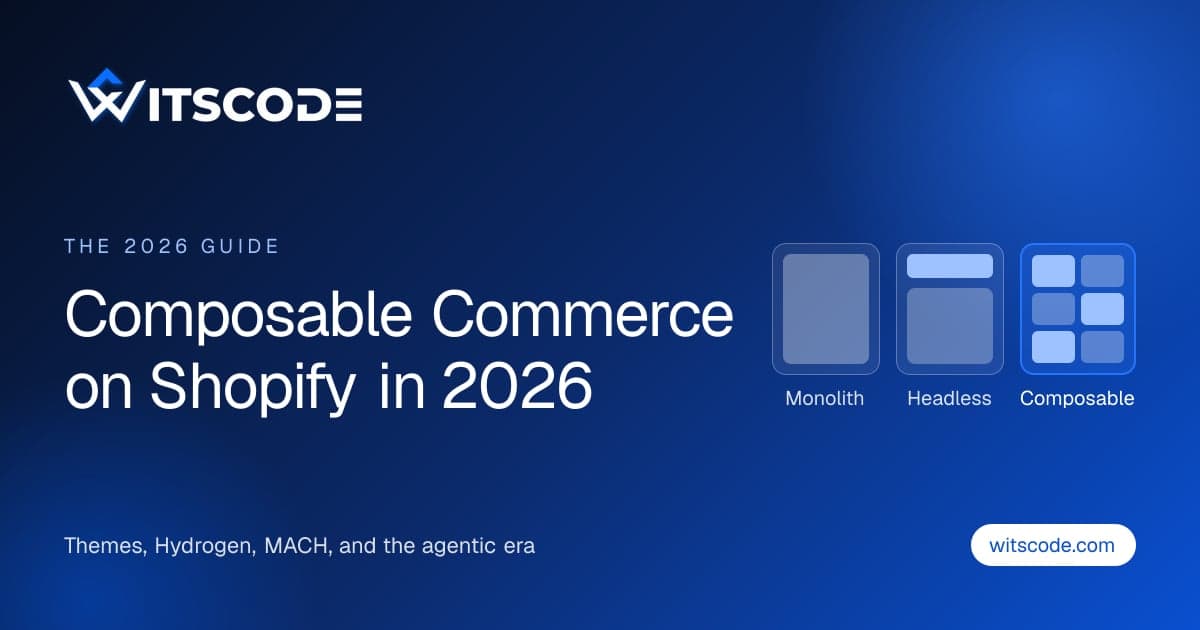
Composable Commerce on Shopify in 2026: Architecture, Real Costs, and the Agentic Shift
What composable commerce really costs on Shopify in 2026, when headless is worth it, and how the new agentic stack changes the answer. With real numbers.
- Ecom
July 19, 2026
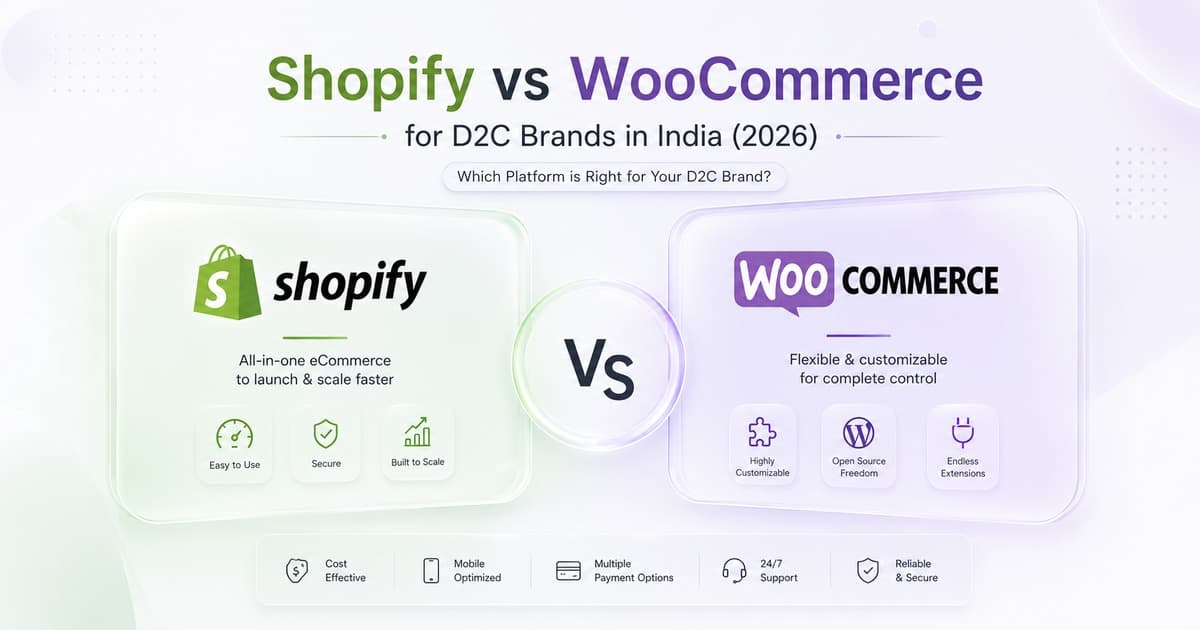
Shopify vs WooCommerce for D2C Brands in India (2026)
Shopify or WooCommerce for your Indian D2C brand in 2026? Real INR costs, the Shopify fee stack, COD, GST, and Shiprocket compared, with an honest verdict.
- Ecom

June 9, 2026
Best Shopify Development Agencies in 2026 (UK and US)
Seven Shopify development companies compared for UK and US brands. Written by one of the seven, and we name where each competitor beats us.