

Composable Commerce on Shopify in 2026: Architecture, Real Costs, and the Agentic Shift


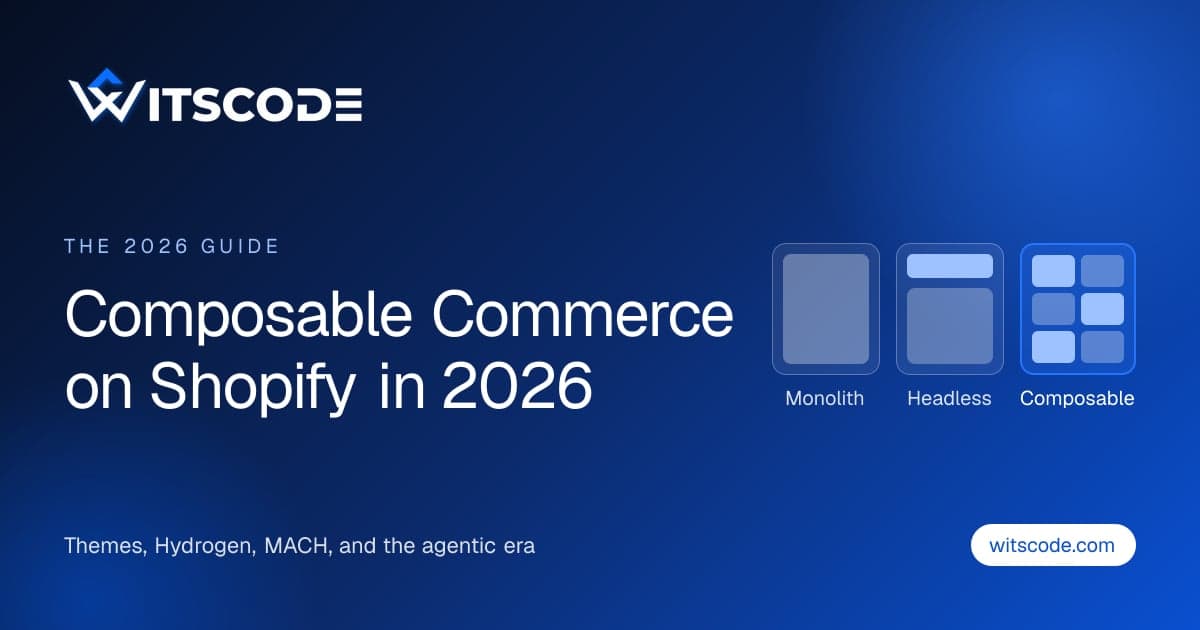
The short version: Composable commerce means assembling your store from independent, API-connected services instead of one monolithic platform. On Shopify in 2026 that conversation has changed twice over: the new framework-agnostic Hydrogen removed most of the old technical lock-in, and Shopify's agentic stack (Universal Commerce Protocol, Catalog, checkout inside AI assistants) added a reason to modernize that has nothing to do with page speed. This guide goes deeper than definitions. It covers what the terms actually mean, what Shopify's composable stack looks like right now, how headless builds actually get fast, the CMS, framework, and internationalization decisions that shape the budget, what it all genuinely costs, when you should refuse to do it, how to migrate without betting the company, and how to lead the program internally once you commit. Numbers included throughout.
What is composable commerce?
Composable commerce is an approach to building ecommerce systems in which each capability, storefront, content management, search, checkout, payments, product data, runs as an independent service, and the services are connected through APIs. Instead of buying one platform that does everything adequately, you compose a stack from parts that each do one thing well, and you can replace any part without rebuilding the whole.
The term has a specific origin. In 2020, Gartner introduced the "composable enterprise" and, with it, packaged business capabilities: software components that each represent one well-defined business capability, recognizable to the business user who works with it, deployable and replaceable on its own. Cart is a capability. Search is a capability. Product content is a capability. Gartner's argument was that enterprise software should be assembled from interchangeable blocks like these rather than bought as sealed suites, and the idea rests on four principles: modularity (each block stands alone), autonomy (blocks scale, fail, and upgrade independently), orchestration (blocks can be combined and recombined as the business changes), and discovery (the organization can see what blocks it has and what they do). Commerce vendors adopted the vocabulary almost immediately, some more honestly than others.
The practical translation is simple: your frontend does not have to be your backend's template layer, your CMS does not have to live inside your commerce platform, and your checkout does not have to dictate your architecture.
What most definitions skip is what composability means operationally, for the team that runs the store on a Tuesday. Four things change:
- Every service becomes a contract. Its own SLA, its own renewal date, its own pricing model, its own security questionnaire. Procurement effort multiplies with the number of parts.
- You become the integrator. In a monolith, the vendor owns the seams between capabilities. In a composable stack, the seams are yours. When search shows a stale price, the debugging session spans the PIM, the index, and the storefront, and "whose fault is this" usually resolves to "the integration you own."
- Releases multiply. A promotion that used to be one theme change can now touch a CMS entry, a search-ranking rule, a discount rule, and a storefront deploy. Good teams automate this; every team has to plan for it.
- In exchange, replacement gets cheap. You can swap the search service without touching checkout, or rebuild the frontend without migrating product data. That selective-replacement property is the entire point of the architecture. If you cannot imagine ever exercising it, you are buying flexibility you will not use, which is the first honest signal that themes are the better deal.
What is headless commerce, then?
Headless commerce is the narrower idea inside composable: separating the frontend (the "head," what shoppers see) from the commerce backend (products, carts, checkout, orders), with the two communicating over APIs. Shopify's own enterprise guide defines it exactly this way, and adds the consequence people miss: once the backend is API-first, one commerce engine can power many heads. A website is one head. A native mobile app is another. So are a kiosk, a smart mirror, a wearable, and a vending machine. In 2026 the list quietly grew to include AI assistants, which is where this guide goes later.
The relationship to composable is containment. Every composable stack is headless; not every headless build is fully composable. If you detach a React storefront from Shopify but keep using Shopify for everything else, you are headless. If you then swap in a dedicated CMS, a search service, and a subscription engine, each chosen independently, you are composing. One more piece of Shopify's framing worth keeping, because headless vendors rarely say it: the coupled monolith is the right starting point. Themes are how you get to market fast. Headless is the escape hatch for when customization or channel requirements outgrow them, not a default posture.
And MACH?
MACH is the architecture standard most fully composable stacks follow, promoted by the MACH Alliance, an industry body of vendors including commercetools and others:
- Microservices: each capability is its own independently deployable service
- API-first: every function is exposed through an API, so anything can talk to anything
- Cloud-native: SaaS services that scale elastically, no servers you babysit
- Headless: the frontend is fully decoupled from backend logic
One caveat worth stating plainly: the MACH Alliance is a vendor consortium, not a neutral standards body. The companies that certify the architecture also sell it. That does not make the principles wrong, they are sound engineering, but it does mean "MACH-certified" is a marketing credential first and a guarantee second. Take the vocabulary; skip the reverence.
A useful way to keep the vocabulary straight: headless is a technique, MACH is a standard, composable is a strategy. You can adopt the strategy incrementally, which is exactly what we recommend later in this guide, and you can be meaningfully composable on Shopify without checking every MACH box. Most successful Shopify builds do not.
Composable vs headless vs monolithic: the honest comparison
| Monolithic (e.g. standard Shopify theme) | Headless | Fully composable | |
|---|---|---|---|
| Frontend | Platform templates (Liquid) | Custom app (React/Next.js/Hydrogen) | Custom app |
| CMS | Built into platform | Platform or external | Dedicated headless CMS |
| Search, subscriptions, PIM | Apps inside the platform | Mix of apps and services | Independent best-of-breed services |
| Time to launch | Weeks | Months | Months to a year |
| Team needed | Designer + theme developer | Frontend engineers + platform devs | Engineering team or agency partner, ongoing |
| Typical first-year cost | $5K-$40K | $50K-$250K | $150K-$1M+ |
| Upgrade path | Platform handles it | You maintain the frontend | You maintain the contracts between every part |
| Right for | Most merchants, full stop | Brands with a real, named constraint themes can't solve | High-GMV, multi-market, multi-catalog operations |
That "most merchants, full stop" is not a throwaway. Shopify's Online Store 2.0 theme architecture, sections everywhere, app blocks, metaobjects, and native A/B testing for themes as of Shopify's Spring '26 release, covers more ground than most headless sales decks admit. The rest of this guide takes composable seriously precisely because it is a serious commitment, not a default.
Here is what the rows mean when you live with them.
Frontend is really a question of who ships changes. Liquid plus the theme editor means a marketer changes the homepage banner at 5pm on a Friday without filing a ticket. A custom app means every storefront change is a code deploy through a pipeline. Pipelines are not worse (they catch mistakes, enable testing, and roll back cleanly), but they move the power to act from marketing to engineering, and that org-chart shift causes more headless regret than any technical issue.
The CMS and services rows are about the app ecosystem trade. The monolith's quiet moat is the Shopify App Store: 8,000+ apps, most of a merchant's feature wishlist installable in an afternoon. Step outside the theme layer and much of that moat drains away, because an app's storefront features assume a theme to inject into. On a headless build those features become integrations you construct and maintain, and the pool of headless-ready apps is a fraction of what themes enjoy. Every "there's an app for that" quietly becomes "there's an API for that, budget accordingly."
Team needed hides two risks the pitch decks skip. First, the skills market: full-stack TypeScript and React engineers who also understand commerce are scarce and priced like it. Second, knowledge silos: a headless storefront built and understood by two engineers is two resignations away from being unmaintainable. Document it, pair on it, or retain a partner; pick at least one before the build starts.
Upgrade path is the row CTOs most often underweight. On the monolith, upgrades arrive with platform releases and cost you nothing. On a custom frontend, every framework migration, dependency bump, and API version deprecation is yours, forever, and the work compounds. Vendor risk belongs here too: when a frontend platform is sunset by its vendor (Shogun Frontend's shutdown is the case that made the point for a lot of teams), everyone built on it inherits a forced replatform on someone else's schedule. Composable done right is the defense: swap the dead part, keep the rest. Composable done wrong, with everything coupled to one vendor's proprietary layer, is the same lock-in with extra steps.
Where the boundaries blur. Treat the three columns as a spectrum, not a trichotomy. Hybrid builds keep the theme for the core storefront and go headless for one surface, a content site or a campaign system, which is the entry point we recommend most often. Metaobjects give the monolith structured, API-addressable content that behaves like a lightweight headless CMS. And a Hydrogen storefront using only Shopify services is architecturally headless but operationally still a single-vendor stack, which is fine, as long as you chose it rather than drifted into it. The label matters less than the specific list of what you own versus what the platform owns. Write that list down; it is the real architecture document.
The questions to answer before you pick a column. The most candid CTO-facing guides in this space, and the pattern in our own client work, converge on the same uncomfortable facts. Headless is still, in Geoffrey Moore's terms, crossing the chasm: the reference customers are real, but the skills and tooling markets are younger than the case studies suggest. Gartner named Shopify a Leader in its 2023 Magic Quadrant for composable commerce, so the platform bet is validated; the chasm applies to your team, not your vendor. And even agencies that sell headless for a living concede that many early adopters migrated back to Online Store 2.0 to cut cost and maintenance overhead. That admission is worth more than any benchmark. So answer these in writing before committing: Who owns the frontend in year three, by name? Which of your current apps become custom builds, and at what cost each? What exactly does marketing lose the day the theme editor goes away, and what replaces it? What happens when any single vendor in the proposed stack is sunset or acquired? If the room cannot answer those crisply, the comparison table has already answered for you. The rest of this guide exists to turn those questions into numbers.
The Shopify composable stack in 2026
If you evaluated headless Shopify in 2023 or 2024, your information is out of date in ways that change the decision. The framework changed, the hosting story changed, the API surface changed, and two hard deadlines have either already passed or sit weeks away. Here is the stack as it stands today.
A useful mental model before the component list, borrowed from Kotn co-founder Benjamin Sehl in Shopify's own headless guide: Shopify covers roughly 80% of what a brand needs out of the box, and headless exists for the remaining 20%, the part where your requirements genuinely outrun the platform's defaults. Kotn ran that playbook itself, consolidating two stores into one and building custom product pages on the Storefront API with Next.js. Everything below is about serving that 20% without rebuilding the 80%.
One note on the diagram: the buyer touchpoints row now includes AI agents alongside your web storefront and mobile app, because Shopify's Universal Commerce Protocol and Catalog made agents a first-class sales channel (the next section covers that in full).
Hydrogen: no longer a framework you marry
Hydrogen, Shopify's headless toolkit, went through a quiet revolution, and the details matter, because Hydrogen's own history is where most of the skepticism comes from.
The stable, production line is versioned by calendar and currently sits in the 2026.x series, built on React Router 7 (new projects scaffold with React Router 7.16). It is mature, actively maintained, and fully supported. The 2026.4 release even tightened its security posture by making the Storefront API proxy mandatory, so your API tokens stay server-side instead of shipping to the browser. If you are building a storefront that must launch this year, this is what you build on.
The bigger news landed at Shopify's Spring '26 Editions release on June 17, 2026: an all-new Hydrogen, in developer preview, rebuilt as an agent-first, framework-agnostic toolkit. Shopify built it with Vercel, whose Next.js team pressure-tested the primitives against real App Router implementations before anything shipped. The architecture has three layers. A framework-neutral, plain JavaScript core holds the commerce logic: a typed Storefront API client (createStorefrontClient), cart primitives that work anywhere (createCartStore), request handlers for the API proxy, cart, and checkout, plus analytics, Shop Pay, money formatting, and product and collection primitives. On top of that sit thin per-framework bindings; React shipped first (createCartComponents), with Vue, Svelte, and Remix 3 planned, and the toolkit already works with Next.js, React Router, SvelteKit, Astro, SolidStart, and Nuxt. The whole thing is runtime-portable across Oxygen, Vercel, Cloudflare Workers, Node, and Deno. Shopify's own line in the announcement: "If it can call fetch, it can run Hydrogen."
The "agent-first" part is not marketing garnish. The toolkit ships versioned agent skills, focused guides copied into your project at setup covering client configuration, routing, cart, product pages, and analytics, so the coding agent your team already uses (Claude Code, Cursor, whichever) works from current, correct Hydrogen documentation in the repo instead of guessing from a two-year-old training set. The July 8, 2026 preview update added Customer Account API support, predictive search, typed routing, and WebMCP tools that let AI agents interact with the storefront itself.
Why this kills the old objections, specifically:
- "We don't want to bet on Shopify's framework choices." Fair, historically. Hydrogen launched as its own React framework, was rebuilt on Remix, then followed Remix into React Router. Three framework identities in the toolkit's short life is a legitimate reason for caution. The new architecture answers that structurally rather than with promises: the commerce logic lives in plain JavaScript with no framework dependency, and the bindings are deliberately thin. If Shopify changes direction again, the blast radius is a small adapter, not your storefront.
- "We don't want hosting lock-in." Gone. Runtime portability is a design requirement now, not an afterthought. Build once, then host on Shopify's Oxygen, on Vercel, on Cloudflare, or on your own Node infrastructure (tradeoffs below).
- "Our team knows Next.js, not Shopify's stack." Also gone. Your Next.js, Astro, or SvelteKit developers keep their framework, their routing, and their deployment habits, and pull Hydrogen in as a library.
Two honest caveats. This is a developer preview, and Shopify says plainly that APIs may change before general availability; the July update already renamed createStorefrontRequestContext to createShopifyRequestContext, which tells you the surface is still moving. Third-party reporting points at a beta later in 2026, but Shopify has committed to no dates. And existing React Router Hydrogen storefronts remain fully supported with no breaking changes, migration guidance promised as the APIs stabilize, so nobody is being forced anywhere. The practical read: production builds go on stable 2026.x today, greenfield experiments can start on the preview (npm create @shopify/hydrogen@latest), and Next.js teams should watch the preview closely because it removes their last reason to hand-roll a Storefront API integration.
And the build-speed ceiling has moved regardless of which line you pick: Shopify's enterprise team cites the Patta x Tommy Hilfiger collaboration storefront, whose core came together on Hydrogen and Oxygen in about two weeks (the full story, peak-traffic numbers included, is in the receipts section).
The API layer
Four APIs carry a composable Shopify build, and each has 2026-specific detail worth knowing before you scope anything.
Storefront API. The backbone: products, collections, carts, market-aware pricing and content, search, subscriptions, and B2B operations over GraphQL. It is built to serve live storefront traffic without the hard rate limits that constrain typical admin APIs, which matters the first time a drop or a campaign spikes you. Operationally, it is versioned quarterly and each version is supported for twelve months; the current stable version is 2026-07, released July 1, 2026. That cadence is a maintenance rhythm your team inherits: pin a version, read the quarterly changelog, budget a small upgrade window four times a year.
Customer Account API. This is how headless builds handle login now: passwordless authentication with Shop sign-in, magic links, and passkeys. It deserves attention because of the deprecation arc behind it. Legacy customer accounts were formally deprecated on February 26, 2026, with a final sunset date to be announced later this year, and the old Storefront API customer mutations (customerCreate, customerAccessTokenCreate, customerUpdate and friends) are deprecated with them. In the 2026-10 API version, the Checkout types and Customer.lastIncompleteCheckout get removed entirely. The practical consequence: any tutorial, boilerplate, or agency proposal that authenticates customers through Storefront API mutations is building on ground scheduled for demolition. Scope new builds against the Customer Account API from day one, and put the auth migration in the plan for any older headless build you inherit.
Shopify Functions. Server-side customization of discount, shipping, payment, and validation logic, written as WebAssembly modules that run inside Shopify's own infrastructure with sub-5ms execution: fast enough to sit inline in checkout without adding latency, with no external server for you to host or keep alive. A concrete example makes the model clear. Say wholesale customers should get 12% off anything they buy by the case. Your Function receives the cart as structured input, checks for the wholesale customer tag and a line quantity of 24 or more, and returns a discount operation targeting exactly those lines. Same shape for shipping: a Function reads the cart, finds an item flagged oversized, and removes the express rate from the options shown at checkout. Deterministic input in, operations out, no network calls, executed by Shopify at checkout speed. This is not optional knowledge anymore: Shopify Scripts, the old Plus-only Ruby sandbox, was frozen on April 15, 2026 and retired on June 30, 2026. That deadline is behind us. Any discount or checkout logic still sitting in Scripts stopped executing on July 1, 2026, so if that sentence made anyone at your company nervous, the Functions migration is this quarter's work, not next year's.
Checkout extensibility. checkout.liquid is gone, and the timeline is nearly complete. Plus stores crossed their deadlines in August 2024 (information, shipping, and payment pages) and August 2025 (Thank you and Order status pages). The last date on the calendar belongs to everyone else: on August 26, 2026, Shopify auto-upgrades the Thank you and Order status pages on non-Plus stores, and Additional Scripts and app ScriptTags are removed, not migrated. Removed. Conversion pixels, post-purchase surveys, and affiliate tags living in Additional Scripts all need rebuilding as checkout UI extensions, Web Pixels, or Functions before that date. Checkout Components also reached general availability for Plus at the same Spring '26 Editions release, extending how far checkout can go without the old model. If your store still has legacy checkout customizations, this migration is urgent regardless of any composable ambitions, and as of this writing you have weeks, not months.
Oxygen, Vercel, or Cloudflare: where the frontend lives
The hosting decision used to be made for you (Hydrogen meant Oxygen). Now it is a real choice with real tradeoffs.
Oxygen is Shopify's hosting for Hydrogen storefronts: a worker runtime built on Cloudflare's open-source workerd, deploying to Cloudflare's global edge network across hundreds of locations. It is included at no extra charge on all paid Shopify plans, though not on Starter plans or development stores, and it comes with unlimited bandwidth, GitHub-integrated CI/CD, and multiple preview and production environments. The tradeoff is that it is a worker environment with hard limits: a 10 MB worker bundle, 128 MB of memory, 30 seconds of CPU time per request, a 400 millisecond startup cap, 110 custom environment variables, and a two-minute timeout on outbound requests. Most storefronts never touch those ceilings; a heavy server-side personalization layer or a bloated dependency tree can. For the majority of builds, Oxygen is the pragmatic default: zero hosting bill, zero pipeline to construct, edge delivery out of the box.
Vercel became a first-class Hydrogen home the moment the partnership shipped; a one-click deploy with a Next.js plus Hydrogen template has been live since June 30, 2026. Choose it when your team already lives there: you keep preview deployments, your observability setup, and your existing build pipeline. The cost is literal. You pay Vercel's usage rates where Oxygen would be a zero line, and that difference compounds with traffic.
Cloudflare Workers runs the same runtime family as Oxygen, so behavior is close to identical, but the account, controls, and pipeline are yours. It is the right answer when your company has already standardized on Cloudflare (DNS, WAF, storage, queues) and wants the storefront governed by the same controls as everything else. You own the CI/CD work Oxygen would have handled for you.
The decision rule we apply: Oxygen by default, Vercel when the team is a Next.js shop with Vercel muscle memory, Cloudflare when the infrastructure standard already lives there, and self-managed Node or Deno in a container you control only when someone holding a compliance document insists. All of them serve rendered pages from locations near the shopper; the meaningful differences are billing, pipeline ownership, and runtime limits, not milliseconds.
Commerce Components, for the very top end
Commerce Components by Shopify (CCS) is the enterprise arrangement: pick roughly thirty modular capabilities, Shopify's checkout, payments, storefront APIs, fulfillment and order management among them, and use them inside your own architecture. It is less a product than a commercial structure, aimed at high-GMV retailers (agency guides put the practical floor around $100M GMV; the marquee references are far larger), with pricing negotiated rather than listed. The pitch is narrow and strong: take the checkout Shopify operates across its entire merchant base, and the components around it, without adopting the full platform surface. For context on the scale behind it: Shopify closed FY2025 with $11.5B revenue on $378B of merchant GMV, and crossed $100B GMV in a single quarter for the first time in Q1 2026. The enterprise tier is not an experiment.
Where WitsCode sits in this: we build Shopify storefronts across this whole spectrum, from Online Store 2.0 theme work to Hydrogen builds. If you want a second opinion on where your store falls, the scorecard later in this guide is the fastest honest answer we can give you.
The agentic era: the 2026 reason to care about composable
Every composable commerce guide written before 2025 gives the same three reasons to go headless: performance, design freedom, and omnichannel. All still true, all covered below (omnichannel in 2026 meaning several storefronts, and now AI agents, on one commerce core). But the reason CTOs are re-opening this conversation in 2026 is different: your next storefront may not be a website at all.
Here is what shipped in the last two Shopify releases, with the mechanics that matter:
- Agentic Storefronts (announced in the Winter '26 release, December 2025; on by default for eligible merchants since late March 2026): Shopify products became discoverable and purchasable across ChatGPT, Microsoft Copilot, Google AI Mode and Gemini, Meta, and Perplexity, with no extra configuration and checkout staying on the merchant's own Shopify checkout and Shop Pay. An Agentic Storefronts hub in admin now centralizes the whole channel: per-surface toggles, performance analytics, order attribution, and search intelligence that flags where your products fail to surface in agent queries.
- Universal Commerce Protocol (UCP) (spec public since January 11, 2026): an open standard, developed by Shopify and Google, for how AI agents browse catalogs, build carts and complete checkout, enabled by default for every Shopify merchant. Mechanically it is layered like TCP/IP. A core Shopping Service defines the transaction primitives (checkout sessions, line items, totals, status). Capabilities such as Checkout, Orders and Catalog version independently on top of it. Extensions for fulfillment, loyalty and payments use reverse-domain namespaces, so any company that owns a domain can extend the protocol without waiting on a standards committee. Merchants and agents each publish a profile at /.well-known/ucp, and every session negotiates the overlap of what both sides support. Agents connect over direct API, Agent2Agent, or MCP, the same Model Context Protocol plumbing the AI industry has standardized on. Governance is the tell that this is not a side project: on April 24, 2026, Amazon, Meta, Microsoft, Salesforce and Stripe joined the UCP Tech Council alongside founders Google, Shopify, Etsy, Target and Wayfair. Stripe co-built OpenAI's rival Agentic Commerce Protocol, which means part of the rival camp now sits inside the UCP tent.
- Shopify Catalog: a structured, continuously enriched product data layer that AI systems query for live pricing and availability instead of scraping your pages, syndicated to ChatGPT, Copilot, Google AI Mode, Gemini and the Shop app. Under the hood it is three query tools. search_catalog handles free text, image-based visual similarity, multimodal text-plus-image, and similar-to-this-product queries. lookup_catalog resolves 1 to 50 identifiers per request (universal product IDs, variant IDs, or plain product URLs) and returns live price and availability. get_product returns full detail with variant selection. Access is self-serve: an API key and a registered agent profile URL, no approval process, which is why agent builders are integrating it at speed. Shopify's number: Catalog-syndicated data converts at twice the rate of scraped data in AI chats. Shop sign-in for agent experiences has shipped, with personalized results flagged as coming soon, and sponsored placements inside agentic experiences (a placements parameter that blends promoted results with organic) are in developer preview.
- Checkout on more surfaces, with a twist. The twist is that pure in-chat checkout stumbled first. OpenAI's Instant Checkout launched in September 2025 promising a million-plus Shopify merchants; by March 2026 fewer than roughly 30 were reportedly live and OpenAI had reframed the effort. Walmart's data explains why: in-chat checkout converted about 3x worse than sending the shopper to walmart.com, even though ChatGPT drove about twice the new-customer rate of search discovery. The industry regrouped around a simpler pattern, discover in the AI, buy on the merchant's checkout, which is exactly the shape Shopify built. Where in-surface checkout does work, it runs on the merchant's rails: Microsoft's Copilot Checkout (launched at NRF on January 8, 2026) completes purchases inside Copilot with Shop Pay support, and Microsoft claims journeys that include Copilot drive 53% more purchases within 30 minutes. Perplexity checks out through a PayPal partnership. Google's Universal Cart, introduced at I/O 2026, spans Search, Gemini, YouTube and Gmail, monitors deals, price history and restocks, and settles through Google Pay or the retailer's own checkout; launch retailers include Nike, Sephora, Target, Walmart and Shopify brands like Fenty and Steve Madden. Meta announced one-tap checkout inside Facebook and Instagram ads in March 2026, with Stripe and PayPal first and Shop Pay named to follow; treat Shop Pay inside Meta as announced, not yet live, as of this writing. Even Amazon moved, folding its Rufus assistant into Alexa for Shopping in May 2026. Shop Pay itself opened up to any brand on any platform in the Spring '26 release. On September 28, 2026, Shopify pushed that pattern further. AI agents running in the shopper's own browser can now fill in and submit your Shopify checkout, and Shopify requires them to get the buyer's approval of the order and total first. Our Shopify agentic checkout guide breaks it down.
- Agents on the operations side too: merchants can now run their stores from Claude, ChatGPT or Perplexity through chat connectors, adding products, creating collections and managing orders conversationally, and the Shopify AI Toolkit brings store management and Shopify's documentation into Claude Code, Codex, Cursor, VS Code and Gemini CLI. The agentic shift is not just a sales channel; it is becoming how stores are operated and built.
And the channel is producing revenue you can measure. Adobe Analytics found that AI-referred shoppers to US retail sites in March 2026 converted 42% better than non-AI traffic, spent 48% more time on product pages, and generated 37% higher revenue per visit. A 94-brand ecommerce study clocked ChatGPT referrals converting at 1.81% against 1.39% for non-branded organic, a 30% edge. Platform-wide, Shopify reports AI-driven orders up 15x year over year in 2025, and AI-referred traffic up 7x from January 2025 to early 2026 with attributed orders up 11x. ChatGPT alone accounts for roughly 87% of AI referral traffic today. At the brand level, Shopify's release notes cite skincare-device brand Omnilux attributing 3.2% of total March 2026 revenue to AI channels, and bedding brand Cozy Earth growing AI-channel revenue twentyfold year over year. Both are Shopify-picked examples, so read them as the favorable end of the range. But 3.2% of revenue from a channel that did not exist two years ago is not a rounding error, and it compounds.
How to make your store agent-ready: the practical checklist
Most of the agentic layer is switched on for you. What is not automatic is whether your store shows up well inside it. This is the work, in order:
- Clean the product data before anything else. Titles under 150 characters carrying brand, product type and the attributes buyers filter on. Valid GTINs on every variant, not just the bestsellers. Google product taxonomy categories assigned. Consistent naming across variants, tags and metaobjects. Shopify's claim is that stores with 99%+ attribute completion see 3 to 4x higher AI visibility, and the logic holds even if you discount the number: an agent cannot infer what you never stated. "The Voyager" tells a model nothing. "Voyager 40L carry-on backpack, recycled nylon" answers the question before it is asked.
- Move specs out of prose and into typed metafields. Materials, dimensions, weight, care instructions, certifications, compatibility, warranty, country of origin. A paragraph forces the model to parse and guess; a typed metafield lets it answer "will this fit under an airline seat" with a number. This is also the single highest-return data task, because Catalog enrichment and every AI surface downstream read from the same fields.
- Ship complete structured data. JSON-LD Product plus Offer with live price, availability and currency; ProductGroup for variant families; Brand; AggregateRating and Review; FAQ schema on question-heavy pages. Validate with Google's Rich Results Test. This is the layer assistants read when they are not reading Catalog. One deliberate omission: skip llms.txt. Google has said it does not use the file, no major vendor confirms consuming it, and analysis of 500M+ bot events shows AI crawlers almost never fetch it. Structured data and Catalog feeds do the real work.
- Confirm Catalog eligibility and watch the sync. The bar: Starter plan or above, no password protection, every product carrying a title and image, price above zero, shipping to the US or Canada, published to your Online Store, Hydrogen or headless channel, and not hidden from search engines. Then treat syndication as a live system: use the Agentic Storefronts hub to monitor sync health and rejected products, because an item that fails validation disappears from every AI surface at once, silently.
- Set the agentic controls deliberately. Review the per-channel toggles for ChatGPT, Copilot, Google AI Mode, Gemini and Shop rather than accepting defaults blind. Configure variant grouping so agents present the right options instead of ten near-duplicate listings. Keep real-time inventory and price rules accurate; an agent quoting a stale price creates a refund and a trust problem in the same transaction. If you sell across borders, configure Shopify Markets so agents quote the right currency.
- Write the content agents cite. Buying guides, comparison pages, FAQs, and relationship data (compatible-with, best-for) give assistants the connective tissue that product pages lack. Descriptive alt text and a clean sitemap round it out. This is where agent-readiness meets answer-engine visibility, and the two feed each other.
- Measure it, or it did not happen. GA4 buckets AI referrals under generic Referral by default, so build a custom channel group with regex on chatgpt.com, perplexity.ai, claude.ai, copilot.microsoft.com and gemini.google.com. GA4 added a native AI Assistant channel in May 2026, but it misses Perplexity and referrer-less sessions, so keep the custom group anyway. Shopify's Agentic Storefronts dashboard now attributes orders from ChatGPT, Copilot, Google AI Mode and Gemini natively; use both views. And know the structural blind spot: shoppers who get a recommendation in a chat, then arrive by branded search or typing your URL, land in organic and direct. Track AI-channel conversion rate and new-customer share, not just last-click revenue, or you will under-invest in the channel that is quietly filling the top of your funnel.
Why this belongs in a composable guide: an agent-ready store is, structurally, a composable store. Clean product data in an API-accessible catalog, checkout that works without your web page, business logic in Functions rather than theme code, every one of those is a composable-architecture property. The difference in 2026 is that Shopify built the agent-facing layer into the platform, so the question shifted from "should we build APIs for the AI future" to "is our data and architecture clean enough to use what is already switched on." That second question is often the strongest actual business case for the modernization work in this guide, and it is the one your board will ask about.
For the marketing-side counterpart of this shift, being the answer AI assistants cite, see our work on AI search optimization.
What headless actually delivers (with receipts)
Most headless pitches run on adjectives. This section runs on named brands and published numbers, with the sourcing caveats attached, because some of these figures come from the agencies that did the work, and you should know which ones before you repeat them to your board.
Performance
Server-side rendering, edge delivery and precise asset control routinely move Core Web Vitals in ways theme optimization cannot. The mechanics, briefly: the storefront renders complete HTML on a server near the shopper (Oxygen and its peers run at the network edge), so the browser paints real content instead of waiting for a JavaScript bundle to boot; code-splitting ships only the JavaScript each template needs; and because you own the asset pipeline, images, fonts and third-party scripts load on your terms instead of a theme's. None of that is free performance. It is available performance: themes hide these controls, headless hands them to you. The stakes, per the research Shopify's enterprise team cites (attributed to WebsiteBuilderExpert): 64% of smartphone users expect a page to load in under four seconds, about 40% of visitors abandon a site that takes longer than three, and 82% of consumers say slow page speed influences whether they buy. Shopify's illustrative math puts a one-second improvement on a store doing $100K a day at roughly $7K in additional daily revenue. That last figure is an extrapolation, not a measured benchmark. The direction is right; the precision is marketing.
The named cases:
- Carpe, a DTC brand selling clinically tested antiperspirants, brought in Shopify's own performance team after months of storefront slowdown. Largest Contentful Paint came back 52% faster and Cumulative Layout Shift improved 41%. The business followed: conversion up 5%, organic traffic up 10% as better Core Web Vitals lifted rankings, and a 15% total revenue increase with record sales. One honest note: this was a Core Web Vitals engagement on Shopify, not a headless rebuild. It is the cleanest published proof that speed moves revenue, and headless is one way to buy speed, not the only way.
- Saranoni, luxury blankets, on Hydrogen with Pack's frontend: 90% faster load times and a 33% higher conversion rate.
- Branded Bills, headwear, on Hydrogen: 74% faster load times within two months of launch.
- Barefoot Dreams, loungewear, as a headless PWA on Nacelle with Contentful: page speed up 34.5%, bounce rate down 18%, page views per visit up 403%, conversions up 64%, and ecommerce sales up 200% year over year in the launch month. Those numbers date from the November 2020 launch and were corroborated by Digital Commerce 360 at the time. Strong and old is still strong; just do not read them as a forecast for 2026.
Two caveats we insist on. First, the Pack figures here and below are agency-reported portfolio numbers, not independently audited results. Second, nothing about React makes a site fast. Discipline does. A fast headless build beats a slow theme, and a sloppy headless build loses to a good theme. We have seen both.
Resilience at peak
The canonical cautionary tale deserves its full detail. Gymshark spent six to eight months building on Magento (later Adobe Commerce) and had outgrown the build before it finished; the company doubled in size while the project ran. Then Black Friday arrived and the site went down for eight hours. Lost sales: roughly £100,000 in Shopify's telling, $143,000 by its agency's count. Founder Ben Francis handwrote more than 2,500 apology notes to affected customers. About ten months after adopting Adobe Commerce, Gymshark replatformed to Shopify Plus. Its first holiday season back produced a 197% year-over-year holiday revenue increase, roughly triple the previous record, on the way to £41M in sales by 2017. Fair sourcing note: the 197% figure comes from Shopify's own enterprise blog, a first-party marketing source. The outage, the cost and the handwritten apologies are the independently retold part, and they are the part that matters. Gymshark later took its storefront headless (the headless commerce and search stack is documented in an Algolia customer story) and now uses the platform to absorb Black Friday spikes and product drops.
The positive version of the same story is Patta x Tommy Hilfiger. The two brands launched a collaboration storefront on Hydrogen and Oxygen, built by Amsterdam agency Ask Phill and creative studio Ronin with support from Shopify's Hydrogen team. Precision matters here: the core store functionality (layout, navigation, product pages, cart, checkout) was assembled in about two weeks from Hydrogen's prebuilt commerce components, and the full project ran about six weeks from kickoff to launch. At peak the site held more than 15,000 concurrent visitors with zero downtime or performance degradation, and the collection sold out within hours.
That is the real enterprise argument for this architecture: put checkout and infrastructure in Shopify's hands, compose your own experience layer on top, and rent peak capacity you could never justify building yourself.
Experience freedom
When the brand genuinely is the experience, the numbers get dramatic. Nour Hammour, the Paris luxury outerwear house, rebuilt on Hydrogen and Oxygen with Sanity as the CMS, delivered by Commerce-UI: conversion rate up 63% year over year, sales up 128%, and Shopify's Build Award for Best Hydrogen Storefront. OneBlade, premium razors, took a headless build from Avex Designs to a 300% increase in conversions, with a separate Shogun engagement crediting a 30.1% lift in average order value. Manly Bands doubled its conversion rate on Pack and Hydrogen, and the same platform reports Liquid I.V. at a 24% conversion lift, Cuts Clothing at 21% and Sand Cloud at 43% (again, agency-reported).
If you want the no-numbers social proof: Denim Tears, Good American, Carhartt WIP North America and Lady Gaga's official store all run Hydrogen storefronts, and Allbirds appears in Shopify's own headless guide (though its regional sites tell a different story, covered in the regret section below).
The honest counterpoint has not changed: most stores do not need any of this. The brands above win because the experience is the differentiation. If your product pages are deliberately conventional, a well-built theme renders them just as well, which is why this guide has a section titled "when composable is the wrong choice."
Content operations
A dedicated headless CMS (Sanity and Contentful are the names you will hear most; Shopify also invested directly in Sanity) gives editorial teams structured content, real workflows and multi-market reuse that no commerce platform's built-in CMS matches.
The number that makes this concrete: Peak Design, the camera-gear brand, runs Hydrogen with Pack's frontend and cut marketing landing-page production from weeks to days, alongside a conversion lift of up to 15%. "Weeks to days" is the metric your marketing team actually feels. It is the difference between campaigns that ship on the campaign's schedule and campaigns that ship on the dev team's. The Feed, sports nutrition on Shopify Plus with Shogun Frontend, posted bounce rate down 4.5% and page views per session up 10.8%: modest, engagement-shaped numbers, which is honestly what content improvements usually look like. And Kotn used the Storefront API with Next.js to consolidate two stores into one, an operational win that never shows up in a conversion table but removes a whole class of duplicated work.
For mid-market brands this is frequently the strongest practical argument for partial headless: keep commerce on Shopify, move storytelling and campaign production to a CMS, and stop making every banner change a developer ticket.
Internationalization and B2B
Multi-market builds with market-aware pricing, language-aware content and per-market URLs are first-class in the Storefront API and Markets, and the same API carries contextual pricing, subscriptions and B2B capabilities natively, served from the edge without the hard rate limits that constrain admin APIs. B2B features also reached Shopify's core plans in Spring '26: company profiles, volume pricing and up to three B2B catalogs on Basic, Grow and Advanced, which pulls a whole class of "we need custom B2B" justifications back onto the platform (multi-entity selling remains Plus-only). For a brand running genuinely different catalogs, price lists and content per market, this is where a composed stack stops being a luxury: one commerce core behind several distinct storefronts is exactly the shape the architecture was built for.
One closing observation that connects this section to the agentic one above: every property that produced these receipts (clean APIs, structured product data, business logic outside the theme) is the same property that makes a store agent-ready, so the performance case and the agentic case are one investment, not two.
What composable commerce actually costs
This is the section most guides refuse to write. One widely read CTO guide to composable commerce on Shopify runs sixteen thousand words, and its costs chapter contains zero dollar figures. Here are ours. These are honest market ranges, what composable and headless work genuinely trades at across the agency market in 2026, blended from published platform pricing, published agency ranges, and the project patterns we see. Your numbers will vary with scope; the shape of the numbers will not. One consistency across every credible source: platform software is the cheapest line. The build and the permanent run-rate behind it dominate composable total cost of ownership.
Platform layer (published prices):
| Platform / component | Public price point | Notes |
|---|---|---|
| Shopify (Basic, Grow, Advanced) | $39 / $105 / $399 per month; roughly $29 / $79 / $299 on annual billing | Themes or headless, same commerce engine. A third-party payment provider instead of Shopify Payments adds 2% / 1% / 0.6% per transaction by plan |
| Shopify Plus | $2,300/mo on a 3-year term; $2,500/mo on 1-year | Above roughly $800K in monthly sales the flat fee turns variable: 0.35% of sales (0.40% on the 1-year term), capped at $40K/mo. Typical Plus merchants spend another $1K-$5K/mo on apps, processing, and development |
| Commerce Components | Custom; agencies place the audience around $100M+ GMV | Negotiated, usage-based (transaction volume, API usage, components consumed). No published rate card; the floor sits meaningfully above Plus |
| Headless CMS (Sanity / Contentful) | Sanity: free tier, then $15 per seat/mo. Contentful: free tier, Lite at $300/mo, Premium custom | Procurement data puts the median Contentful Premium contract near $33K/yr, enterprise averages around $179K/yr. Usage scales on API calls, records, users, and locales |
| commercetools (composable engine) | No public prices; reported entry around $40K/yr, large deployments $250K-$2M+/yr all-in | Third-party analysis puts first-year TCO including implementation at $200K to over $1M |
| Elastic Path | From about $50K/yr per its own blog; its AWS Marketplace listing shows a 12-month contract from $100K | GMV-tiered, multi-year, custom-quoted |
| Medusa | $0 license (MIT open source); Medusa Cloud $29-$299/mo; self-hosted infrastructure $50-$500+/mo | No platform transaction fees. You pay in engineering instead |
| Hosting | Oxygen included with paid Shopify plans. Vercel Pro is $20 per user/mo plus usage; Vercel Enterprise reportedly starts near $3,500/mo | Vercel-class hosting at production scale typically lands between $500 and $2,000/mo |
Two footnotes that quietly reshape budgets. The payments surcharge is not a rounding error: 2% on Basic against $1M of card volume is $20,000 a year, which makes "Shopify Payments wherever possible" a financial decision, not a preference. And plan prices are the floor, not the bill: self-serve merchants commonly pay two to three times the base subscription once apps, processing, and themes are counted.
One caution on vendor TCO math. Shopify commissioned a consulting study claiming its TCO averages 33% better than major competitors; commercetools and Elastic Path publish their own TCO calculators and comparisons. Every one of these finds its sponsor cheapest. Use them as line-item checklists, never as verdicts.
Build and run (typical market ranges, USD):
Our ranges below sit inside what agencies publish. Weaverse puts headless Shopify builds at $10K-$150K+, rising past $300K for full composable scope with senior agency delivery. Roboto Studio cites roughly $20K-$130K+ for custom builds. Enterprise headless implementations on other platforms are published at $75K-$250K+. One pro-headless agency, Commerce-UI, argued in spring 2026 that the initial build premium of headless over Liquid has compressed to roughly 20%, against the 3-5x commonly assumed. That is one shop's claim about its own trade, but the direction matches what we see. What has not shrunk is everything after launch.
Composable commerce cost by scope, showing monthly run-rate
| Scope | Initial build | Ongoing engineering |
|---|---|---|
| Hybrid: theme + one headless surface (content site, landing system) | $15K-$50K | $1K-$5K/mo |
| Full headless storefront on Hydrogen, single market | $50K-$150K | $3K-$10K/mo |
| Multi-market composable program (CMS, search, PIM, custom integrations) | $150K-$500K+ | $10K-$30K/mo |
| Enterprise CCS-scale program | $500K to multi-million | Permanent engineering organization |
First-year total = initial build plus 12 months of ongoing engineering.
Inside that ongoing column: tooling at $200-$6,000+/mo depending on stack (CMS, hosting, and search SaaS alone commonly add $500-$2,000/mo), plus retained development on top. Every agency that publishes run-rate numbers issues the same warning: headless is a permanent engineering line item, the equivalent of one to three full-time engineers, not a build you finish.
The three cost truths nobody puts in the pitch deck:
- The build is the cheap part. A composable stack is a product you operate, not a project you finish. If the ongoing engineering line above made you wince, that is the signal to stay on themes, and it is a completely respectable signal.
- Total cost of ownership swings on integrations, not frontends. The React app is rarely what blows the budget; the ERP sync, the PIM migration and the search relevance tuning are. And every app on your current store is a future integration line item in disguise; the decision framework below puts a number on it.
- "Headless regret" is real and measurable. A visible pattern of brands has reverted from early headless builds back to Liquid themes after underestimating operating cost, losing marketing autonomy (every banner change needing a developer), or watching platform features close the gap. The fix is not "never go headless", it is the decision framework below plus an incremental path that keeps rollback cheap.
The receipts on that third truth are named and documented (Allbirds' regional sites moved back to themes, a four-of-five regret rate among audited Hydrogen stores in the $2M-$4M band, and even headless specialists steering most of their own inbound back to native Shopify), and the migration chapter's regret-pattern section covers them in full. The detail worth pricing in now: the recurring complaint in those audits was content changes requiring developer deploys unless a paid CMS (typically several hundred dollars to $2,000 a month) got bolted on afterward. The trigger in every documented reversion is content operations and staffing, never platform fees.
While we are being honest about evidence: you will find precise-sounding "Gartner 2025" regret statistics circulating (68% citing cost overruns as their biggest regret, and similar). We tried to trace them to a primary Gartner publication and could not. They appear only in low-authority SEO posts, so they do not appear in this guide.
A worked example: three-year total cost of ownership
Here is what those ranges mean for a hypothetical brand doing $10M a year online, run three ways: a theme build, a hybrid, and a full single-market Hydrogen program. Every figure is derived from ranges already in this guide; nothing new is invented. Build and run-rate figures are the midpoints of the table above. The theme build is priced at $30K, toward the top of this guide's $5K-$40K theme range, and its run-rate is held at $1K/mo, the floor of the hybrid range, which is generous to the theme. Platform cost is Shopify Plus on the 3-year term in all three columns; at $10M a year (about $833K a month in sales) this brand sits right at the threshold where the flat fee flips to 0.35% of sales, so the platform line is $35K a year, identical across architectures.
| Year | Theme build (Online Store 2.0) | Hybrid | Full Hydrogen program |
|---|---|---|---|
| Year 1 (build + platform + run-rate) | $77K | $104K | $213K |
| Year 2 | $47K | $71K | $113K |
| Year 3 | $47K | $71K | $113K |
| Three-year total | $171K | $246K | $439K |
The arithmetic, so you can check it: theme is a $30K build plus $12K a year in upkeep; hybrid is a $33K build (midpoint of $15K-$50K) plus $3K/mo; Hydrogen is a $100K build (midpoint of $50K-$150K) plus $6.5K/mo. Add the $35K platform line to every year.
Three things this table says out loud. First, the theme-to-Hydrogen gap over three years is $268K, and only about $70K of it is the build. The other $198K is run-rate, which is truth number one with a dollar sign on it. Second, our derived total lands at roughly 2.6 times the theme column, comfortably inside the 2-3x three-year headless TCO multiple Ask Phill publishes independently. When a bottom-up model and a top-down agency estimate agree, the midpoints are probably honest. Third, midpoints cut both ways: a disciplined hybrid running at the floor of its ranges totals $156K over three years, while a scope-creeping Hydrogen program at the ceiling totals $615K. Same table, almost a fourfold spread. Scope discipline is worth more than vendor choice.
Two deliberate omissions. The $1K-$5K/mo of apps and processing applies roughly equally to all three columns, so it nets out. The integration work from truth number two is scope-specific and can swamp any column; price it against your own ERP and PIM, not our midpoints. One honest wrinkle: a $10M store on themes does not need Plus at all. On Advanced at $399/mo the theme column drops roughly $30K a year and every gap widens. We held Plus constant to isolate architecture cost, not plan choice. If a proposal shows you a three-year model without a run-rate line, you are reading a pitch, not a budget.
When composable is the wrong choice
The most useful thing an agency can tell you is when not to hire it.
Start with a fact from the sell side. Ask Phill, an Amsterdam agency that builds headless storefronts for a living, reports steering roughly 75% of the merchants who come asking for headless back to native Shopify Plus instead. When the people who profit from an architecture spend most of their discovery calls talking prospects out of it, believe them.
Stay on Online Store 2.0 themes if any of these describe you:
- Your revenue is under roughly $5M and nothing on the theme platform is measurably blocking growth. Your money is better spent on product, acquisition and CRO. The threshold is not arbitrary: agency COREPPC audited five Hydrogen stores in the $2M-$4M GMV band and reports that four of the five regretted the move within 18 months. That is the band where headless overhead eats the gains.
- Your motivation is a Lighthouse score. Theme-level optimization, image discipline and app hygiene usually recover most of the gap for a tenth of the cost. Worth knowing: Carpe, the case study every headless pitch cites for speed-equals-revenue, got its 52% LCP improvement from a performance engagement with Shopify's own team, on the platform, not from a headless rebuild. Speed is a discipline, not an architecture.
- You have no in-house engineers and no appetite for a retained partner. A headless storefront without an owner decays within months. Framework releases, quarterly Shopify API version bumps, dependency patches: none of it pauses because your build shipped. On a theme, Shopify absorbs that upkeep. On headless, you inherit it.
- Marketing ships daily through the theme editor. Unless your build includes a real visual editing workflow (a headless CMS with preview), you are about to make every campaign change a developer ticket. In the COREPPC audits above, the recurring complaint was exactly this: content changes needed developer deploys unless a paid CMS was bolted onto the build afterward. Losing the theme editor is the most reliably underestimated cost in every documented reversion.
- Your feature need is actually one app. Subscriptions, bundles, search, most "themes can't do this" claims dissolve after an honest App Store audit. The trade also cuts the other way: on a custom storefront, roughly 40% of Shopify apps need custom integration work, because their frontend components are built for themes. The app you install in an afternoon today becomes a scoped engineering task after the migration.
Take composable seriously if most of these are true: revenue comfortably eight figures or spiky enough that peak resilience is existential; a named requirement themes demonstrably cannot meet (multi-brand multi-market content operations, complex B2B catalogs, experience differentiation central to the brand); real engineering ownership; budget treated as a program; and, increasingly, a board-level mandate to be early and excellent in AI channels.
That "program, not project" criterion deserves its own receipt. In a Retail Dive survey of composable adopters run with Elastic Path, 69% said implementation took more than six months and 27% said it took more than a year. If your plan says one quarter, your plan is wrong, and being wrong about duration is how migration budgets turn into regret stories.
Score yourself honestly before anyone scores you in a sales call:
Composable readiness scorecard
Eight questions, two minutes. Get a straight verdict on whether your store should go composable.
0 of 8 answered
Answer all 8 questions to see your verdict.
A migration path that doesn't bet the company
The single biggest de-risking decision is refusing the big-bang replatform. Shopify's architecture makes incremental composable adoption genuinely practical because the commerce backend never moves: the same store, products, checkout and orders serve your theme and your headless surfaces simultaneously. You are migrating surfaces, not the engine, and every phase below is independently reversible.
- Phase 1: Audit and baseline (weeks 1-4). No code ships. The output is a document and a dashboard.
- Capture field Core Web Vitals and conversion baselines per template (home, collection, product, cart), so post-launch claims are provable, not vibes.
- Inventory every app and classify it: backend-only (survives headless untouched), frontend (needs rebuilding or replacing), or dead weight (uninstall now regardless).
- Map every integration and its owner: ERP, email, reviews, subscriptions, analytics.
- Confirm checkout status. Scripts retired June 30, 2026, and legacy thank-you and order-status customizations sunset August 26, 2026. This work is due whether or not you migrate.
- Run a product data and Catalog readiness check: titles, variants, metafields, imagery. This is the data AI agents will read, so it doubles as your agentic audit.
- Define success metrics and wire the analytics now. A measurement plan written after cutover measures nothing.
- Phase 2: First headless surface (weeks 5-12). Not your storefront. A content site, a campaign landing system, or one small market.
- Pick a surface where a bad week costs almost nothing in revenue.
- Stand up the CMS with preview and publishing workflows, and put marketers on it from day one, not developers.
- Build the deployment pipeline properly: staging environment, automated checks, one-command rollback.
- Run the Friday test: a marketer changes a banner at 5pm without filing a ticket. If that fails here, fix it here. It is the failure that ends whole programs (see the regret pattern below).
- Compare actual effort against the estimate and reforecast Phase 3 with real numbers before committing to it.
- Phase 3: Core storefront (weeks 13-24). Hydrogen, or your framework through the new toolkit, for the main market, with the theme kept warm behind a traffic switch as the rollback plan.
- Write a feature parity list against the live theme (every app surface, every template, edge cases like gift cards and draft orders) and gate launch on it.
- Keep the theme deployable throughout. Rollback should be a routing change that takes minutes, and you rehearse it before cutover, not during an incident.
- Load test against your worst historic peak before the switch.
- Cut over gradually where the setup allows: one market first, or a controlled slice of traffic.
- Treat the SEO checklist below as a launch gate. None of its five items is optional.
- Phase 4: Compose deliberately (week 24+). Only now swap further pieces, search, PIM, subscriptions, as measured needs emerge.
- One service at a time, each with a written justification tied to a metric. Never a batch.
- Decommission the theme only after the new stack has survived a real peak event.
- Re-run the Phase 1 baselines quarterly; a composable stack drifts when nobody measures it.
- Document every service contract and integration decision as you go. The stack will outlive the people who built it.
Two program-level rules from the field: every phase needs a rollback point that costs hours, not weeks; and whoever will operate the stack long term should be in the room from Phase 1.
SEO migration: the non-negotiables
Replatforming a storefront is one of the few self-inflicted ways to lose rankings that were perfectly healthy. Five gates, all provable before cutover:
- URL parity first, redirects second. Keep every URL identical where the new stack allows it, which on Shopify-to-Hydrogen migrations is almost everywhere. An unchanged URL carries zero migration risk. A redirected one always carries some.
- A complete 301 map for anything that must change. One-to-one, generated from a full crawl (export it from Screaming Frog, not from memory), no redirect chains, and no wildcard shortcuts that flatten hundreds of product URLs into one collection page. Load the map and test it on staging before launch day.
- Server-side rendering verified in raw HTML. Fetch key templates with JavaScript disabled and confirm titles, product content, prices and internal links exist in the server response itself. Content that only appears after hydration is content you are asking Google to work overtime for.
- Structured data parity. Diff the JSON-LD between theme and new build: Product, Offer, BreadcrumbList, plus any FAQ or review markup. Rich results you silently drop are rankings and clickthrough you silently lose. Validate every template with the Rich Results test on staging.
- Search Console watched daily through cutover. Submit the new sitemap at launch, then track index coverage, crawl stats and impressions per template every day for the first few weeks. A 10% impressions dip caught on day two is a fix. Caught in a monthly report, it is a quarter of lost revenue.
The headless regret pattern, and how to not become it
The reversion stories are documented now, and they rhyme. Shopify partner Superco published a case study moving Allbirds' Canada and South Korea sites off headless and back onto native Online Store 2.0 themes, so distributor-run regional teams could manage content themselves without developer deploys. Commerce-UI, itself a headless specialist, reported in its Spring 2026 state-of-Shopify piece that Nike's Nike Strength store launched as a standard Liquid build rather than headless, and that it had two more headless-to-Liquid migrations of its own in progress. Put those next to COREPPC's four-of-five regret rate in the $2M-$4M band and the pattern is unmistakable.
Read the stories closely and the cause is the same every time: not performance, not platform failure, but content operations and staffing. The storefront was fast. The marketing team just could not touch it. Meanwhile the counterexamples Shopify itself publishes (Kotn, Ruggable, Paul Valentine) are brands that went in with real engineering ownership and content workflows designed for the architecture from the start. Headless does not fail. Stores that adopt it without the operating model do.
That is why the migration path above front-loads the unglamorous parts: the Friday test in Phase 2, the warm theme in Phase 3, the peak event before decommissioning in Phase 4. Every documented regret story skipped at least one of them.
Choosing the stack: platform comparison for 2026
For teams comparing beyond Shopify, the honest landscape:
| Stack | Best for | Watch out for |
|---|---|---|
| Shopify + Hydrogen/Oxygen | Brands that want composable frontends with a batteries-included commerce core, checkout, payments, fraud, and the agentic layer (UCP, Catalog) switched on by default | You compose the experience layer; the commerce core stays opinionated (that is mostly a feature) |
| Shopify Commerce Components | High-GMV enterprises (roughly $100M+) wanting Shopify's checkout scale inside their own architecture | Sales-negotiated pricing; enterprise procurement timelines |
| commercetools | Large enterprises with strong engineering committed to full MACH | Highest operational burden; you are assembling everything, including what Shopify gives free |
| Elastic Path | Deep, complex catalogs and pricing models | Mid-market pricing reported around $50K/yr before build costs |
| Medusa (open source) | Developer-led teams wanting full control at zero license cost | You are the vendor: hosting, security, upgrades, everything |
| BigCommerce (headless) | Mid-market multi-storefront on a budget | Smaller ecosystem; less agentic-commerce momentum in 2026 |
Shopify + Hydrogen/Oxygen. Covered throughout this guide, so just the cost picture: Oxygen hosting is included with paid plans, and the build premium is contested even among headless specialists: the costs section above walks the spread, from a claimed 20% build premium at one end to a published 2-3x three-year TCO at the other, both from pro-headless agencies citing their own numbers. The truth sits between them and depends mostly on scope discipline.
Commerce Components by Shopify. No rate card exists. Pricing is negotiated with enterprise sales, usage-based (transaction volume, API usage, components consumed), with a floor meaningfully above Plus's $2,300/mo entry. Reference customers include Mattel, Steve Madden and Staples, and agency guides describe the practical audience as anywhere from roughly $100M+ GMV upward.
commercetools. No public prices either. Procurement data puts entry around $40K/yr, rising through six-figure tiers to $300K+ for custom enterprise, with large deployments reported at $250K-$2M+ per year all-in and first-year TCO, implementation included, at $200K to over $1M. It is the purest MACH play here, and the right call when Shopify's opinionated core is genuinely your constraint, which is rarer than the sales cycle implies.
Elastic Path. The rare vendor that publishes a floor: its own blog puts typical starting pricing around $50K/yr, and its AWS Marketplace listing shows a 12-month contract from $100K. Beyond that, contracts are multi-year, GMV-tiered and custom-quoted.
Medusa. The MIT-licensed core is free with no GMV take, and Medusa Cloud publishes plans from $29 to $299/mo. Self-hosted infrastructure runs an estimated $50-$500+/mo. You are not saving the license fee; you are converting it into engineering time, because hosting, security, upgrades and every integration are now yours.
BigCommerce (headless). Enterprise pricing is unpublished; most contracts reportedly start around $1,000-$2,000+/mo based on GMV. The Catalyst framework (Next.js) cuts build effort, but enterprise headless builds still land at $75K-$250K+, with ongoing headless maintenance estimated at $2K-$8K/mo. And in June 2026 it reportedly renamed its plans and added a payment-provider fee of up to 2% for third-party payments, so model the processing line before signing.
Our position, stated openly since this is our trade: for the majority of brands between $1M and $250M that we work with, Shopify's composable spectrum, from smart theme builds through hybrid to full Hydrogen, wins on total cost of ownership, and the 2026 agentic layer has widened that gap, because Shopify shipped the agent infrastructure as platform features rather than as another integration project on your roadmap.
The team you actually need
The published headless regret stories almost all trace back to staffing and content operations, not platform fees, so the operating model deserves as much scrutiny as the architecture. What follows are capabilities, not job ads; each needs a named owner.
Product ownership. Someone owns the storefront as a commercial asset: the roadmap, the tradeoffs, the authority to say no. When the backlog belongs to whoever spoke last, the stack drifts and the budget follows it.
Frontend engineering. Deep skill in the framework you chose (Next.js, React Router, Astro), TypeScript, and performance discipline, because the speed you bought at launch erodes with every unaudited third-party script. These skills are scarce and priced accordingly, so plan for continuity: if all the knowledge sits with one engineer, you have rebuilt vendor lock-in inside your own payroll.
Backend and integration engineering. Shopify Functions (every discount and checkout rule, post-Scripts), webhooks, ERP and PIM synchronization, and the API contracts between services. Composable programs rarely fail in the React app. They fail in the integration layer, so put your most experienced engineering here.
Content operations. The role most programs forget to fund. Someone owns the CMS content model, the editorial workflow, and the standing guarantee that marketing publishes without filing a ticket. Skip this role and you have scheduled your own reversion story.
Platform and release discipline. CI/CD, preview environments, monitoring, and a rollback measured in minutes. This role also owns the upgrade treadmill: Hydrogen versions by calendar, Shopify API versions deprecate on schedule, and four skipped quarters of upgrades turn maintenance into a project.
Data and analytics. Tracking parity from day one and ownership of the KPI dashboard in the next section. If analytics breaks at cutover, you will make two quarters of decisions on guesses.
In-house, partner, or hybrid. All three models work. In-house gives the best long-term economics but the slowest start, with hiring risk in a thin market. Partner-led starts fastest and suits the build phase, but insist on a contractual knowledge-transfer plan, or you have swapped platform lock-in for agency lock-in. Hybrid, where a partner builds while in-house people learn to operate, is the model we most often recommend. The one that fails is the unspoken fourth: an agency ships a repo, the retainer lapses, and nobody owns the product.
The operating cadence. A weekly ship rhythm with preview deploys, a monthly performance and cost review against the KPIs below, quarterly dependency and API-version upgrades, and a retro after every peak event. Composable does not need more ceremonies. It needs a heartbeat.
How to measure success: the KPIs that matter
Baseline before you build. Capture a full quarter of current-state data before migration work starts: Core Web Vitals field data, conversion by segment, revenue by channel, publishing throughput, engineering lead time. A migration without a baseline produces arguments instead of verdicts.
Core Web Vitals, from the field. Track LCP, INP and CLS from real users (CrUX or your own RUM data), not lab runs on a fast laptop. For calibration on what a well-run rebuild can move, use the Saranoni and Branded Bills numbers from the receipts section; they are agency-reported, so treat them as the ceiling, not the promise.
Conversion, segmented. Blended conversion rate hides the story. Track by device, market and traffic source, and split new from returning buyers. Headline case studies are usually segment effects: Nour Hammour's Hydrogen rebuild posted a 63% year-over-year conversion lift alongside 128% sales growth, a design-led luxury brand fixing a specific experience constraint. Expect your lift where your named constraint was, and roughly nowhere else.
Content velocity. Time from brief to live page, and the share of publishes that require zero engineering. Peak Design cut landing-page production from weeks to days on its Hydrogen stack. If this metric worsens after migration, you have built the regret case yourself.
AI-channel revenue share. Give agentic surfaces (ChatGPT, Copilot, Perplexity) their own attribution line from day one, so the trend is on record while the base is small. Backdrop: MACH Alliance research from February 2026 (600 enterprise decision-makers, seven markets) found 78% of organizations with fully scaled composable implementations report clear AI ROI, against 13% of those still in early planning. Set it as a trend (share rising quarter over quarter), not an absolute; the channel is too young for those.
Engineering lead time. Commit-to-production time, deploy frequency, and time-to-rollback. These justify the permanent engineering line: if shipping is not visibly faster than it was on the old stack within two quarters, the program is paying for architecture, not outcomes.
How to set targets honestly. Set ranges, not case-study headlines; the brands above were fixing constraints your store may not share. Pair every goal with a guardrail: conversion up, but organic traffic and AOV hold through cutover. And define failure in writing before you start: the adoption-timeline survey cited earlier found most composable adopters took over six months and a quarter took over a year, and a program without predefined checkpoints always finds a reason to keep going.
How to choose a composable commerce partner
If you need candidates to put on the shortlist in the first place, start with our rundown of the best Shopify development agencies. Then, whether it is us or anyone else, score every agency you brief against this list:
- They tried to talk you out of it. If the discovery call did not include a serious "have you considered staying on themes" conversation, they are selling architecture, not outcomes. Good looks like the Ask Phill pattern cited throughout this guide, a headless specialist steering most inbound prospects back to native Shopify Plus. A partner who wins either way has no reason to oversell the build.
- They show operating costs, not just build quotes. Ask for the year-two number. A partner who will not estimate it is planning to surprise you with it. Good looks like a line-itemed run rate covering hosting, CMS licensing, tooling and retained engineering, sanity-checked against published ranges (tooling alone runs $200-$6,000+ per month across agencies).
- They have shipped on the current stack. Ask specifically about Hydrogen's 2026 toolkit, Shopify Functions (post-Scripts), Checkout Kit, and what they have done with Catalog or UCP. A portfolio of 2023 Remix builds is a different skillset. Good looks like recent, verifiable work, a straight answer about what broke on their last build, and claims that survive a reference call.
- They put SEO migration in the plan unprompted. URL mapping, SSR verification and structured-data parity should appear in their proposal before you ask. Good looks like a launch gate: crawl comparison, redirect map and rendered-HTML checks signed off before traffic switches, because rankings lost at cutover cost more than the build.
- They define rollback points per phase. "Big reveal in six months" is how headless regret stories start. Good looks like a rehearsed rollback: the old theme kept warm behind a traffic switch, tested before it is needed, with reverting costed in hours.
- Their content workflow answer is specific. Ask exactly how a marketer changes a homepage banner at 5pm on a Friday. If the answer involves a developer, keep interviewing. Good looks like a live demo of the CMS preview workflow from a marketer's seat. This is the failure mode behind most documented reversions, including the Allbirds regional-site reversion covered earlier in this guide.
Frequently asked questions
What is composable commerce in simple terms?
Building your online store from independent, specialized services connected by APIs, storefront, CMS, search, checkout, instead of one platform that does everything. You can swap any piece without rebuilding the rest.
What is the difference between composable and headless commerce?
Headless means separating your frontend from your commerce backend, one architectural cut. Composable applies that separation across the whole stack, choosing each capability independently. Headless is a technique; composable is the strategy built on it.
Is Shopify a composable commerce platform?
Yes, on a spectrum. Standard Shopify is a monolith by design; Hydrogen, Oxygen, the Storefront and Customer Account APIs, and Shopify Functions enable headless builds; and Commerce Components lets enterprises use Shopify capabilities modularly inside their own architecture. Since 2026, the agentic layer (Universal Commerce Protocol, Shopify Catalog) is part of that composable surface for every merchant.
How much does headless Shopify cost?
Typical market ranges: $15K-$50K for a hybrid build (theme plus one headless surface), $50K-$150K for a full single-market Hydrogen storefront, $150K-$500K+ for multi-market composable programs, plus ongoing engineering of $3K-$30K/mo depending on scope. Shopify Plus itself runs $2,300/mo on a three-year term or $2,500/mo on a one-year term. Budget the run-rate first: published agency analysis puts three-year headless TCO at roughly 2-3x native Shopify Plus.
How long does a headless migration take?
Four to six months for a typical full storefront, phased, never big-bang. The incremental path in this guide runs about 24 weeks: audit, a first low-risk headless surface, then the core storefront with the theme kept warm as rollback. Agency-published timelines agree: 4 to 5 months for an MVP, 5 to 7 for a standard build, 6 to 10 for enterprise scope. Outliers exist (Patta x Tommy Hilfiger assembled its core storefront on Hydrogen in about two weeks), but plan on months.
Is composable commerce worth it for small businesses?
Usually not. Below roughly $5M in revenue, Online Store 2.0 themes with disciplined optimization deliver better return on every dollar. The exceptions are brands whose entire differentiation is an experience themes cannot render, and even then a hybrid approach beats a full replatform.
What is MACH architecture?
Microservices, API-first, Cloud-native, Headless, the four properties the MACH Alliance defines for modern composable systems. It is the standard most fully composable stacks follow; you can be meaningfully composable on Shopify without checking every MACH box.
What is Hydrogen in Shopify?
Shopify's toolkit for building custom (headless) storefronts. Historically a React Router framework; as of the June 2026 developer preview it is a framework-agnostic toolkit rebuilt in collaboration with Vercel's Next.js team: a plain JavaScript core, usable from Next.js, Astro and others, deployable to Shopify's free Oxygen hosting, Vercel, Cloudflare Workers, Node or Deno. Existing Hydrogen builds stay fully supported while the new APIs stabilize.
What replaced Shopify Scripts?
Shopify Functions. Scripts retired on June 30, 2026, and every discount, shipping, or payment rule that lived there must now run as a Function. Functions execute server-side inside Shopify's infrastructure and work identically on theme and headless storefronts. If your store still carries Script-era logic, migrate it before any composable work; legacy thank-you and order-status checkout customizations sunset August 26, 2026.
Can AI agents really buy from a Shopify store?
Yes. Shopify products surface inside ChatGPT, Microsoft Copilot, Perplexity, Google AI Mode and Gemini, and the Universal Commerce Protocol lets agents read catalogs, build carts and complete checkout. Checkout inside Copilot with Shop Pay is live; Meta ads checkout is announced. One nuance: the market has settled on discover-in-AI, buy-on-site, after Walmart found in-chat checkout converted roughly 3x worse than its own site. The revenue is real: Shopify cites Omnilux attributing 3.2% of March revenue to AI channels.
What is the Universal Commerce Protocol?
An open standard from Shopify and Google, published January 2026, that defines how AI agents discover products, build carts and complete checkout with any merchant. It is layered like TCP/IP: a core shopping service, independently versioned capabilities (Catalog, Checkout, Orders), and extensions any organization can add. Merchants and agents publish profiles at /.well-known/ucp and negotiate shared capabilities per session. Amazon, Meta, Microsoft, Salesforce and Stripe joined its governing council in April 2026. Shopify merchants are UCP-enabled by default.
What is Shopify Catalog?
A structured, continuously enriched product data layer that AI assistants query for live pricing and availability instead of scraping your pages. It is on by default for eligible products (Starter plan or above, no password protection, title and image, price above zero, US or Canada shipping) and syndicates to ChatGPT, Copilot, Google AI Mode, Gemini and the Shop app. Shopify claims Catalog data converts at twice the rate of scraped data in AI chats; the API supports text, image and multimodal search plus live lookup of up to 50 products per request.
Do I need Shopify Plus to go headless?
No, the Storefront API and Hydrogen work on standard plans, and Oxygen hosting is included with paid plans. Core B2B features now ship on Basic, Grow and Advanced too. Plus adds checkout extensibility depth, B2B multi-entity selling and scale economics that most serious headless programs end up wanting, but it is not the entry ticket.
Does going headless hurt SEO?
Done properly, no, server-side rendering keeps content fully crawlable, and performance gains can help. Done carelessly, migrations lose rankings through URL changes without redirects, client-side rendering of key content, and dropped structured data. Treat SEO parity as a launch gate, not a post-launch fix.
Is headless commerce dead?
No, but the pitch that oversold it is. The regret stories are real: one agency reports steering roughly 75% of inbound headless prospects back to native Shopify, and Allbirds moved two regional sites from headless back to Liquid themes so local teams could ship content without developer deploys. At the same time the initial build premium over Liquid has compressed (one pro-headless agency puts it near 20%), Hydrogen went framework-agnostic, and the agentic layer rewards exactly the clean, API-first architecture headless builds produce. Headless is not dead. Headless-by-default is.
Written by Sudhakaran, Head of Technology at WitsCode. We build and operate Shopify storefronts, from theme systems to composable Hydrogen programs, for brands in the UK, US and beyond. Sources for the statistics in this guide: Shopify Editions Winter '26 and Spring '26 release notes (shopify.com/editions/spring2026), Shopify developer documentation for UCP, Catalog and Hydrogen (shopify.dev, hydrogen.shopify.dev), Shopify's enterprise guide to headless commerce, Shopify FY2025 and Q1 2026 financial releases, Shopify's Carpe performance case study, official announcements from Google, Microsoft Advertising and Meta, Adobe Analytics AI-traffic data, trade coverage from TechCrunch, Modern Retail and Search Engine Land, published platform pricing pages (Shopify, Medusa, Contentful, Sanity, Vercel), agency-published build, cost and migration analyses (Ask Phill, Weaverse, Superco, Commerce-UI), and the MACH Alliance. Platform prices and ranges reflect publicly listed or widely reported figures as of July 2026 and market-typical project ranges; confirm current pricing with vendors before budgeting.
Building or fixing a Shopify store?
Tell us what you are working with. You get a scoped plan and a straight answer on whether you need a rebuild or just a fix.
- New builds, replatforms, and migrations
- Speed, checkout, and conversion fixes
- Scoped estimate within 48 hours
Working on something in Shopify & Ecommerce?
Tell us what you are working on. You get a scoped estimate within 48 hours.
Keep reading
More from Shopify & Ecommerce.
- Shopify & Ecommerce
September 29, 2026
Shopify Agentic Checkout: What Changed and Your To-Do List
Shopify agentic checkout is live: AI agents in a shopper's browser can now complete your checkout. What changed, what you control, and a 16-step to-do list.
- Shopify & Ecommerce

October 16, 2026
Shopify Phishing Attack: Fake Checkout Hijack and What to Check
A Shopify phishing attack used app scripts to send shoppers on real stores to fake checkouts in October 2026. What happened, who is affected, what to check.
- Shopify & Ecommerce

October 1, 2026
Google AI Mode Checkout on Shopify: Why GA4 Misses These Sales
Google AI Mode checkout is rolling out to eligible US Shopify stores, on by default, and GA4 tags don't fire in it. How to check, decide and fix reporting.