

Wispr Flow Marketing Strategy: How Its Paid Ads Work


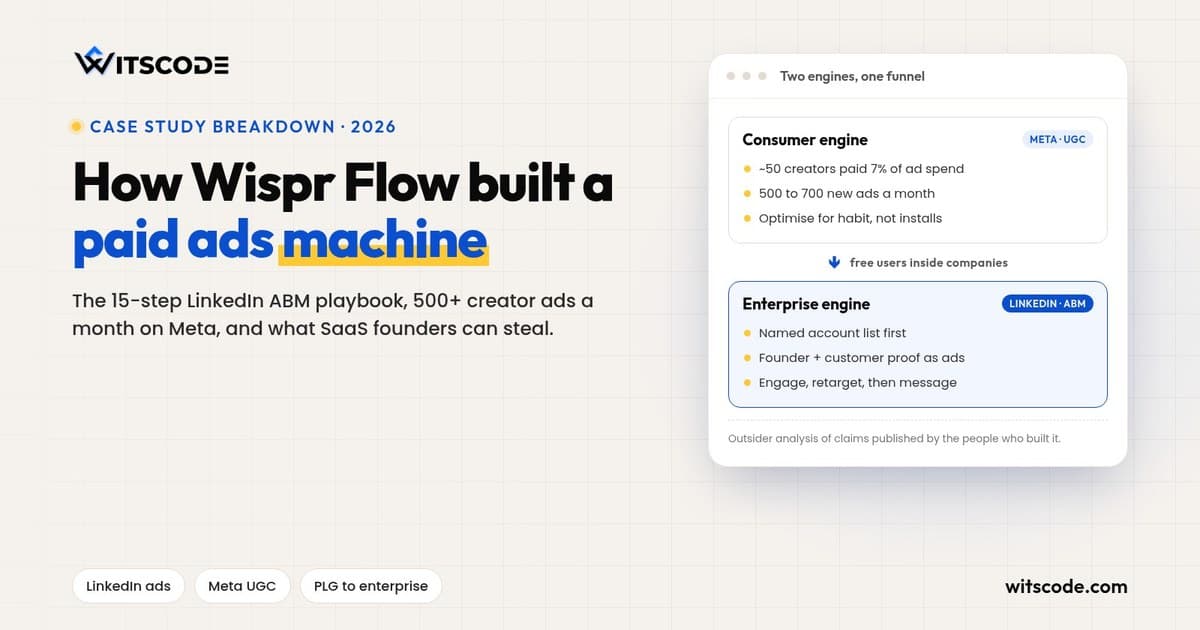
TL;DR: what is Wispr Flow's paid ads strategy?
Based on what the people who say they built it have published, Wispr Flow runs two connected paid engines:
- A consumer engine on Meta (plus TikTok and AppLovin). Around 50 performance-paid creators produce 500 to 700 new UGC ads a month. Creators earn 7% of the ad spend behind their videos. Every ad has to look different, and the account optimizes for users who build a dictation habit, not just installs.
- An enterprise engine on LinkedIn. Target-account lists, founder and customer content promoted as ads, cheap engagement bidding to build retargeting pools, warm message ads, and measurement by account movement and influenced deals rather than cost per lead.
The consumer engine fills the free plan. The LinkedIn engine turns companies that already have users into team and enterprise deals. None of the results are independently verified, and the hard parts (a product people love, creator management, attribution) are harder to copy than the tactics.
In October 2026, two people posted breakdowns of Wispr Flow's paid acquisition on X within days of each other. Hector Serrano, who describes himself as "marketing hire #2" at Wispr Flow, posted a 14-minute video titled "i built @WisprFlow's paid ads program, here's how i'd rebuild it in 30 days". It passed 2 million views. Two days later Waqas Khokhar, founder of the agency ScalixAI and nine years at Google, quoted it with a 15-step LinkedIn ads playbook, saying he had built Wispr Flow's LinkedIn playbook for its enterprise push.
We don't work with Wispr Flow and didn't build any of this. This is an outsider's read: what they say they did, how the pieces fit, and where the claims are thinner than they sound. We read the X threads in full, transcribed both Wispr marketing videos, and cross-checked funding coverage, Wispr's pricing page and the agency's case study. Where a number comes from someone describing their own work, we say so.
Who built Wispr Flow's ads, and what do they claim?
Three people have publicly described parts of the program. Their roles and claims, in their own framing:
| Person | Role (self-described) | Channel | Main claim | Source |
|---|---|---|---|---|
| Hector Serrano | "Marketing hire #2" at Wispr Flow (X bio) | Meta, TikTok, AppLovin (paid UGC) | 500 to 700 new UGC ads a month from about 50 performance-paid creators | X video, Oct 8 |
| Eric Zaworski | Marketing at Wispr Flow (X bio) | Meta media buying | Grew the Meta account from "about 100 ish ads" to "over 3,500 since January" | X video, Oct 12 |
| Waqas Khokhar | Founder/CEO, ScalixAI (agency) | LinkedIn Ads | Built "the LinkedIn ads playbook for @WisprFlow to push enterprise sales as a motion that cooked millions in revenue" | X post, Oct 10 |
ScalixAI's own case study is more specific than the X post: $850K+ in "LinkedIn-influenced closed revenue", "two dozen+ closed-won deals" and a 5.96% average CTR in one quarter, measured with an any-touch influenced model. Keep that gap in mind. "Millions in revenue" on X and "$850K+ influenced in 90 days" on the case study page aren't the same claim.
Why does Wispr Flow need two ad engines?
Because it sells the same product two ways. Wispr Flow is an AI voice dictation app with a free plan on Mac, Windows, iPhone and Android. Pro is listed at $15 per user per month, or $12 billed annually, and it already supports teams with no seat minimum. Enterprise (SSO, SCIM, HIPAA with a signed BAA, audit logs) goes through sales.
The company has grown fast on both sides:
- Funding. It raised a $280M Series B at a $2B valuation in August 2026, led by Menlo Ventures, bringing total funding to $361M.
- Revenue. Menlo's Matt Kraning wrote that Wispr "has grown revenue over 30x year over year" and is used "by tens of thousands of paying businesses".
- Enterprise. NEW ECONOMIES' notes on a July 2026 interview with co-founder Tanay Kothari say enterprise was built "from zero in under a year", with B2B at about a third of revenue and more than half the Fortune 500 as customers.
Menlo's post also explains the business logic behind the ads: enterprises were "pulling it from personal dictation into whole-team and whole company deployments without any scaled sales motion", and "every organic user is the future pipeline". That sentence is the strategy. Cheap, high-volume consumer ads create individual users inside companies. A precise, expensive B2B channel then works on the companies where those users already sit.
It also explains the pressure. TechCrunch names Willow, Monologue, Aqua and Superwhisper as competitors, and free dictation ships with every phone and laptop.
How does Wispr Flow's Meta and UGC program work?
Hector's video is less a 30-day calendar than a six-step walkthrough of how Wispr runs paid UGC through Trybe, a performance-based creator platform. (He says the video isn't sponsored.) Eric's follow-up covers the media buying side. Here is the combined picture.
Creators are paid on ad spend, not per video
Traditional UGC pays a fixed fee per video. Wispr pays creators a share of what their ads spend. Hector says ecommerce brands usually pay a percentage of GMV, but SaaS has a longer conversion cycle, so Wispr pays 7% of ad spend, and on LinkedIn he added that payouts go out every seven days.
New creators get a "smart retainer": hit a quota (his example is 25 videos) and you're guaranteed a minimum ($1,000 in the example). Earn $500 in commissions and Wispr tops you up by $500. Earn $3,000 and the retainer never kicks in. It's a way to sign good creators before the program has a track record, and it means spend only flows to ads that perform.
Few creators, many ads
The counterintuitive bit is the size of the roster. Hector says most brands sign hundreds of creators who behave like "mercenaries" and produce thousands of near-identical talking-head videos. By his account, Wispr started with four or five handpicked creators, each chosen to fill a gap in the ad library: a new format, a new customer type, or a new region. It then scaled 5 to 10 to 20 to 40 and capped at around 50 active creators, over about four months.
Recruiting was manual: Instagram keyword searches ("creators, tech, SaaS"), mining good creators' followers and comments, and 100 to 200 DMs over a few days, plus a $100 referral bonus later. Hector says Trybe sent about 7,000 applications and Wispr accepted roughly five to seven.
He says creators are run "like a sales team": coaches, a weekly Thursday call with the media buyer about what the ad account shows, gear giveaways, and a first creator retreat in San Francisco.
Different ads, not more ads
The rule the whole program hangs on: no two ads can look alike. Hector's explanation is that Meta's ad retrieval system, Andromeda, groups creative that is "50 to 60%" similar and suppresses its reach, so copies of a winning ad get filed under the original and never break out. When creators start cloning whatever tops the leaderboard, he pushes them back to new concepts: "new keys" that open "new doors".
Meta has published how Andromeda works as a retrieval engine, but not any similarity threshold. Treat the percentage as a practitioner's rule of thumb. The direction (diverse creative reaches more distinct people) is sound either way.
Meta optimizes for habit, not installs
Eric's video adds the measurement layer, and it's the most transferable part. For a PLG app, a download is too shallow and a purchase is too slow. Wispr instead rallies around "how many words dictated after a certain point", meaning whether someone builds a habit. That's how they judge whether an ad brought in good users.
His other rules:
- Mine objections first. Pull real questions from reviews, Reddit, support tickets and ad comments. The big one: why pay when dictation is free in Siri and on your Mac?
- Brief, don't script. One person, their situation, the promise, one piece of proof. Hire creators who already like the product and look like the customer: real estate agents, lawyers, developers, founders, students. He says some of the best creators have about a thousand followers.
- Concept, angle, awareness. Every ad is one product truth, told one way, to one awareness level. Mapping those combinations gave them about 150 ads to test.
- Test the funnel on your phone. Swipe up inside Instagram's in-app browser, check events fire into PostHog, and check the page matches the creator's promise.
- Wait five days. He says you "probably won't learn anything for five days".
- Keep a company brain. Since April, lessons from paid, landing pages, newsletters and creator deals go into an internal GitHub repo that feeds the next briefs.
What are the 15 steps in Waqas Khokhar's LinkedIn ads playbook?
Waqas's thread is framed as how he'd run LinkedIn now for any B2B SaaS company, informed by the Wispr work. His premise: "Most people think LinkedIn doesn't work because they treat it like Google Search." Here are all 15 steps with our read on each.
| # | Step (his heading) | What it means | Our read |
|---|---|---|---|
| 1 | Start with the exact accounts you want to win | Define ICP by size, industry, funding stage, titles, seniority, named accounts, competitor users | Standard ABM, and correct. LinkedIn is the major network built for this targeting. |
| 2 | Build your account list first | Top 300, top 1,000, dream accounts, open opps, closed-lost, high-intent visitors, before creative or budget | The strongest step. LinkedIn company lists need at least 300 rows, so his "top 300" is also the practical minimum. |
| 3 | Stop only running ads from the company page | Founder-, creator- and customer-led ads "usually hit harder" | Right, and it's now a product feature: Thought Leader Ads promote a member's post with their permission. |
| 4 | Turn founder POV into ads | Founder explaining the problem "doesn't feel like an ad" | Only works if the founder posts something worth promoting. |
| 5 | Use customer proof as creative | Testimonials, screenshots, comments, use cases as ads; "probably the biggest unlock" | Agreed. Wispr has unusual amounts of organic praise to draw on, which most products don't. |
| 6 | Make the ads feel native | Strong hook, simple format, clear pain, one idea per ad | Same principle as the Meta side. Corporate polish loses on both. |
| 7 | Build around pain, not features | "You think faster than you type" beats "AI voice dictation tool" | Good copy advice. The pains he lists are individual pains, which suits a bottom-up product. |
| 8 | Create multiple angles, not just multiple ads | Founder POV, before/after, problem rant, objection handling, category education | Mirrors Eric's concept-angle-awareness grid. |
| 9 | Bid for engagement first | Engagement campaigns reach the right people "without paying insane CPCs" and build retargeting pools | Smart, but under-specified. Engagement bidding buys likes from anyone in the audience; it only works if the audience is already tight. |
| 10 | Retarget everyone who shows intent | Sequence by behavior: saw founder ad, show proof; visited site, show use case; engaged repeatedly, push demo | This is where LinkedIn earns its price. Video, website, form and page audiences all need 300+ members to run. |
| 11 | Use message ads carefully | Only to warm audiences, with contextual copy, never "Hey {{first_name}}, want to book 30 minutes?" | Correct. Cold message ads are the fastest way to burn a list. |
| 12 | Match the CTA to awareness level | Cold: watch, read, see the workflow. Warm: book a demo, try it, talk to sales | Right. For Wispr, "try it" is cheap because there's a free plan. |
| 13 | Make LinkedIn support sales | Sales should see which accounts and personas engage and which objections show up | The step most teams skip. It needs CRM plumbing, not just a shared Slack channel. |
| 14 | Measure account movement, not just leads | Account engagement, target-account visits, demo lift, pipeline influence, closed-won with ad exposure | Right direction, but "influence" metrics flatter the channel. See the weak spots below. |
| 15 | Scale after the message works | Raise budget when the right accounts engage, sales hears the language back and pipeline moves | Sensible. In practice, "the message works" needs a written threshold or it becomes a feeling. |
His summary of the Wispr version: "Get the right people to repeatedly see the strongest possible proof that this product changes how fast they work." The list he closes on is the real playbook in eight words: founder POV, customer proof, native creative, ABM targeting, engagement, retargeting, message ads, sales follow-up.
Two replies in the thread matter. Asked how "founder-led" ads work when you can't advertise from a personal account, Waqas said you take the founder's content "and put that against your ICP", which is what Thought Leader Ads do. And when someone asked how he tested incremental pipeline against accounts that didn't see ads, he said they used Fibbler for attribution, looked at deals where the account was created after ad exposure, looked for "strong signals of paid ad influence" on existing accounts, and met weekly with sales, including hearing customers say they'd seen the ads. That's a reasonable attribution process. It isn't an incrementality test.
What does the funnel look like end to end?
Put the two engines side by side and the funnel is clearer than either thread makes it:
| Stage | Consumer engine (Meta/TikTok/AppLovin) | Enterprise engine (LinkedIn) |
|---|---|---|
| Who | Anyone who types a lot at work: lawyers, agents, developers, founders, students | Founders, engineers, VPs of Engineering and C-suite at target accounts (per ScalixAI) |
| Creative | Creator UGC, each ad a distinct concept, angle and awareness level | Founder posts, customer proof, creator content promoted as ads, static images |
| First conversion | Free download and signup | Engagement, video view, site visit |
| Quality signal | Words dictated after a set point (habit) | Target-account engagement and site visits |
| Mid-funnel | Product does the work; Pro at $12-15 a month | Retargeting sequences, warm message ads |
| Close | Self-serve upgrade | Sales conversation, team or enterprise contract |
| Measured by | Habit-forming users from each ad, in Meta and PostHog | Influenced pipeline and closed-won deals, via Fibbler |
The free plan is the hinge. The consumer engine fills companies with individual users. Those users become the "customer proof" and internal champions that the LinkedIn engine leans on when it targets the same companies. Neither engine would work as well alone.
What creative and offer patterns keep showing up?
Across both threads and the case study, the same patterns repeat:
- Pain before product. "You think faster than you type." "Your best ideas die in Slack drafts." The feature comes second.
- Answer the free-alternative objection. Eric says many ads tackle "why pay when it's built into Siri?" head on, or just show the product making someone's day easier.
- People over logos. Creators on Meta, founders and customers on LinkedIn. ScalixAI says its bottom-of-funnel image ads, "including the creator-led formats", beat video on conversion efficiency.
- One idea per ad. Both Waqas and Eric say it in almost the same words.
- A low-friction offer. The default offer is "try it free", not "book a demo". Demo CTAs are for warm, repeat-engaged accounts.
- Speed as the proof point. ScalixAI's creative centered on "three-times-faster typing"; Wispr's own tagline says "4x faster". Even the proof points vary by source.
Why does this work for a prosumer-to-enterprise PLG product?
Four conditions make the approach fit Wispr unusually well:
- The pain is universal and personal. Anyone who types at work gets the pitch in three seconds, which is what makes broad UGC work on Meta.
- Trying it costs nothing. A free plan on every platform lets the consumer funnel end at "download" and the product do the selling.
- Usage spreads inside companies. By the time LinkedIn targets a company, there are often users inside it already, so "customer proof" is real rather than aspirational.
- Enterprise needs are additive. SSO, HIPAA, admin controls and invoicing are reasons to formalize something staff already use. The LinkedIn ads don't create demand from zero; they make leadership aware it's already there.
If your product lacks two or more of these, you'll get less from copying the tactics.
What could be weak or hard to copy?
Plenty. In rough order of importance:
- Attribution is influence, not causation. ScalixAI's own note says "Influence is not the same as the sole cause". Any-touch models credit LinkedIn for every closed deal where the company saw an ad. With a tight target list of companies that already have Wispr users, many of those deals might have closed anyway. No holdout test has been described.
- The claims don't fully line up. "Millions in revenue" (X) vs "$850K+ influenced" in a quarter (case study). "500 to 700 ads a month" vs "over 3,500 since January". These aren't contradictions, but none of it is audited, and every author has something to sell: an agency, a personal brand, a creator platform.
- Creator costs scale with spend. At 7% of spend, creative cost rises with every dollar you put behind a winner. Fine for a well-funded company in growth mode, awkward for a fixed annual budget.
- The volume needs the budget. 500 ads a month only teaches you something if each ad gets enough spend for a read. Eric says that takes about five days. A $10K-a-month account can't learn from 500 ads.
- The product is doing a lot of work. Organic enthusiasm makes customer-proof creative easy to source. Most B2B products have a handful of testimonials, not a feed of them.
- People are the moat. Hector says he spent two years filming and editing hundreds of ads from his dorm room, and calls creator culture the step "most companies skip because it is the most time consuming". You can copy a playbook. Hiring the people who run it is the hard part.
- We couldn't see the ads. The four LinkedIn Ad Library examples Waqas linked were blocked to us, and so was the Meta Ad Library. We're describing the system from the builders' own accounts, not from the ads themselves.
What can other SaaS founders take from Wispr Flow's playbook?
Most of the value is in the structure, not the scale. Here's what we'd lift for a typical SaaS product:
- Define your "good user" event before you spend. Wispr's is a habit threshold. Yours might be the third project created or the first teammate invited. Send that event back to the ad platforms, not just signups.
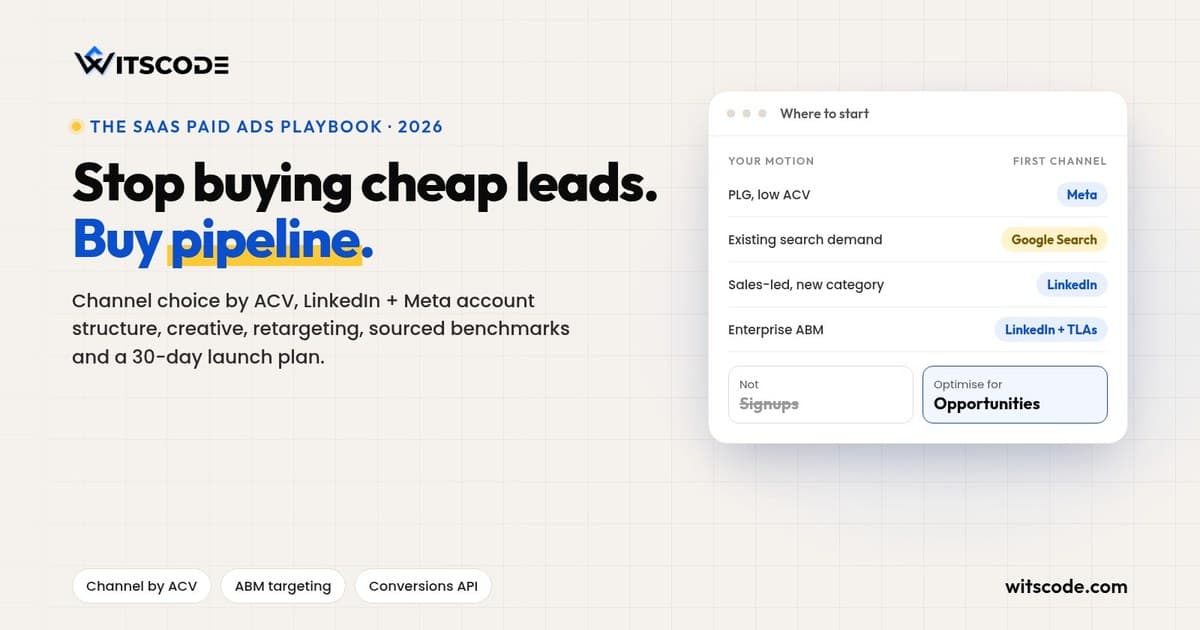
- Pick channels by motion. Waqas's own advice in a later reply was that PLG products like Wispr should "lean toward Meta first", while new-category products with a clear ICP should lean toward LinkedIn. Wispr does both because it has both motions.
- Brief creators on one person, one situation, one promise, one proof. Then let them say it their way.
- Make "different" the brief. A new hook, person, setting or angle is a new ad. A new face on the same script often isn't.
- Build the account list before the campaign. Include closed-lost and open opportunities. Clean up your CRM's loss reasons first.
- Promote people, not your logo. Use Thought Leader Ads for founder and customer posts on LinkedIn.
- Let cold audiences watch, warm ones talk. Soft CTAs first, demo and message ads only after repeat engagement.
- Wire ads to the CRM. If sales can't see which target accounts engage, LinkedIn becomes a cost line nobody can defend. Fast lead routing at form submit matters more once ads start pushing warm accounts to sales.
- Fix the landing page before the creative. Eric's phone test catches broken pixels and mismatched promises. A dedicated landing page per angle is often the cheapest win in the funnel.
For the channel-by-channel version (budgets, benchmarks, account structure and a 30-day launch plan), read our SaaS paid ads strategy guide.
If you'd rather have someone run it, we do LinkedIn ads for B2B SaaS and Meta ads management, and we build the product and tracking side for SaaS founders too.
Frequently asked questions
What is Wispr Flow's marketing strategy?
According to the people who say they built it, Wispr Flow pairs a high-volume consumer ad engine with a targeted enterprise one. On Meta, TikTok and AppLovin, about 50 performance-paid creators produce 500 to 700 new UGC ads a month that drive free signups. On LinkedIn, account-based campaigns use founder and customer content, engagement bidding, retargeting and warm message ads to turn companies with existing users into team and enterprise deals.
Who built Wispr Flow's paid ads?
Hector Serrano, who calls himself Wispr's "marketing hire #2", says he built the paid UGC program. Eric Zaworski, who works in marketing at Wispr, says he scaled the Meta account. Waqas Khokhar of the agency ScalixAI says he built the LinkedIn ads playbook for the enterprise push. These are their own public accounts and have not been independently verified.
How much does Wispr Flow pay UGC creators?
According to Hector Serrano, Wispr pays creators 7% of the ad spend behind their videos, paid out every seven days. New creators get a minimum guarantee if they hit a video quota. His example is $1,000 for 25 videos, topped up if commissions fall short.
Do LinkedIn ads work for B2B SaaS?
They can, when targeting is built on a named account list and success is measured by pipeline rather than cost per lead. Dreamdata's 2026 LinkedIn Ads benchmarks, built on its own customers' data, put LinkedIn's ROAS ahead of Google Search and Meta, even though LinkedIn clicks cost more than Meta's. Results depend heavily on ACV, list quality and sales follow-up.
What are LinkedIn Thought Leader Ads?
Thought Leader Ads let a company promote a public post from a LinkedIn member, such as a founder, employee or customer, with that person's permission. They run under brand awareness, engagement or video view objectives. This is how "founder-led ads" work on LinkedIn, since ads can't be run from a personal account.
Can a small SaaS company copy Wispr Flow's ad playbook?
The structure transfers: a defined good-user event, distinct creative angles, an account list, behavioral retargeting and CRM-linked measurement. The scale doesn't. 500 ads a month needs a budget big enough to give each ad a fair read.
Sources
- Waqas Khokhar, LinkedIn ads playbook thread and continuation, X, Oct 10, 2026
- Waqas Khokhar, reply on attribution and reply on channel choice, X, Oct 2026
- Hector Serrano, "i built @WisprFlow's paid ads program" (video; our transcript), X, Oct 8, 2026
- Hector Serrano, paid UGC video, X, Oct 6, 2026
- Eric Zaworski, "i scaled @WisprFlow's paid ads on meta" (video; our transcript), X, Oct 12, 2026
- ScalixAI, Wispr Flow LinkedIn Ads case study
- TechCrunch, Wispr raises $280M at $2B valuation, Aug 17, 2026
- Menlo Ventures, The Keyboard Is Dying on Schedule, Aug 17, 2026
- NEW ECONOMIES, Tanay Kothari interview notes, Jul 30, 2026
- Wispr Flow, Pricing
- Meta Engineering, Meta Andromeda, Dec 2, 2024
- LinkedIn Help: Thought Leader Ads, company list targeting, retargeting with Matched Audiences
- Dreamdata, LinkedIn Ads 2026 Benchmarks Report
Facts checked on October 20, 2026.
Invisible in ChatGPT and AI Overviews?
Send us your domain. You get a citation gap report and a straight answer on what to fix first, schema, llms.txt, or the content itself.
- AI citation and visibility audit
- Schema, llms.txt, and crawler access fixes
- Scoped estimate within 48 hours
More in SaaS Marketing
Working on something in Guides & Insights?
Tell us what you are working on. You get a scoped estimate within 48 hours.
Keep reading
More from Guides & Insights.
- Guides & Insights
October 19, 2026
SaaS Paid Ads Strategy: LinkedIn + Meta Playbook (2026)
A SaaS paid ads strategy for B2B pipeline: pick channels by ACV, structure LinkedIn and Meta, target accounts, test creative, and measure pipeline, not CPL.
- Guides & Insights
November 25, 2025
API Documentation for AI Agents: Making Your API Discoverable
A developer opens ChatGPT and types: "How do I add Stripe payments to my Next.js app?" Within seconds, the AI responds with a step-by-step answer that references Stripe's API, includes endpoint URLs,...
- WordPress
October 19, 2026
Rank Math PRO Backdoor: How to Check and Clean Your Site
The Rank Math PRO backdoor hit copies of 3.0.123 downloaded Oct 15 to 16, 2026. Check if your site is affected, spot the signs, and clean it in the right order.