

SaaS Paid Ads Strategy: LinkedIn + Meta Playbook (2026)


TL;DR: what is a good SaaS paid ads strategy?
A good SaaS paid ads strategy matches channels to how you sell, then measures pipeline instead of cheap leads.
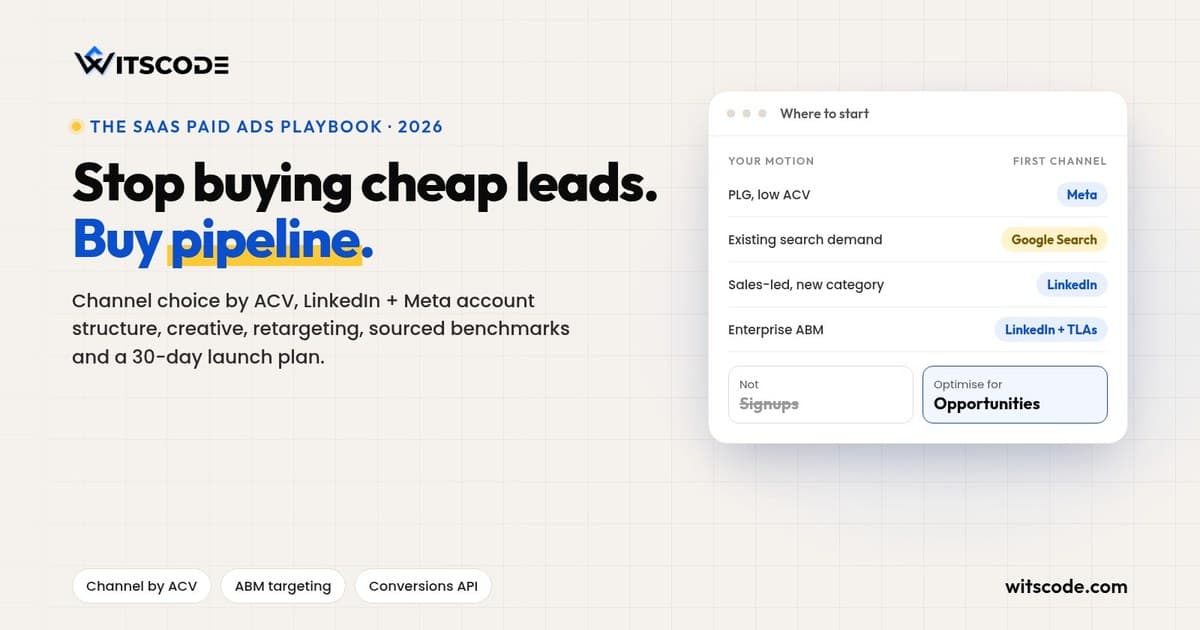
- Pick channels by ACV and motion. Low-ACV, self-serve (PLG) products usually start on Meta. Sales-led products with a defined account list usually start on LinkedIn. If people already search for your category, Google Search comes first.
- Build the audience before the ads. On LinkedIn, that's a named account list (at least 300 companies, ideally 1,000+). On Meta, it's broad targeting plus a conversion event that signals a good customer.
- Lead with people and pain. Founder posts, customer proof and creator videos beat logo ads. One idea per ad, many different angles.
- Match the offer to awareness. Soft CTAs for cold audiences; demos and trials for warm, retargeted ones.
- Measure what sales sees. Send qualified-lead and opportunity events back through LinkedIn's and Meta's Conversions APIs, ask "How did you hear about us?", and judge channels on pipeline per dollar.
Most SaaS ad accounts fail the same way. The team launches a demo-request campaign to a broad job-title audience, gets expensive leads that sales won't call, and decides "paid doesn't work for us". The channel wasn't the problem. The sequence was.
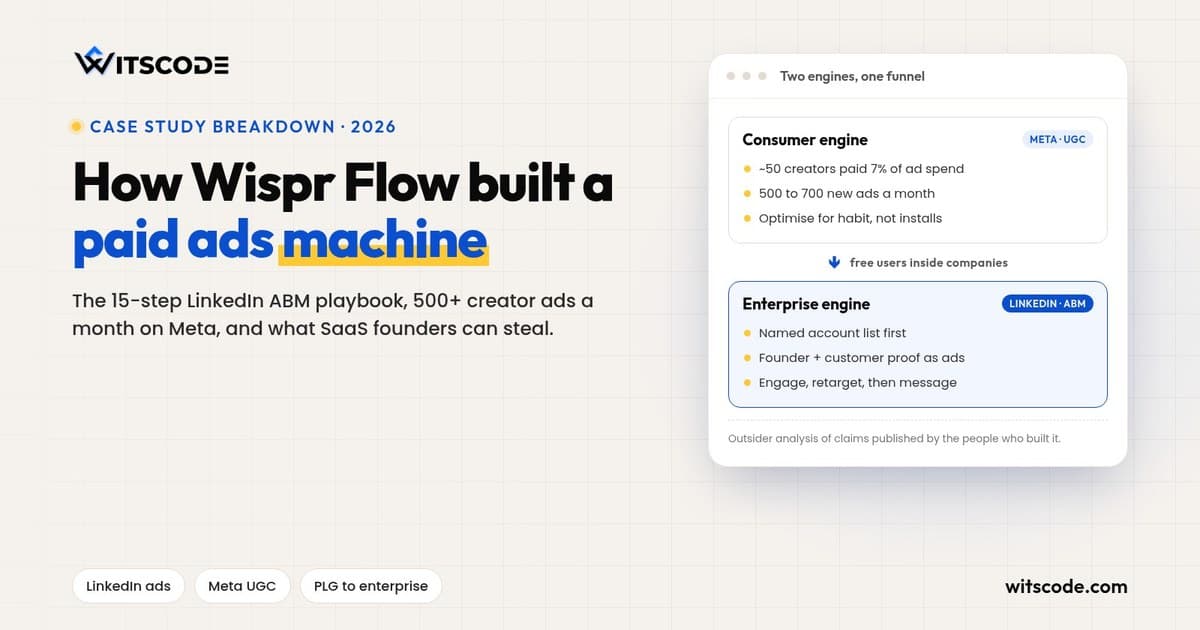
This guide is the playbook we'd use to launch paid acquisition for a B2B SaaS product in 2026, across LinkedIn and Meta, with Google Search where demand already exists. We use published benchmarks where they exist and say plainly where they don't. For a worked example of one company running both channels, see our breakdown of Wispr Flow's paid ads machine.
Which paid channel should a SaaS company start with?
Start with how your customer buys, not with which channel is fashionable. Two variables do most of the work: annual contract value (ACV) and whether the first conversion is self-serve or a sales conversation.
| Your motion | Typical first conversion | Start with | Add next | Why |
|---|---|---|---|---|
| PLG, low ACV, broad audience (prosumer tools) | Free signup or trial | Meta (plus TikTok if your buyers are there) | Google Search for category terms | Cheap reach and creative-led targeting; the product does the selling |
| PLG with a team or enterprise tier | Free signup, later a sales-assisted upgrade | Meta for users | LinkedIn ABM on companies with active users | Users inside an account become proof and champions for the sales motion |
| Sales-led, mid-market, existing search demand | Demo or trial request | Google Search | LinkedIn retargeting and ABM | Capture people already looking, then work the accounts |
| Sales-led, new category, clear ICP | Content engagement, then demo | Meta retargeting, review sites | Nobody searches for a category that doesn't exist yet; LinkedIn reaches the exact titles | |
| Enterprise, few hundred target accounts | Meeting with a buying group | LinkedIn ABM with Thought Leader Ads | Outbound, events | The account list is the strategy; ads warm accounts for sales |
This matches the rule of thumb that Waqas Khokhar, founder of the ad agency ScalixAI, gave in a reply on X: "If you're PLG, like Wispr Flow, I'd typically lean toward Meta first. ... If there's existing search intent for your product or category, Google Ads is the obvious starting point. But if you're building in a completely new category, where search demand is limited and you have a clearly defined ICP, I'd lean toward LinkedIn Ads."
Two filters before you commit budget:
- Can you afford the learning period? A channel needs enough spend to produce a read. If you can only fund one channel properly, fund one.
- Can sales follow up? LinkedIn without sales follow-up is an expensive awareness campaign. If you have no sales capacity, stay self-serve and lean on Meta and search.
If you're still pre-product-market fit, paid ads will mostly tell you your onboarding is broken. Fix the MVP and activation first.
What do LinkedIn, Meta and Google ads cost for B2B SaaS?
LinkedIn doesn't publish average costs. The useful public numbers come from attribution vendors measuring their own customers. Two of the most detailed 2026 reports disagree on some numbers, which is normal for different samples. Quote the source with the figure.
| Metric (2025 data) | Meta | Google Search | Source | |
|---|---|---|---|---|
| Cost per click | €5.98 | €1.60 | Not given in highlights | Dreamdata 2026 |
| Cost per click (spend-weighted) | $9.39 | - | - | Metadata 2026, via Digital Applied |
| Cost per lead (spend-weighted) | $202 (median advertiser: $376) | Facebook $145, Instagram $138 | $524 (Google Ads) | Metadata 2026 |
| Clicks that became leads | 5.9% | Facebook 2.6%, Instagram 4.0% | 1.9% (Google Ads) | Metadata 2026 |
| Cost per company influenced | €70.11 | €128.70 | €110.37 | Dreamdata 2026 |
| ROAS | 121% | 51% | 67% | Dreamdata 2026 |
What to take from this:
- LinkedIn clicks are expensive and LinkedIn leads aren't. A higher share of LinkedIn clicks turn into leads, so cost per lead lands closer to Meta than the click price suggests.
- "Average" hides the spread. Metadata's $202 is spend-weighted. Three in four LinkedIn advertisers paid more, and the middle advertiser paid $376.
- Company-level metrics flip the ranking. In Dreamdata's data, LinkedIn is the cheapest way to reach a company and the only network with ROAS above 100%. Dreamdata also reports LinkedIn now takes 41% of B2B ad budgets.
- Non-branded search is getting worse. Dreamdata reports non-branded search CPCs up 29% and CTR down 26%, and blames the CTR drop on AI Overviews answering queries on the results page.
Use these numbers to sanity-check your own results after 60 to 90 days, not to set targets on day one.
How should you structure a SaaS ad account?
Structure by funnel stage and audience, not by ad format. Each campaign should have one job and one success metric.
LinkedIn account structure
| Campaign | Audience | Objective | Creative | Success metric |
|---|---|---|---|---|
| 1. Account warm-up | Named account list x buying-group functions and seniority | Engagement or video views | Thought Leader Ads from founder and customers, short video | Engagement rate and reach inside target accounts |
| 2. Problem education | Same list | Engagement or website visits | Pain-led single images, document ads, workflow demos | Target-account site visits |
| 3. Proof retargeting | Engagers, 50%+ video viewers, site visitors (90 days) | Website visits or lead gen | Customer stories, comparisons, ROI | Qualified leads and demo requests |
| 4. Warm conversion | Repeat engagers, pricing-page visitors | Lead gen or message ads | Demo, trial, "talk to sales", contextual message ads | Opportunities created |
| 5. Open pipeline support | Accounts with open opportunities (CRM sync) | Brand awareness or engagement | Security, implementation, case studies | Win rate and cycle length vs non-exposed accounts |
Keep exclusions tight: current customers (unless you're selling an upgrade), competitors, your own employees, and job-seekers if you can filter them.
Meta account structure
Meta works differently. Its delivery system does most of the targeting, so the creative and the conversion event matter more than audience settings. Meta's own engineering team describes its ad retrieval system, Andromeda, as narrowing tens of millions of candidate ads to a few thousand relevant ones for each ad request. Practitioners read that as "give it many different ads".
A simple B2B SaaS setup:
- One prospecting campaign with broad targeting in your countries, optimized for a quality event (activation, not raw signup), holding your active creative.
- One creative testing campaign where new concepts get a fair budget before graduating.
- One retargeting campaign for site visitors and video viewers who didn't sign up.
Don't split audiences by interest or job title on Meta. You'll fragment the data and pay more for less.
How do you target the right buyers on LinkedIn?
Build the list before you build the campaign. Targeting is where LinkedIn earns its higher price, and it's where most accounts waste it.
1. Start with a named account list. LinkedIn's company list targeting needs at least 300 companies, takes up to 300,000, and LinkedIn recommends 1,000 or more. Include company page URLs and domains to improve matching. Build it from:
- Your ICP filter (industry, headcount, funding stage, geography, tech stack)
- Open opportunities and closed-lost accounts from the CRM
- Companies that already have free or trial users (for PLG)
- High-intent website visitors identified by your reverse-IP tool
- Competitor customers, where you can identify them
2. Layer functions and seniority, not just job titles. Exact job titles miss people with odd titles. Combine job function (for example Engineering or Marketing) with seniority (Manager and above) for the buying group, and use titles only to add specific roles.
3. Use matched audiences for the middle of the funnel. LinkedIn lets you retarget website visitors, video viewers, Lead Gen Form openers and Company Page visitors. Each audience needs at least 300 matched members to run, so small lists won't serve until they grow.
4. Size check. Your total audience should be large enough to deliver but small enough that every impression is a plausible buyer. If your "ABM" audience is several million people, it isn't ABM.
Some cleaning matters more than people think. Closed-lost accounts only make a useful audience if your CRM's loss reasons are filled in properly. Fix the picklist first.
How should B2B SaaS target on Meta?
Mostly, let the creative do the targeting. Three things matter more than audience settings:
- The conversion event. Optimizing for signups teaches Meta to find people who sign up, including people who never use the product. Define the event that predicts a good customer and send it back. Eric Zaworski, who says he heads performance marketing at Wispr Flow, says in his video breakdown that the company rallies around "how many words dictated after a certain point", a habit signal, rather than downloads.
- Server-side signal. Use Meta's Conversions API to send activation and paid events from your backend. Browser pixels miss events, and B2B funnels often convert days later on another device.
- Seed audiences. Upload customer and high-value user lists as custom audiences for exclusions and as seeds for lookalikes, then let broad prospecting run alongside.
Meta works for B2B when the buyer is also the user, the product is understandable in a 15-second video and the first step is self-serve. It works badly for products that need a buying committee before anyone can try them.
What creative works for SaaS ads?
People, pain and proof, one idea at a time. Three frameworks cover most of what works.
Pain, mechanism, proof
Lead with the pain the buyer already feels, explain how the product removes it, then prove it. Waqas Khokhar's example from Wispr Flow: don't lead with "AI voice dictation tool"; lead with "You think faster than you type" or "Your best ideas die in Slack drafts". The feature explains the mechanism afterwards.
Concept, angle, awareness
Every ad gets three labels:
- Concept: one product truth (usually just one per ad)
- Angle: how you come at it (save time, reduce risk, look good to your boss, replace a tool)
- Awareness level: problem-unaware, problem-aware, solution-aware, product-aware
Plot those as a grid and you have a testing plan where every ad is genuinely different. Eric Zaworski says that matrix gives any brand about 150 ads to work through. A small team might start with 3 concepts x 3 angles x 2 awareness levels: 18 ads.
People over logos
- Founder and employee posts as ads. LinkedIn's Thought Leader Ads let you promote a member's public post with their permission. LinkedIn's own case study on Dreamdata reports 3-4x higher engagement for employee-led than brand-led ads.
- Customer proof. Real quotes, screenshots, short video testimonials, named logos where you have permission.
- Creator and UGC video on Meta. Brief the creator on one person, one situation, one promise and one proof, and don't script every line.
Formats that tend to earn their place in a B2B account:
| Format | Best stage | Channel | Notes |
|---|---|---|---|
| Founder or expert text/image post | Cold | LinkedIn (Thought Leader Ad) | No CTA button; links go in the post copy |
| 15-45 second product-in-use video | Cold to warm | Meta, LinkedIn | Show the workflow, not the UI tour |
| Customer quote image | Warm | Both | Name, role, company, one specific outcome |
| Document or carousel (guide, checklist) | Warm | Doubles as a lead magnet | |
| Comparison or "why switch" | Product-aware | Both, retargeting | Answer the objection directly |
| Conversation or message ad | Hot | Only to people who've engaged |
How many ads? Enough that each gets a fair read. On a modest budget, run fewer, more different ads rather than dozens of near-copies.
What offers should SaaS ads lead with?
The offer is the reason to act now, and it has to match how warm the audience is. Asking a cold audience to book a demo is the single most common SaaS ad mistake.
| Awareness | Good offers | CTA examples |
|---|---|---|
| Cold, problem-unaware | Short insight, contrarian take, benchmark, "how X teams do Y" | Watch this, read the breakdown |
| Problem-aware | Guide, checklist, calculator, template, workflow demo | See how it works, get the template |
| Solution-aware | Comparison, case study, ROI story, free tool | See the comparison, read the story |
| Product-aware, warm | Free trial, sandbox, live demo, pilot | Try it free, book a demo |
| Hot, repeat engagement | Personal note from founder or AE, pricing review, security pack | Talk to sales, get pricing |
A free plan or no-card trial is the strongest offer if your product can deliver value without a call. If it can't, a short recorded demo is a better middle step than a live meeting. Calculators and interactive tools make good mid-funnel offers too, because they qualify the lead while they help.
How should SaaS retargeting work?
Retargeting is where the money is made. Build sequences based on what people did, not one generic "come back" ad.
| If they... | Show them next | Window |
|---|---|---|
| Watched 50%+ of a founder or problem video | Customer proof or a workflow demo | 30-90 days |
| Visited a blog post or guide | The product use case that solves that problem | 30-90 days |
| Visited pricing or comparison pages | Objection handling, security, implementation, trial CTA | 7-30 days |
| Engaged with two or more ads, or opened a lead form | Demo, trial or a contextual message ad | 7-30 days |
| Started signup but didn't activate (PLG) | "Here's the one thing to do first" onboarding video | 7-14 days |
| Has an open opportunity | Case studies from similar companies, security, ROI | Duration of deal |
On message ads, Waqas Khokhar's copy rule is worth adopting: "Saw you checked this out. Thought this might be useful." Not: "Hey {{first_name}}, want to book 30 minutes?"
How much budget does a SaaS ad program need?
There's no honest universal number. Work it out from what you need to learn.
A simple method:
- Pick your test unit. For example, 50 clicks per ad before you judge it.
- Multiply by a cost you can source. At Metadata's spend-weighted LinkedIn CPC of $9.39, 50 clicks is about $470 per ad. At Dreamdata's €5.98, it's about €300.
- Multiply by the number of ads you want to test per cycle. Six ads at $470 is about $2,800 for one LinkedIn test round.
- Add retargeting and always-on campaigns. Retargeting audiences are small, so they cost less, but they need to run continuously.
LinkedIn also has hard minimums: a $10 daily budget per campaign and audiences of at least 300 members.
For allocation, Jasper's 2025 LinkedIn program is a useful published reference. LinkedIn's case study says Jasper put 40% into brand awareness, 30% into consideration and 30% into lead generation, after shifting most of its LinkedIn spend away from lead-gen campaigns. It reports a 226% increase in qualified leads and a 40% lower cost per lead. That's a vendor-published case study, but the split is a sensible starting point for a sales-led account.
If you can't fund a proper test on LinkedIn, don't spread a small budget across three channels. Run one channel well and add the next when it pays.
How do you measure SaaS paid ads by pipeline, not CPL?
Cost per lead is the easiest metric to report and the easiest to game. Measure what sales and finance care about instead.
1. Send CRM stages back to the ad platforms
Both major platforms accept offline events:
- LinkedIn: the Conversions API accepts online and offline conversions from your server or CRM, so qualified leads, opportunities and closed deals can flow back as events.
- Meta: the Conversions API takes server-side events, including activation and purchase.
- Google: offline conversion imports and enhanced conversions for leads do the same for search. Google is moving these uploads to its Data Manager API, so build new integrations there.
Then optimize toward the deeper event once you have enough volume. Dreamdata's own LinkedIn case study describes using the Conversions API to see which priority accounts were exposed to its ads.
2. Ask people how they heard about you
Add a required free-text "How did you hear about us?" field to your demo and signup forms. Self-reported attribution catches what tracking can't: the podcast, the founder's post someone saw three times, the colleague who recommended you. Compare it with platform data every month. When the two disagree, investigate.
3. Measure at account level
Track target-account reach, engagement, website visits, opportunities created and win rate for exposed vs non-exposed accounts. Dreamdata reports that 81% of the B2B customer journey now happens outside the sales pipeline, so lead-level reporting misses most of it.
4. Be honest about influence
"Influenced pipeline" credits ads for any deal where the account saw an ad. That flatters the channel, especially with a tight list of accounts you'd likely have won anyway. When an agency told the story of Wispr Flow's LinkedIn program, its own attribution note said "Influence is not the same as the sole cause". The fix is a holdout: split your target list randomly, advertise to half, and compare opportunity creation after a quarter.
5. Report a small set of numbers weekly
| Metric | Why it matters |
|---|---|
| Spend by channel and campaign | Basic control |
| Qualified leads or activated users per channel | The first number sales and product trust |
| Opportunities and pipeline value created | What the business actually gets |
| Cost per opportunity | Better than CPL for sales-led |
| Target-account engagement rate | Leading indicator for ABM |
| Self-reported source mix | Sanity check on platform attribution |
If you need help wiring forms to scoring and the CRM, start with our guide to lead scoring and our marketing automation work.
What does a 30-day SaaS paid ads launch plan look like?
This plan assumes one primary channel and a small team. Stretch it if your sales cycle is long.
Week 1: Foundations
- Write down the ICP, the buying group and the one conversion event that predicts a good customer.
- Build the target account list (300+ companies, ideally 1,000+) and upload it to LinkedIn.
- Install the LinkedIn Insight Tag and Meta pixel, and set up both Conversions APIs from your backend or CRM.
- Add a "How did you hear about us?" field to every form.
- Test the full funnel on a phone: ad click, landing page load, form, thank-you page, events firing.
Week 2: Creative and offers
- Pull 20 objections and phrases from sales calls, support tickets, reviews and Reddit.
- Draft a concept x angle x awareness grid and pick 8 to 12 distinct ads.
- Get two to four founder or employee posts live organically, then request them as Thought Leader Ads.
- Build one landing page per offer, with the same promise as the ad.
- Prepare a soft offer for cold audiences and a trial or demo offer for warm ones.
Week 3: Launch
- Launch the account warm-up and problem education campaigns on LinkedIn, or prospecting and testing campaigns on Meta.
- Launch retargeting as soon as audiences reach 300 members.
- Share target-account engagement with sales weekly.
- Don't change anything for five days unless something is broken.
Week 4: Read and adjust
- Kill ads with no engagement from target accounts; keep the angles that are earning it.
- Diagnose the funnel: attention without clicks means weak offer; clicks without conversions means a weak page; conversions without quality means the wrong event or audience.
- Brief the next round of creative with what you learned.
- Compare platform attribution, self-reported sources and CRM pipeline.
- Decide what to scale. Raise budget in steps on what's working; don't jump tenfold.
What are the most common SaaS paid ads mistakes?
- Asking cold audiences for a demo. Match the CTA to awareness.
- Optimizing for the wrong event. Signups and form fills are easy to generate and often worthless. Optimize toward activation or opportunity.
- Broad job-title audiences called "ABM". Start from a named account list.
- Ten versions of the same ad. Change the concept or angle, not just the button color.
- Logo-only creative. People trust people. Use Thought Leader Ads and customer proof.
- No offline conversions. Without CRM data flowing back, the platforms optimize for whoever fills forms.
- Judging on CPL. A $145 lead that never becomes pipeline costs more than a $376 one that does.
- Spreading a small budget across every channel. Fund one channel properly first.
- Ads that don't match the landing page. The page should repeat the ad's promise in its headline. Conversion rate optimization on the page often beats new creative.
- Sales out of the loop. If reps don't know which accounts are engaging, retargeting and outreach never meet.
How are real SaaS companies applying this?
Three published examples, each with its own source caveats:
| Company | What they did | Reported result | Source and caveat |
|---|---|---|---|
| Wispr Flow (AI dictation, PLG + enterprise) | Performance-paid creator UGC on Meta, 500 to 700 new ads a month; LinkedIn ABM with founder and customer content, engagement bidding, retargeting and message ads | Agency reports $850K+ LinkedIn-influenced revenue in a quarter | Self-reported on X and in the agency's case study by people who say they built it, not independently verified; see our full breakdown |
| Jasper (AI marketing platform) | Moved most LinkedIn spend from lead gen to full funnel: 40% awareness, 30% consideration, 30% lead gen, with Thought Leader Ads from the CEO and CMO | 226% more qualified leads, 40% lower CPL, 14% more demo requests | LinkedIn case study (published by the platform) |
| Dreamdata (B2B attribution) | Promoted top employee videos as Thought Leader Ads to named accounts, retargeted site visitors, used the Conversions API | 3-4x higher engagement for employee-led ads; 83% of closed-won deals influenced by Thought Leader Ads | LinkedIn case study (published by the platform) |
The pattern is consistent across all three: people-led creative, account-level targeting, retargeting by behavior and measurement tied to the CRM. None of them won on a cheap click.
When should you bring in outside help?
When the work you're missing is execution, not ideas. Most SaaS teams know they should run account lists, Conversions API and behavioral retargeting. They lack the hours or the engineering to wire it up.
At WitsCode we run LinkedIn ads and Meta ads for B2B SaaS, and because we're a product engineering studio, we also build the landing pages, tracking and CRM plumbing that make pipeline measurement work. If you're earlier than that, our SaaS launch playbook covers the free channels to try first.
Frequently asked questions
What is the best paid ads channel for SaaS?
It depends on your motion. Low-ACV, self-serve products usually do best starting on Meta. Sales-led products with a clear list of target accounts usually start on LinkedIn. If buyers already search for your category, Google Search is the first channel to fund.
Are LinkedIn ads worth it for SaaS?
They usually are for sales-led SaaS with an ACV high enough to absorb expensive clicks. Dreamdata's 2026 benchmarks put LinkedIn's CPC at €5.98 but also show the lowest cost per company influenced and the highest ROAS of the major networks in its dataset. They work best with a named account list and CRM-linked measurement.
How much does LinkedIn advertising cost for B2B?
Published 2026 benchmarks put LinkedIn's cost per click at €5.98 (Dreamdata) or $9.39 spend-weighted (Metadata), and spend-weighted cost per lead at $202, with the median advertiser paying $376. LinkedIn's minimum is $10 a day per campaign.
Do Meta ads work for B2B SaaS?
Yes, when the buyer is also the user, the product makes sense in a short video and the first step is self-serve. Optimize for an activation event sent through the Conversions API, not raw signups. Meta is weaker for products that need a buying committee before anyone can try them.
What is a good cost per lead for SaaS ads?
There isn't a universal one. Metadata's 2026 benchmark shows spend-weighted cost per lead of $202 on LinkedIn, $145 on Facebook, $138 on Instagram and $524 on Google Ads. Judge leads by the pipeline they create, because a cheaper lead that never becomes an opportunity costs more.
How do you measure paid ads for SaaS?
Send qualified-lead, opportunity and closed-won events from your CRM back to LinkedIn and Meta through their Conversions APIs, ask "How did you hear about us?" on every form, and track target-account engagement and pipeline. Use a holdout group of accounts when you need to prove the ads caused the lift.
What are LinkedIn Thought Leader Ads?
Thought Leader Ads let a company promote a public post from a LinkedIn member, such as its founder, an employee or a customer, with that person's permission. They run under brand awareness, engagement or video view objectives and are the standard way to run founder-led ads on LinkedIn.
Sources
- Dreamdata, LinkedIn Ads 2026 Benchmarks Report, Mar 2026
- Metadata, 2026 B2B Benchmark: cost per lead by channel, Aug 2026 (2025 data)
- Digital Applied, LinkedIn Ads Benchmarks 2026 (summary of Metadata and Dreamdata figures)
- LinkedIn Help: Thought Leader Ads, company list targeting, retargeting with Matched Audiences, Conversions API, message vs conversation ads
- LinkedIn, Making the most of your budget
- LinkedIn Marketing Solutions case studies: Jasper, Dreamdata
- Meta for Developers, Conversions API
- Meta Engineering, Meta Andromeda
- Google Ads Help, About offline conversion imports
- Waqas Khokhar on X: LinkedIn playbook thread and continuation, reply on channel choice
- Eric Zaworski on X, Wispr Flow Meta ads breakdown (video), Oct 12, 2026
- Hector Serrano on X, Wispr Flow paid ads program (video), Oct 8, 2026
- ScalixAI, Wispr Flow LinkedIn Ads case study
Facts checked on October 20, 2026.
Invisible in ChatGPT and AI Overviews?
Send us your domain. You get a citation gap report and a straight answer on what to fix first, schema, llms.txt, or the content itself.
- AI citation and visibility audit
- Schema, llms.txt, and crawler access fixes
- Scoped estimate within 48 hours
More in SaaS Marketing
Working on something in Guides & Insights?
Tell us what you are working on. You get a scoped estimate within 48 hours.
Keep reading
More from Guides & Insights.
- Guides & Insights
October 18, 2026
Wispr Flow Marketing Strategy: How Its Paid Ads Work
An outsider's breakdown of Wispr Flow's ads: the 15-step LinkedIn ABM playbook, the 500+ UGC ads a month on Meta, the funnel, and what SaaS founders can copy.
- Guides & Insights
November 25, 2025
API Documentation for AI Agents: Making Your API Discoverable
A developer opens ChatGPT and types: "How do I add Stripe payments to my Next.js app?" Within seconds, the AI responds with a step-by-step answer that references Stripe's API, includes endpoint URLs,...
- WordPress
October 19, 2026
Rank Math PRO Backdoor: How to Check and Clean Your Site
The Rank Math PRO backdoor hit copies of 3.0.123 downloaded Oct 15 to 16, 2026. Check if your site is affected, spot the signs, and clean it in the right order.