

Google's August 2026 Spam Update: What It Hit and Why


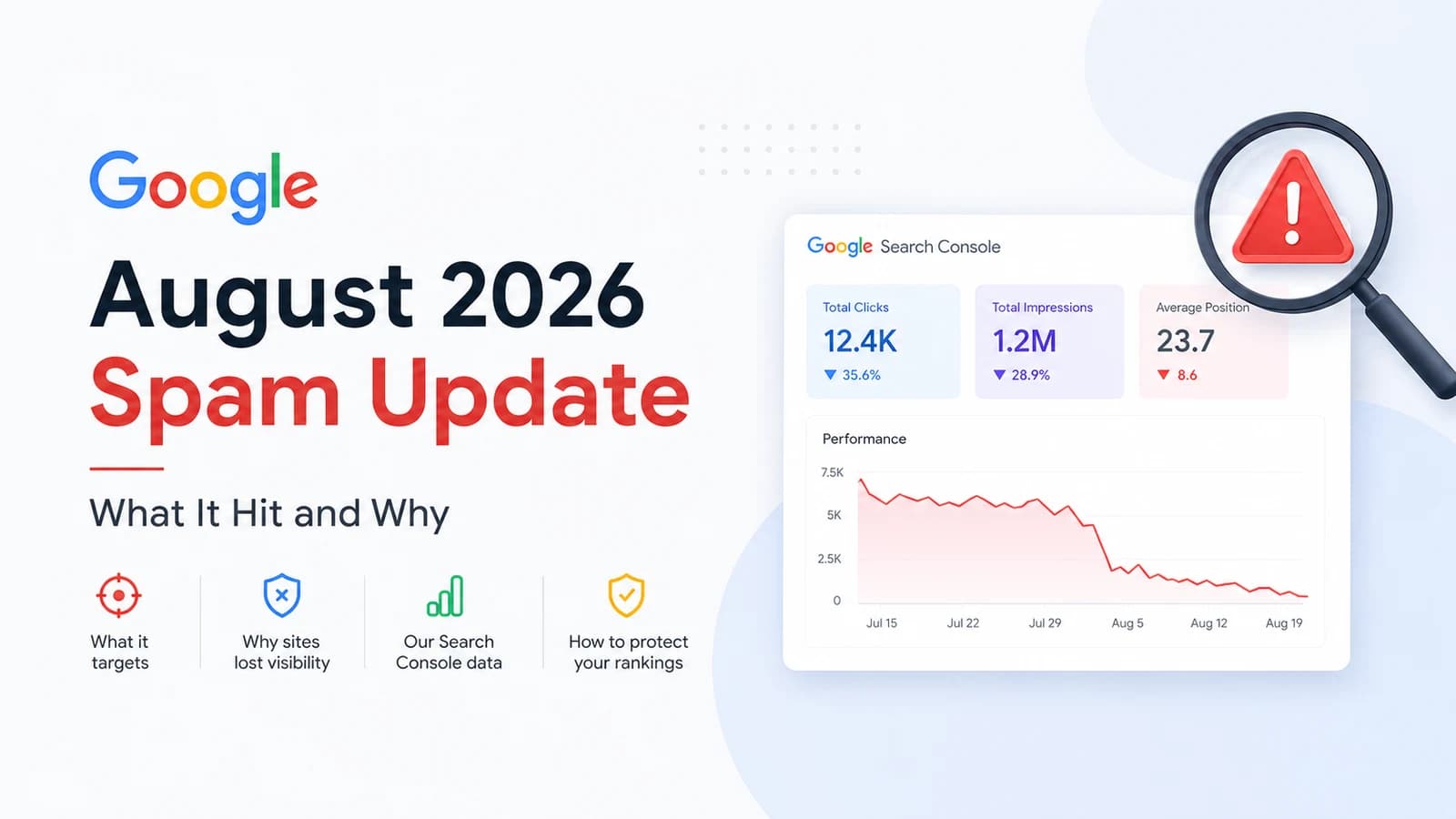
Google announced its August 2026 spam update on August 18 via the Search Status Dashboard and marked it complete on August 21, after 2 days and 16 hours. Global rollout. All languages. No new spam policies, just tighter enforcement of the existing ones.
Most coverage stops there. This post goes further: what the update actually enforces, what Google explicitly ruled out, why the AI framing everyone is using is half wrong, and what we saw in our own Search Console data after the rollout closed. If your traffic moved last week, this is the post to read before you touch anything.
What happened, in facts
This was the third spam update of 2026, and the slowest of the three. Search Engine Journal tracked all three:
| Update | Rollout window | Duration | Notable |
|---|---|---|---|
| March 2026 spam update | March | About 19.5 hours | Fastest confirmed spam update ever |
| June 2026 spam update | June 24-26 | About 2 days | Quiet by comparison |
| August 2026 spam update | Aug 18-21 | 2 days 16 hours | Longest of the three, elevated tracker volatility |
Three spam updates in eight months is a cadence, not a coincidence. Google is refreshing its spam detection systems more often than it used to, which changes the math for anyone running on borrowed time. A tactic that survives one refresh now has to survive three or four per year.
Trackers showed elevated volatility during the rollout, and the effects were visible in three places at once: classic blue-link rankings, AI Overviews, and AI Mode. That last part matters. Spam enforcement now shapes what gets cited in AI answers, not just what ranks on page one.
What this update actually enforces
Here is the detail most posts missed. Google confirmed, via Barry Schwartz at Search Engine Roundtable, what this update does NOT target:
- It does not target link spam.
- It does not target site reputation abuse.
That narrows the field considerably. Take those two off the table and enforcement points at the content-level policies in Google's spam policy documentation:
- Scaled content abuse. Publishing many pages of low-value content at volume, by any method.
- Doorway abuse. Near-identical pages built to funnel searchers, the classic being a location page for every city you have never worked in.
- Scraped content. Republishing other sites' content with little or no added value.
- Keyword stuffing. Still alive in 2026, mostly in programmatic templates.
- Thin affiliation. Affiliate pages that add nothing beyond the merchant's own description.
- Expired domain abuse. Buying a dead domain's authority and pointing it at unrelated content.
If you lost visibility on August 18 through 21 and you can honestly rule out all six, your drop probably has a different cause. If you cannot rule them out, you have your audit list.
The AI angle, done honestly
Almost every hot take framed this as "Google's AI content crackdown." That framing fails on the facts, and the distinction is worth getting right because it determines what you fix.
Scaled content abuse, the policy at the center of this, was written in 2024 and explicitly names generative AI tools as one method of producing scaled content. But the policy is method-agnostic. Danny Sullivan said it plainly: "We focus on the quality of content, not how content is produced." His fuller warning was that scaled low-value content was going to be an issue regardless of the tool.
So no, this update does not target AI content. It targets scaled low-value content. AI just happens to be the cheapest way ever invented to produce it, which is why AI-generated sites are overrepresented in the casualty list. Correlation with the method, enforcement of the outcome.
Google did not penalize AI content. It penalized content nobody would miss.
There is one genuinely new wrinkle. On May 15, 2026, Google updated its spam policies to clarify that they also cover attempts to manipulate generative AI responses in Google Search, meaning AI Overviews and AI Mode. August is the first spam update to land after that clarification. Commentators, Glenn Gabe among them, framed this update partly around GEO and AEO spam: pages engineered to get quoted by AI answers rather than to help a reader. That is commentary, not confirmed targeting, and we present it as such. But the timing is suggestive, and if your content strategy is "stuff the page with quotable declarative sentences and pray for citations," you should read that May clarification twice. There is a right way to earn AI citations, and it looks like answer-first content built on real expertise, not citation bait.
What we saw on our own site
Here is the part you will not get from the announcement coverage: our own numbers. witscode.com's Search Console, comparing August 18-24 against August 11-17, weekday-aligned, measured after the rollout closed:
- Impressions down 30 percent: 12.1K versus 17.4K.
- Clicks down 17 percent: 69 versus 83.
- Average position essentially flat: 13.3 versus 13.1.
- CTR slightly up.
Read those four together and a pattern emerges. If our rankings had been demoted, average position would have dropped as pages slid down the results. It did not move. Instead, impressions fell much harder than clicks, which is what you see when queries where a site ranked poorly stop surfacing it at all, while the pages with real rankings hold their positions. A long-tail trim, not a demotion.
This is one small B2B site's observation. Correlation, not proof, and a single week of data. But it matches the shape of an enforcement pass that prunes marginal query matches rather than reranking everything, and we would rather show you our actual numbers with honest caveats than quote anonymous forum percentages with none. Most posts about updates never show their own data. That should tell you something.
Who gets hit, and why
Across the reported casualties and the policy list, the risk profile is consistent. You are exposed if your site leans on any of these:
- Undifferentiated scaled posts. Hundreds of articles that say what the top ten results already say, produced faster than anyone could have researched them. Volume without information gain.
- Doorway location pages. "Plumber in [City]" times 400, same template, swapped city name, no local evidence. This pattern has been on the policy list for years and keeps getting re-enforced because it keeps getting rebuilt.
- Permutation listicles. "Best X for Y" generated across every X and Y combination in a spreadsheet. Ten genuine comparisons help readers. A thousand permutations help nobody.
- Citation-farming FAQ stuffing. Pages padded with dozens of question headings written for AI answer engines rather than humans. Post-May, this reads as manipulation of generative AI responses, not optimization.
- Thin roundups and scraped aggregation. Content assembled from other sources with no first-hand testing, data, or opinion added.
Notice what these have in common. None of them would exist if search engines did not exist. That is Google's own litmus test, and it is the one worth internalizing.
The protection playbook
If you were hit, or you want to make sure you never are, here is the order of operations.
1. Confirm what actually happened
Open Search Console and compare the week after August 21 to a weekday-aligned week before August 18. Look at impressions, clicks, and average position separately, the way we did above. A long-tail impression trim is a different problem from a position collapse. Check whether the losses concentrate in a specific page type or template, because spam enforcement tends to hit patterns, not random pages. Also check for a manual action under Security and Manual Actions. Almost nobody has one, but it takes ten seconds to rule out.
2. Run the "would this page exist" test
Go template by template, not page by page. For each content type you publish at volume, ask: would this page exist if search engines did not? Does it contain anything (data, testing, experience, opinion) that the reader cannot get from the ten results above it? If the honest answer is no, that template is your exposure.
3. Improve, consolidate, or prune
Three options for every weak page, in order of preference. Improve it with first-hand evidence, real data, or genuine depth. Consolidate five thin pages into one strong one with redirects. Prune only what cannot be saved and has no links or traffic worth keeping. Do not mass-noindex your way out of this. Blanket noindexing hides the symptom, wastes pages that could be fixed, and does nothing to teach Google's systems that the site now complies.
4. Put a person behind the content
Real author names, real credentials, first-hand evidence in the content itself. Screenshots of your own dashboards. Numbers from your own projects. The reason we published our GSC data in this post is the same reason you should publish yours: it is the one thing a scaled content operation cannot fake at volume. Google's guidance on AI-generated content is consistent on this point: originality and quality decide, not the drafting tool.
5. Fix the technical substrate
Spam enforcement and technical debt compound each other. Parameter URLs multiplying thin pages, faceted navigation generating crawlable near-duplicates, templates emitting boilerplate at scale. A clean technical SEO foundation shrinks the surface area an enforcement system can misread. While you are in there, make sure your crawler directives are deliberate; our robots.txt strategy for 2026 covers how to manage both classic and AI crawlers without accidentally amputating your own visibility.
6. Hold steady after fixing
This is the step people skip. Google is explicit in its spam updates documentation that after you fix violations, its systems must learn over a period of months that the site now complies. There is no reconsideration request for algorithmic spam demotions. That path only exists for manual actions. Fix, then keep publishing genuinely useful content, then wait for the systems to re-evaluate. Thrashing (rewriting everything twice, toggling noindex, restructuring URLs weekly) resets the clock instead of speeding it up.
What does not work
Two "fixes" circulate after every spam update, and both are traps. Moving the same content to a new domain is circumvention of Google's spam policies, itself a violation, and it torches whatever history and links the old domain had. Running penalized content through a "humanizer" rewriting tool changes the words without changing the value; the policy targets low-value scaled content, and a paraphrased low-value page is still a low-value page. Neither addresses the reason you were demoted, so neither survives the next refresh.
The opportunity nobody writes about
Every query has a fixed number of results worth showing. When an update removes scaled spam from those results, the visibility does not vanish. It redistributes. Sites with genuine expertise, first-hand evidence, and real authors pick up the impressions the pruned pages lose, in classic rankings and in AI answers alike.
That makes the weeks after a spam update the best publishing window of the quarter for legitimate sites. Competitors running scaled operations are retreating, auditing, and deleting. If you have been sitting on content that demonstrates actual experience (case data, teardowns, honest postmortems), ship it now. And with a Q3 core update widely expected but not announced, the sites that used this window to strengthen their content will be the ones positioned when broader ranking systems refresh.
If you want a starting point, run your site through our free audit to find the technical and content patterns that create spam-adjacent risk, and check your AI visibility to see how your pages currently show up in AI answers. Both give you a concrete list instead of a vague worry.
FAQ
Was the August 2026 spam update a manual action?
No. Spam updates are algorithmic, applied automatically across all sites and languages. A manual action is a separate thing: a human reviewer flags your site and a notice appears in Search Console under Manual Actions. If there is no notice there, you were not manually penalized. This distinction matters for recovery, because reconsideration requests exist only for manual actions.
How long does recovery from a spam update take?
Google says its systems need to learn over a period of months that a site has stopped violating spam policies. There is no form to file and no way to expedite it for algorithmic demotions. In practice, meaningful recovery tends to become visible around a later spam refresh, once the fixes have been in place long enough for the systems to re-evaluate. Anyone promising a faster timeline is guessing.
Is AI-generated content banned now?
No. Google's position, stated in its own guidance and repeated by Danny Sullivan, is that quality decides, not production method. AI-assisted content that adds real value, carries genuine expertise, and serves readers is fine. What gets enforced is scaled low-value content, and AI is simply the most common way that content gets produced today.
Should I delete all my AI-assisted posts?
Not as a blanket move. Evaluate each template against one question: does this page offer something a reader cannot get elsewhere? Improve the pages that can carry real value, consolidate overlapping thin ones, and prune only the pages that cannot be saved. Mass deletion driven by panic removes good pages along with bad ones and does not by itself signal compliance.
How do I know if the August 2026 spam update hit my site?
Compare Search Console data for August 18-24 against a weekday-aligned week before the rollout, such as August 11-17. Look at impressions, clicks, and average position separately. Losses concentrated in one template or page type point to a policy pattern. A sharp impression drop with flat positions suggests a long-tail trim rather than a demotion. Confirm the timing lines up with the rollout window before attributing anything to the update.
Does this update affect AI Overviews and AI Mode?
Yes. Observers reported effects across classic rankings, AI Overviews, and AI Mode, and since May 2026 Google's spam policies explicitly cover attempts to manipulate generative AI responses in Search. Content demoted for spam is less likely to be surfaced or cited anywhere in Google's results, AI surfaces included.
Invisible in ChatGPT and AI Overviews?
Send us your domain. You get a citation gap report and a straight answer on what to fix first, schema, llms.txt, or the content itself.
- AI citation and visibility audit
- Schema, llms.txt, and crawler access fixes
- Scoped estimate within 48 hours
Working on something in Guides & Insights?
Tell us what you are working on. You get a scoped estimate within 48 hours.
Keep reading
More from Guides & Insights.
- Guides & Insights

October 2, 2026
Google September 2026 Spam Update: How to Tell If You Were Hit
The Google September 2026 spam update began Sept 24 and is still rolling out, with two reported waves of drops. How to tell if you were hit and what to avoid.
- Guides & Insights

September 30, 2026
Should You Buy a .si Domain? What the Superintelligence Rebrand Means for Your SEO
Trump wants AI renamed SI, and .si domain registrations have exploded. Here is what a .si domain does to your Google rankings, who is actually making money, and the one cheap move worth making.
- Guides & Insights

September 3, 2025
Robots.txt Strategy for 2026: Managing AI Crawlers and Traditional Bots
Your robots.txt file used to be simple. Allow Googlebot, block a few scrapers, move on.