

Amtex Systems, modernizing an 85-page enterprise website end to end
Enterprise WebUSEnterprise IT and AI services
300+ websites shipped, clients in 4 countries
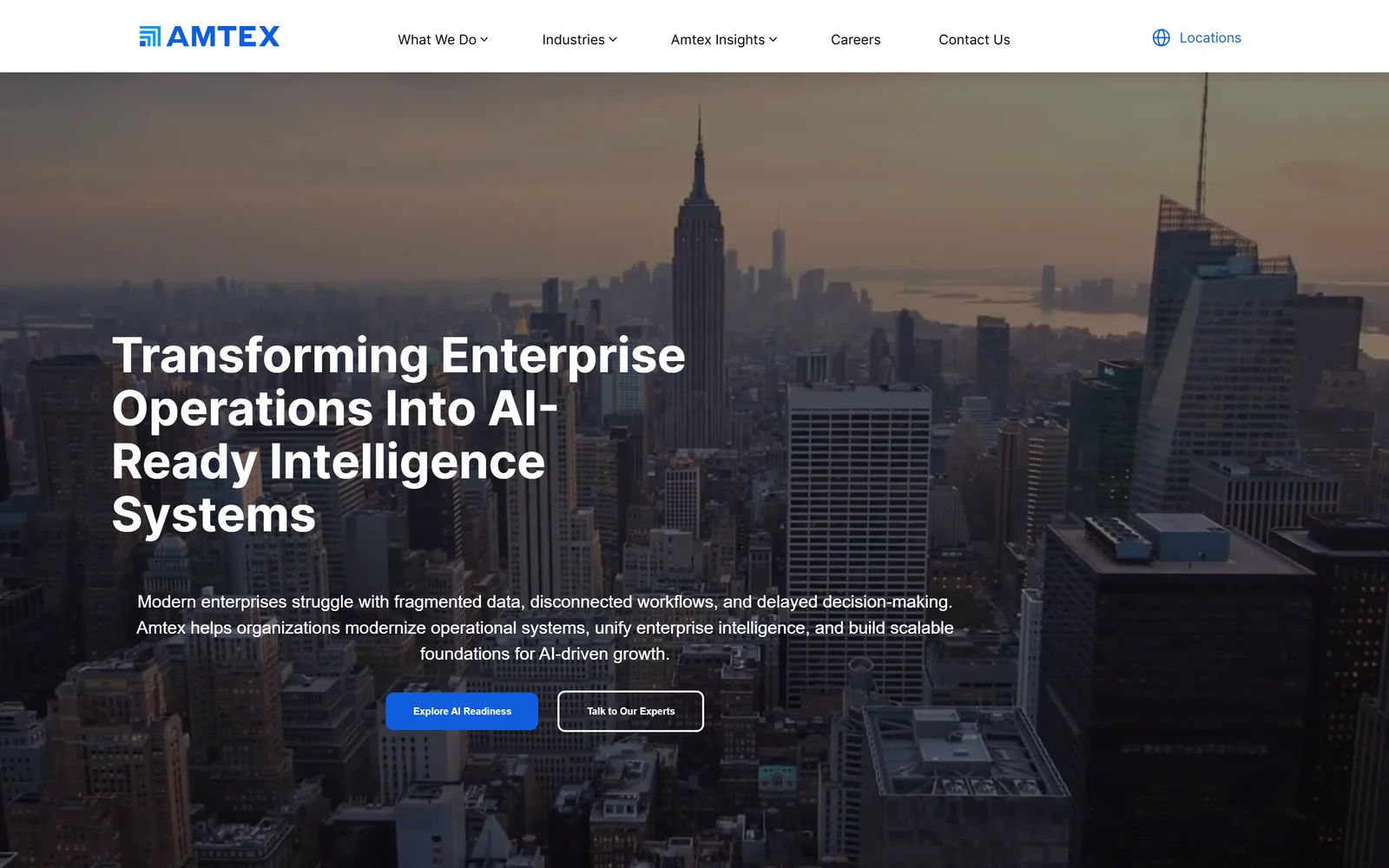
- 85 pages under one convention
- Sitemap grown from 43 to 87 URLs
- 7 service pages shipped in one day
- Dual-remote Git delivery pipeline
The challenge
Where we started.
A strong company on a fragile website. The audit explained why a firm with 847 backlinks and healthy domain authority earned only around 253 organic visits a month, nearly all branded: 77 of 85 pages had no H1 and most inner pages no heading structure, 1,508 of 2,485 images had no alt text, not one page carried Open Graph or Twitter Card tags, and the XML sitemap listed 43 stale URLs with dates from 2023. Production was fragile too: a www redirect loop had taken the site down for some visitors, the hero video and analytics beacon intermittently returned 503s, styling drifted across four overlapping stylesheets, and deploys were manual pulls from a VPN-only GitLab where line-ending mismatches turned one-line changes into 13,000-line diffs.
Our approach
What we built.
WitsCode ran the engagement as five phases, each one turning a fix into a convention and each convention into tooling.
Stabilize: we traced the redirect loop to Apache-style rules that were inert on the nginx production stack, removed the conflict, and shipped quick UX fixes to hero messaging, menu legibility, and layout regressions.
Audit: a complete technical and SEO review of all 85 pages, source analysis plus live browser testing, covering headings, metadata, schema, social tags, images, Core Web Vitals, analytics, security headers, and infrastructure behavior. The audit became the shared backlog for everything after it.
Consolidate the design system: the homepage got a scoped namespace so it can evolve without breaking 84 other pages, the service card grid was rebuilt as a uniform system that expands on hover instead of clipping, navigation type got a 16px floor, spacing was normalized, the locations page became a four-region tab system, and a cache-busting convention now versions every asset.
Rebuild delivery: a dual-remote Git workflow mirrors GitHub for review into the client's self-hosted GitLab over VPN with automatic line-ending normalization, while Python tooling generates the sitemap, injects sitewide schema, and verifies every page before commit.
Relaunch the services line: when the client delivered a 6,600 word content pack, parallel AI-accelerated builds cloned a hand-verified reference page and deterministic verification scripts checked structure, headings, canonicals, social tags, Service and FAQ schema, navigation, redirects, sitemap, and cache-busting on every page. Seven production service pages went from raw copy to a verified, committed release inside one working day.
Outcomes
What followed.
- 7 production service pages shipped in a single working day, verified programmatically before commit
- XML sitemap grown from 43 stale URLs to 87 current ones, generated by tooling on every release
- Service, FAQ, and Organization schema on the relaunched pages, up from none
- Open Graph and Twitter Card tags on the relaunched service line for a LinkedIn-heavy B2B audience
- 85 pages brought under one scoped, versioned design convention
- A reviewable delivery pipeline replacing manual deploys and 13,000-line noise diffs
- Root-cause fix for the production redirect loop, with infrastructure findings documented for the client's server team
Stack
What we used.
- Static HTML5
- nginx
- Python tooling
- Playwright QA
- Schema.org JSON-LD
- Git dual-remote

Want to be the next case study? Let's talk.
Tell us what you're building. We'll reply within 24 hours with how we'd approach it.